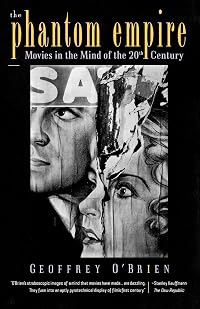
The Phantom Empire: Movies in the Mind of the 20th Century
by Geoffrey O'Brien
On This Page
Description
"The invention of moving pictures is almost certainly the most powerful shaper of the unique consciousness of the modern age. For almost a century now we have all been at the movies, and our brains are overcrowded with the ghostly traces of all we have seen and "experienced." By now the movies are our mental wallpaper and, perhaps, even the medium through which we perceive the world." "The Phantom Empire is the first book that truly captures and explains this peculiar and now universal state show more of thought and feeling. It focuses on the global proliferation of film, a worldless, irrational lingua franca, infinitely rich in images but conveying a knowledge radically different from the culture of the word. What, finally, do we internalize from the endlessly multiplying scenes from already ancient silent films, "real" documentary footage of massacres and bombardments, classic movies whose unerasable performers (Keaton, Astaire, Shirley Temple) never age, such mutating genres as Italian spy movies, German westerns, Chinese gangster flicks, Japanese vampire movies, porn films and splatter films of every national origin ...? Their grammar bypasses poetry, history, and philosophy to create a parallel universe, an invented landscape of the supernatural whose ghosts haunt the denatured landscape of our postindustrial civilization." "Still, we love movies. The Phantom Empire measures the degree and nature of that love by mixing the modes of fiction and criticism and by blurring the distinctions between objective and subjective in a completely original way. It is not so much concerned with what happens on the screen as with what happens inside the person watching it. Geoffrey O'Brien's brilliant book communicates, as no other prose work has done, the visceral power of film, rooted as it is in terror, longing, and obsessive devotion. In doing so it erases the artificial distinction between spectator and commentator and virtually reinvents film writing in our time."--Jacket. show lessTags
Recommendations







Member Reviews
This is a unique book — a fluid meditation on our collective experience of the movies.
Geoffrey O’Brien is a poet, and his book gives us an experience rather than an argument or a collection of facts. You have to give in to it and just let him go where he’s going.
The effect, for me anyway, is to provoke my own thinking about the movies and what their part in our lives is. Movies came along as something very different in our experience — different from live theater, different from novels, different from radio, even different from the experience of television that came later. You go into a darkened theater and, if you’re lucky and not distracted, you lose yourself in the movie. For an hour or two, or sometimes more, the movie is show more reality. What you see and hear genuinely affects you and may change you.
From the standpoint of the creature evolution built us to be, experiencing a movie is a strange thing. Our senses give us the experience of a reality that is not here or now and in which we cannot act or have effect. The whole point is to fool your senses and your mind into living in a world that isn’t “really” there.
But only for a time. And then you’re left to somehow make your experience in the world of the movie part of your experience in the real world. A movie that really affects us becomes part of our lives. We don’t leave it in the theater.
Although he doesn’t follow a timeline, O’Brien takes us through the history of movies from the days of D.W. Griffith and George Méliès to Stanley Kubrick and George Miller. But he doesn’t really focus in on how the movies have changed over time — the current of his writing is really how the movies have changed us, become not just another thing in our culture but a substantive part of modern life.
That said, he does visit the different genres of the movies — the western, film noir, suspense, horror, and all the other genres and sub-genres. What’s interesting to me in his repeat trips through the movies and genres is the blurring between our lives and the movies we watch. Our experiences in horror movies or suspense movies are part of our “real lives.
And it’s a two way street. Different genres arrive at different times in our collective lives — film noir in the forties, science fiction in the fifties, spy and secret agent movies in the seventies, . . . And they appeal to us at different parts of our own lives as well — maybe we were horror movie fans as teenagers, fans of suspense or mysteries later, and maybe historical drama later still.
And different genres have their unique characteristics in our experience.
Horror movies compel us to watch them. We are drawn to them even against our better judgement, and then they reward us with the reminder that everything normal is just a veneer over everything threatening, like a murderer stalking us on summer days or our Dr. Jekyll ready to burst out of our Mr. Hyde.
Movies can even double back on themselves to give us an experience of our experience of movies. O’Brien dwells for a chapter on the “Italian system” in which movies were made up of and about movies, like a commentary on themselves or an alternative world in which everything was predictable because it had all been done before in other movies. That the movies’ plots and scenarios were unoriginal even seems to have been the point, that we experience what our experience of the movies is.
The book was written well before the Trump presidency, and O’Brien was free to imagine that Ronald Reagan’s presidency was a culmination of advanced interplay between the movies and reality. He hadn’t seen what happens when the presidency is occupied by a character from “reality” television. I would love to know how the Trump presidency fits into the view he developed here (I did search for anything in his more recent writing but didn’t find anything like what I was looking for — maybe other readers can find something interesting).
In the final chapter, O’Brien repeats the reminder, “It’s only a movie,” several times. But what does that mean? I think there is irony in his reciting the line, and it comes back to the theme I began with. Movies are real. During the movie, it is reality itself, in the dark theater. The experiences we have had are real, not just “movie real” but “real” — we were scared during Alien, tormented during The Deer Hunter, and amazed during 2001. And the era of movies, beginning in the twentieth century, changed what life is for us. show less
Geoffrey O’Brien is a poet, and his book gives us an experience rather than an argument or a collection of facts. You have to give in to it and just let him go where he’s going.
The effect, for me anyway, is to provoke my own thinking about the movies and what their part in our lives is. Movies came along as something very different in our experience — different from live theater, different from novels, different from radio, even different from the experience of television that came later. You go into a darkened theater and, if you’re lucky and not distracted, you lose yourself in the movie. For an hour or two, or sometimes more, the movie is show more reality. What you see and hear genuinely affects you and may change you.
From the standpoint of the creature evolution built us to be, experiencing a movie is a strange thing. Our senses give us the experience of a reality that is not here or now and in which we cannot act or have effect. The whole point is to fool your senses and your mind into living in a world that isn’t “really” there.
But only for a time. And then you’re left to somehow make your experience in the world of the movie part of your experience in the real world. A movie that really affects us becomes part of our lives. We don’t leave it in the theater.
Although he doesn’t follow a timeline, O’Brien takes us through the history of movies from the days of D.W. Griffith and George Méliès to Stanley Kubrick and George Miller. But he doesn’t really focus in on how the movies have changed over time — the current of his writing is really how the movies have changed us, become not just another thing in our culture but a substantive part of modern life.
That said, he does visit the different genres of the movies — the western, film noir, suspense, horror, and all the other genres and sub-genres. What’s interesting to me in his repeat trips through the movies and genres is the blurring between our lives and the movies we watch. Our experiences in horror movies or suspense movies are part of our “real lives.
And it’s a two way street. Different genres arrive at different times in our collective lives — film noir in the forties, science fiction in the fifties, spy and secret agent movies in the seventies, . . . And they appeal to us at different parts of our own lives as well — maybe we were horror movie fans as teenagers, fans of suspense or mysteries later, and maybe historical drama later still.
And different genres have their unique characteristics in our experience.
Horror movies compel us to watch them. We are drawn to them even against our better judgement, and then they reward us with the reminder that everything normal is just a veneer over everything threatening, like a murderer stalking us on summer days or our Dr. Jekyll ready to burst out of our Mr. Hyde.
Movies can even double back on themselves to give us an experience of our experience of movies. O’Brien dwells for a chapter on the “Italian system” in which movies were made up of and about movies, like a commentary on themselves or an alternative world in which everything was predictable because it had all been done before in other movies. That the movies’ plots and scenarios were unoriginal even seems to have been the point, that we experience what our experience of the movies is.
The book was written well before the Trump presidency, and O’Brien was free to imagine that Ronald Reagan’s presidency was a culmination of advanced interplay between the movies and reality. He hadn’t seen what happens when the presidency is occupied by a character from “reality” television. I would love to know how the Trump presidency fits into the view he developed here (I did search for anything in his more recent writing but didn’t find anything like what I was looking for — maybe other readers can find something interesting).
In the final chapter, O’Brien repeats the reminder, “It’s only a movie,” several times. But what does that mean? I think there is irony in his reciting the line, and it comes back to the theme I began with. Movies are real. During the movie, it is reality itself, in the dark theater. The experiences we have had are real, not just “movie real” but “real” — we were scared during Alien, tormented during The Deer Hunter, and amazed during 2001. And the era of movies, beginning in the twentieth century, changed what life is for us. show less
Ratings
Members
- Recently Added By
Lists

Film
114 works; 1 member
Author Information

35+ Works 1,140 Members
Awards and Honors
Classifications
Statistics
- Members
- 101
- Popularity
- 318,991
- Reviews
- 1
- Rating
- (3.73)
- Languages
- English
- Media
- Paper
- ISBNs
- 2