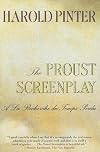
The Proust Screenplay: a la Recherche du Temps Perdu
by Harold Pinter
On This Page
Description
In the early 1970s Harold Pinter joined forces with director Joseph Losey and Proust scholar Barbara Bray to develop a screenplay of Proust's masterpiece, Remembrance of Things Past. Pinter took more than a year to conceive and write the screenplay and called the experience "the best working year of my life." Although never produced, Harold Pinter's The Proust Screenplay is considered one of the greatest adaptations for the cinema ever written. With fidelity to Proust's text, the show more screenplayis an extraordinary re-creation by one of the leading playwrights of our time. It is, in its way, a unique collaboration between two extraordinary writers united across more than half a century and two different cultures by a special concern for time and memory. show lessTags
Recommendations














Member Reviews
Did you finish Swann’s Way? Did you go on to read any more Proust? Once you finish the whole thing, you need to read Harold Pinter’s Proust screenplay. It was written in 1972 and has never been made into a movie. When we read Pinter, in the introduction, saying “If the thing was to be done at all, one would have to try to distill the whole work,” we may be forgiven for thinking of the “Summarize Proust Contest” on Monty Python’s Flying Circus. But Pinter might have beaten the girl with the biggest tits; in a sense it’s all there, but in a way that I can’t imagine making a lot of sense unless one knows the whole novel. The dramatic condensations of Shakespeare are somewhat similar. Of course it’s interesting here in a show more special way, since Pinter is using the proustian idea that a little taste can bring a whole scene or narrative section back. show less
Pinter and friends take on a daunting task here... Distilling Proust's 7-volume masterwork into a two-hour movie. I've read the whole book, I lead a group that's reading it with me again, so I got it, I loved it, I was visualizing his scene descriptions and quick-flash images. So all I can say is-- Is Julie Taymor or Mira Nair available? And that British costume designer who wins all the Oscars. It wouldn't be that hard, it wouldn't make any money, but boy, would it ever give you Proust-at-a-glance.
not filmed.
Michael Wood, Times Literary Supplement, June 2nd 1978. "We read The Proust Screenplay with all kinds of things in our mind: Proust, Pinter's reading of Proust; the problem of abridgment, the problem of dramatization, the problem of visualization; the film which might have been made from this script; the script itself as a literary work, words on the page. In permitting and controlling the interplay of these things Pinter has created a small masterpiece of wit and understanding."
Michael Wood, Times Literary Supplement, June 2nd 1978. "We read The Proust Screenplay with all kinds of things in our mind: Proust, Pinter's reading of Proust; the problem of abridgment, the problem of dramatization, the problem of visualization; the film which might have been made from this script; the script itself as a literary work, words on the page. In permitting and controlling the interplay of these things Pinter has created a small masterpiece of wit and understanding."
Ratings
Members
- Recently Added By
Author Information

254+ Works 9,371 Members
English playwright, poet, and political activist Harold Pinter was born on October 10, 1930, in London's East End. From childhood he was interested in literature and acting. He studied at both the Royal Academy of Dramatic Arts and the Central School of Speech and Drama. Pinter was a Nobel Prize-winning English playwright and screenwriter. One of show more the most influential modern British dramatists, his writing career spanned more than 50 years. His best-known plays include The Birthday Party (1957), The Homecoming (1964), and Betrayal (1978), each of which he adapted to film. Pinter published his first poems in 1950. He worked as a bit-part actor in a BBC Radio program and also toured with a Shakespearean troupe. Pinter has written over 30 plays, achieving great success internationally. He has also directed several of his dramas. Pinter was married to actress Vivien Merchant from 1956 to 1980, before wedding biographer Lady Antonia Fraser. From his first marriage he has a son who is a writer and musician. Pinter has won numerous prestigious literary prizes in poetry and theatre. He was awarded the Hermann Kesten Medallion for outstanding commitment on behalf of persecuted and imprisoned writers. He has been granted honorary degrees at universities in England, Scotland, the United States, Bulgaria, Ireland, Italy, and Greece. In 2005, Pinter received the Nobel Prize for Literature. He died from cancer on December 24, 2008 at the age of 78. (Bowker Author Biography) show less
Work Relationships
Common Knowledge
- People/Characters
- Albertine Simonet
Classifications
Statistics
- Members
- 140
- Popularity
- 234,311
- Reviews
- 3
- Rating
- (3.96)
- Languages
- English, French, Italian
- Media
- Paper
- ISBNs
- 12
- ASINs
- 2