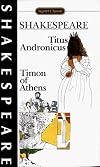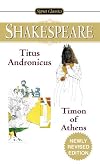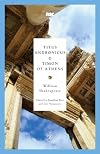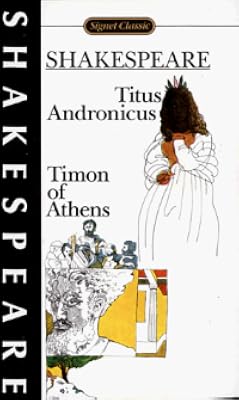
2 Plays: Timon of Athens; Titus Andronicus
by William Shakespeare
On This Page
Description
As part of the Signet Classics Shakespeare Series edited by Sylvan Barnet of Tufts University, this edition includes commentaries on both plays as well as up-to-date production histories.Tags
Recommendations
















Member Reviews
43. Titus Andronicus by William Shakespeare
editor: Sylvan Barnet
commentaries: H. T. Price, Richard David, Alan C. Dessen &, The History of Titus Andronicus (an anonymous brief history in prose of unknown origin)
1st performed: 1591? (an early play)
format: 160-pages in Signet Classic paperback that includes Timon of Athens.
acquired: May
read: Jul 12- Aug 16
time reading: 10 hr 39 min, 4 min/page
rating: 5
locations: later empire Rome
about the author April 23, 1564 – April 23, 1616
T. S. Eliot called [Titus Andronicus] “one of the stupidest and most uninspired plays ever written”. It is Shakespeare's most macabre play. It's not just that a lot of people die, including most of the main characters, which would put it along the lines of show more Hamlet or King Lear, it's the manner the human body is treated. It opens with an execution by dismemberment off stage, and family murder on stage. But it also involved heads, and severed hands cut off on stage, cannibalism, a rape where men cut off the hands and tongue of their victim and then make fun, on stage, of her inability to communicate. It's a play that involves a march to display body parts. It's awful, it's also—well it can be—great fun.
There is a lot of King Lear in the set-up. Titus, a Roman general obsessed with honor, gallantly turns down an offer to become emperor of Rome in return for having his daughter marry the new emperor. In a blink this decision of giving up power becomes disastrous. His daughter Lavinia is carried off, Titus has killed his own son, and the new emperor marries Titus's captive goth - the mother of captive he just executed by dismembering him. This new empress, Tamora, will have her revenge. Honor and vengeance and their endless cycle, have reign. Throw in Tamora's barbaric Goth sons and her lover, the Moor Aaron - who is both a racist stereotype of evil and sharp maneuverer, and well there's a lot to come. Ovid is not only a reference, but directly cited. A copy of [Metamorphoses] appears on stage, the characters flipping through the book and discussing the gruesome rape of Philomena byTereus. Ovid had a thing for macabre humor, most extreme his battle of the Centaurs and the Lapiths at a wedding. This one story is simply a series of more spectacular and gruesome and more ridiculous deaths in the riot. The point is gruesome humor, although I'm not sure anyone reads it that way today. Shakespeare makes a direct reference to it. It felt to me like this was what Shakespeare had in mind...that he wanted us to see the humor.
It hard to explain why this play works—except, like for T. S. Eliot, and, well, for anyone who else kept their decency, where it doesn't. But somehow this does work. The language is toned down, the plot sequence is the driver. And there is enough here to think about to allow that an element of fascination to thrive in us, and in such a way as to allow us to the separate the spectacle on stage from the kind of judgement we use in reality. To put it another way, I loved it.
Makes you wonder, though. I put it this way on my compressed Litsy post: "It‘s not that I enjoyed this so much or how it works with the jammed together mixture of gore/shock gamed with concerns of calculation vs mistakes, it‘s what it says about art in relation to our finicky sense of what‘s ok. This macabre can do the magic, can work. We can laugh at it, our fascination thoroughly dominating over our sense of need for decency. But have to wonder about our programming."
Obviously not a play for everyone.
60. Timon of Athens by William Shakespeare
composed: c 1605
format: 227-pages in Signet Classic paperback that includes Titus Andronicus.
acquired: May
read: Nov 18 – Dec 19
time reading: 11 hr 34 min, 3.1 min/page
rating: 4
locations: Classical Athens
about the author April 23, 1564 – April 23, 1616
other contributors
Editing
Maurice Charney - editor – c1965, 1989, 2005
Sylvan Barnet – series editor – c1963, 1989, 2005
Sources:
Lucian– Timon (100’s), translated from Greek by Lionel Casson (1962)
Plutarch – excerpts from Lives from Antony & Alcibiades (c 120), translated from Greek by Sir Robert North (1579)
William Painter – from [The Palace of Pleasure] (1566)
Commentary:
William Richardson – On the Dramatic Character of Timon of Athens (1785)
Roy Walker – from Unto Caesar: A Review of Recent Production (1958)
David Cook – Timon of Athens (1963)
Susan Handelman – Timon of Athens: The Rage of Disillusion (1979)
Maurice Charney – Timon of Athens on Stage and Screen (1965/2005)
This was the last Shakespeare of the year for the Listy group I follow, and another where I led the discussion. (It included a misanthropic theme song challenge.)
Timon is a classical misanthrop story, a rich man in Athens who ran out of money and became a hater of all humanity. He's credited with many sly remarks, such as, before cutting down a tree used for hanging, offering anyone in Athens a last chance to hang themselves before he cut it down. A second century satire by [[Lucian]] about him is preserved, and [[Plutarch]] references him twice, once in the life of Athenian general Alcibiades (who appears in this play), and the other in the life Mark Antony, who is compared to Timon at one point when he secluded himself near the end of his life.
This play was never supposed to be preserved and was probably not finished or preformed. Apparently when the First Folio of Shakespeare was getting printed there was some kind of legal issue over the inclusion of [Troilus and Cressida], and pages were left blank in the tragedy section. Eventually those pages were partially filed-in with this play, and partially left blank, since this play is shorter. (Also, eventually, T&C was included). So, what was this filler text?
This is not a perfect play, but despite some heavy criticism, it's a very interesting and heavily worked piece. The play opens with Timon a rich man, flagrantly spreading his wealth in crazy events, or dramatically helping someone in need. Timon sees his followers as friends, and they see him as a source of money. First Timon runs out of money, then he sends his servants to borrow money from all his "friends", who turn him down in a variety of humorous ways. Distraught at his treatment and debt Timon flips from philanthropist to misantrop, abandons Athens for the woods, cursing the city and its inhabitants profusely (in creative ways Shakespeare excelled at). Alas, naked, angry and alone, Timon, digging for roots, strikes gold. But his misanthropy is set and he uses his gold only to undermine Athens, funding an attack on the city by the spurned Athenian general Alcibiades. Athens at his mercy, Alcibiades halts only learning Timon has died and left a bitter epitaph. Alcibiades goes a difference route, finds mercy and most of Athens is spared.
Among the plays best parts is the cynic Apemantus. When Timon is wealthy, Apemantus humorously shreds his false impression of those who appear to praise him. But he criticized everyone and is seen as a misanthrop. Timon ignores his prophecy of poverty. When Timon is alone in the woods, Apemantus confronts him in a long conversion between misanthrop and spurned cynic. It's a terrific part of the play and it's funny in the overall sense in how Apemantus approves of Timon's poverty and hatred but blasts him for the narcissistic aspect of his misanthropy.
The play has some oddities and doesn't entirely work, and it may well have been abandoned because of its problems, yet it makes a curious and entertaining work and provides a lot of think about. It manages to be one of those things that seem to get more impressive when you're not reading it (or watching it?), and just thinking about it.
2020
Titus: https://www.librarything.com/topic/322920#7251789
Timon: https://www.librarything.com/topic/322920#7356017 show less
editor: Sylvan Barnet
commentaries: H. T. Price, Richard David, Alan C. Dessen &, The History of Titus Andronicus (an anonymous brief history in prose of unknown origin)
1st performed: 1591? (an early play)
format: 160-pages in Signet Classic paperback that includes Timon of Athens.
acquired: May
read: Jul 12- Aug 16
time reading: 10 hr 39 min, 4 min/page
rating: 5
locations: later empire Rome
about the author April 23, 1564 – April 23, 1616
T. S. Eliot called [Titus Andronicus] “one of the stupidest and most uninspired plays ever written”. It is Shakespeare's most macabre play. It's not just that a lot of people die, including most of the main characters, which would put it along the lines of show more Hamlet or King Lear, it's the manner the human body is treated. It opens with an execution by dismemberment off stage, and family murder on stage. But it also involved heads, and severed hands cut off on stage, cannibalism, a rape where men cut off the hands and tongue of their victim and then make fun, on stage, of her inability to communicate. It's a play that involves a march to display body parts. It's awful, it's also—well it can be—great fun.
There is a lot of King Lear in the set-up. Titus, a Roman general obsessed with honor, gallantly turns down an offer to become emperor of Rome in return for having his daughter marry the new emperor. In a blink this decision of giving up power becomes disastrous. His daughter Lavinia is carried off, Titus has killed his own son, and the new emperor marries Titus's captive goth - the mother of captive he just executed by dismembering him. This new empress, Tamora, will have her revenge. Honor and vengeance and their endless cycle, have reign. Throw in Tamora's barbaric Goth sons and her lover, the Moor Aaron - who is both a racist stereotype of evil and sharp maneuverer, and well there's a lot to come. Ovid is not only a reference, but directly cited. A copy of [Metamorphoses] appears on stage, the characters flipping through the book and discussing the gruesome rape of Philomena byTereus. Ovid had a thing for macabre humor, most extreme his battle of the Centaurs and the Lapiths at a wedding. This one story is simply a series of more spectacular and gruesome and more ridiculous deaths in the riot. The point is gruesome humor, although I'm not sure anyone reads it that way today. Shakespeare makes a direct reference to it. It felt to me like this was what Shakespeare had in mind...that he wanted us to see the humor.
It hard to explain why this play works—except, like for T. S. Eliot, and, well, for anyone who else kept their decency, where it doesn't. But somehow this does work. The language is toned down, the plot sequence is the driver. And there is enough here to think about to allow that an element of fascination to thrive in us, and in such a way as to allow us to the separate the spectacle on stage from the kind of judgement we use in reality. To put it another way, I loved it.
Makes you wonder, though. I put it this way on my compressed Litsy post: "It‘s not that I enjoyed this so much or how it works with the jammed together mixture of gore/shock gamed with concerns of calculation vs mistakes, it‘s what it says about art in relation to our finicky sense of what‘s ok. This macabre can do the magic, can work. We can laugh at it, our fascination thoroughly dominating over our sense of need for decency. But have to wonder about our programming."
Obviously not a play for everyone.
60. Timon of Athens by William Shakespeare
composed: c 1605
format: 227-pages in Signet Classic paperback that includes Titus Andronicus.
acquired: May
read: Nov 18 – Dec 19
time reading: 11 hr 34 min, 3.1 min/page
rating: 4
locations: Classical Athens
about the author April 23, 1564 – April 23, 1616
other contributors
Editing
Maurice Charney - editor – c1965, 1989, 2005
Sylvan Barnet – series editor – c1963, 1989, 2005
Sources:
Lucian– Timon (100’s), translated from Greek by Lionel Casson (1962)
Plutarch – excerpts from Lives from Antony & Alcibiades (c 120), translated from Greek by Sir Robert North (1579)
William Painter – from [The Palace of Pleasure] (1566)
Commentary:
William Richardson – On the Dramatic Character of Timon of Athens (1785)
Roy Walker – from Unto Caesar: A Review of Recent Production (1958)
David Cook – Timon of Athens (1963)
Susan Handelman – Timon of Athens: The Rage of Disillusion (1979)
Maurice Charney – Timon of Athens on Stage and Screen (1965/2005)
This was the last Shakespeare of the year for the Listy group I follow, and another where I led the discussion. (It included a misanthropic theme song challenge.)
Timon is a classical misanthrop story, a rich man in Athens who ran out of money and became a hater of all humanity. He's credited with many sly remarks, such as, before cutting down a tree used for hanging, offering anyone in Athens a last chance to hang themselves before he cut it down. A second century satire by [[Lucian]] about him is preserved, and [[Plutarch]] references him twice, once in the life of Athenian general Alcibiades (who appears in this play), and the other in the life Mark Antony, who is compared to Timon at one point when he secluded himself near the end of his life.
This play was never supposed to be preserved and was probably not finished or preformed. Apparently when the First Folio of Shakespeare was getting printed there was some kind of legal issue over the inclusion of [Troilus and Cressida], and pages were left blank in the tragedy section. Eventually those pages were partially filed-in with this play, and partially left blank, since this play is shorter. (Also, eventually, T&C was included). So, what was this filler text?
This is not a perfect play, but despite some heavy criticism, it's a very interesting and heavily worked piece. The play opens with Timon a rich man, flagrantly spreading his wealth in crazy events, or dramatically helping someone in need. Timon sees his followers as friends, and they see him as a source of money. First Timon runs out of money, then he sends his servants to borrow money from all his "friends", who turn him down in a variety of humorous ways. Distraught at his treatment and debt Timon flips from philanthropist to misantrop, abandons Athens for the woods, cursing the city and its inhabitants profusely (in creative ways Shakespeare excelled at). Alas, naked, angry and alone, Timon, digging for roots, strikes gold. But his misanthropy is set and he uses his gold only to undermine Athens, funding an attack on the city by the spurned Athenian general Alcibiades. Athens at his mercy, Alcibiades halts only learning Timon has died and left a bitter epitaph. Alcibiades goes a difference route, finds mercy and most of Athens is spared.
Among the plays best parts is the cynic Apemantus. When Timon is wealthy, Apemantus humorously shreds his false impression of those who appear to praise him. But he criticized everyone and is seen as a misanthrop. Timon ignores his prophecy of poverty. When Timon is alone in the woods, Apemantus confronts him in a long conversion between misanthrop and spurned cynic. It's a terrific part of the play and it's funny in the overall sense in how Apemantus approves of Timon's poverty and hatred but blasts him for the narcissistic aspect of his misanthropy.
The play has some oddities and doesn't entirely work, and it may well have been abandoned because of its problems, yet it makes a curious and entertaining work and provides a lot of think about. It manages to be one of those things that seem to get more impressive when you're not reading it (or watching it?), and just thinking about it.
2020
Titus: https://www.librarything.com/topic/322920#7251789
Timon: https://www.librarything.com/topic/322920#7356017 show less
Ratings
Members
- Recently Added By
Author Information

6,112+ Works 442,262 Members
William Shakespeare, 1564 - 1616 Although there are many myths and mysteries surrounding William Shakespeare, a great deal is actually known about his life. He was born in Stratford-Upon-Avon, son of John Shakespeare, a prosperous merchant and local politician and Mary Arden, who had the wealth to send their oldest son to Stratford Grammar School. show more At 18, Shakespeare married Anne Hathaway, the 27-year-old daughter of a local farmer, and they had their first daughter six months later. He probably developed an interest in theatre by watching plays performed by traveling players in Stratford while still in his youth. Some time before 1592, he left his family to take up residence in London, where he began acting and writing plays and poetry. By 1594 Shakespeare had become a member and part owner of an acting company called The Lord Chamberlain's Men, where he soon became the company's principal playwright. His plays enjoyed great popularity and high critical acclaim in the newly built Globe Theatre. It was through his popularity that the troupe gained the attention of the new king, James I, who appointed them the King's Players in 1603. Before retiring to Stratford in 1613, after the Globe burned down, he wrote more than three dozen plays (that we are sure of) and more than 150 sonnets. He was celebrated by Ben Jonson, one of the leading playwrights of the day, as a writer who would be "not for an age, but for all time," a prediction that has proved to be true. Today, Shakespeare towers over all other English writers and has few rivals in any language. His genius and creativity continue to astound scholars, and his plays continue to delight audiences. Many have served as the basis for operas, ballets, musical compositions, and films. While Jonson and other writers labored over their plays, Shakespeare seems to have had the ability to turn out work of exceptionally high caliber at an amazing speed. At the height of his career, he wrote an average of two plays a year as well as dozens of poems, songs, and possibly even verses for tombstones and heraldic shields, all while he continued to act in the plays performed by the Lord Chamberlain's Men. This staggering output is even more impressive when one considers its variety. Except for the English history plays, he never wrote the same kind of play twice. He seems to have had a good deal of fun in trying his hand at every kind of play. Shakespeare wrote 154 sonnets, all published on 1609, most of which were dedicated to his patron Henry Wriothsley, The Earl of Southhampton. He also wrote 13 comedies, 13 histories, 6 tragedies, and 4 tragecomedies. He died at Stratford-upon-Avon April 23, 1616, and was buried two days later on the grounds of Holy Trinity Church in Stratford. His cause of death was unknown, but it is surmised that he knew he was dying. (Bowker Author Biography) show less
Common Knowledge
- Canonical title
- 2 Plays: Timon of Athens; Titus Andronicus
- Disambiguation notice
- Signet Classics ISBN 0451522699 contains 2 plays by William Shakespeare, "Titus Andronicus" and "Timon of Athens". This 2-play edition should not be combined with single play editions of those plays due to this different cont... (show all)ent. Thank you.
Classifications
Statistics
- Members
- 163
- Popularity
- 200,745
- Reviews
- 1
- Rating
- (3.08)
- Languages
- English, Finnish
- Media
- Paper, Ebook
- ISBNs
- 10
- ASINs
- 3