Moments: The Pulitzer Prize Photographs
by Sheryle Leekley
On This Page
Description
Dramatic, prize-winning photographs from 1942 to the 1970's illuminate small everyday human happenings and make important historical events come alive again.Tags
Recommendations



































Member Reviews
An international journalism memory album of tragedy, disasters, horror, murder, and other mostly negative/shocking emotions frozen for our eyes to linger over
Dan Rather writes the foreword to this compendium of world history (as viewed by American press) from 1942 union organizing violence outside River Rouge plan to 1970's civil rights and anti-Vietnam War struggles
The volume begins with the first Pulitzer Prize photograph: "Battle on the Picket Lines," 1942, Pete Brooks, Detroit News, a photo "capturing in a startling way the fury and the power" of breaking a picket line by Ford goons.
One show more of the most recognizable photographs is raising the flag at Iwo Jima, 1945, Joe Rosenthal. Generally, each photo fills one page with the opposite page explaining the background, historical significance, photographer, and other context.
Some that are not crystalized mayhem include a photographer shooting a subject from the rear:
* Nat Fein, New York Herald-Tribune to snap Babe Ruth's #3 on the back of his jersey in "the King of Clout, the Sultan of Swat," 1949, taken two months before the Babe died and the number was retired.
* "A Miracle," 1954, was taken by a tourist with a Brownie camera. The "miracle" was the cab of a diesel hanging off a bridge, ready to drop, and does seconds after rescue of the passengers.
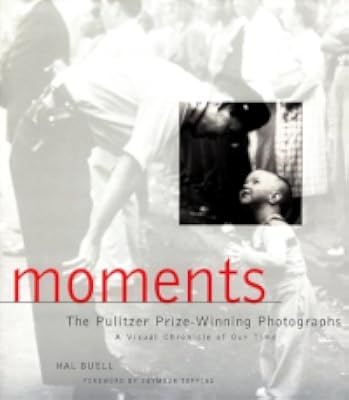
* The Norman Rockwell-like composition of a photograph that drew "more response than any photo every published in the Washington Daily News" A tiny little boy steps in the street to get a better view of the meandering floats of the Chinese New Year parade in Washington, D.C., 1958. A policeman spots the boy stepping into the street and he bends down to the boy.
* A joyous, live birth.
More with the effective theme of lives disrupted are:
*"Live...from Dallas," 1964, the shooting of Lee Harvey Oswald by Jack Ruby
* The shooting of James Meredith in Mississippi, after he integrated Ole Miss in 1967 and was shot while on a solo march
* The cold killing captured in "Democracy and Freedom?", 1969, the shooting of a Viet Cong by Brigadier General Nguyen Ngoc Loan, Vietnam's national police chief. Eddie Adams of AP took this photograph with a telephoto lens.
* 1971, "A God-Awful Scream" captured the nation's appalled reaction to the shooting of several Kent State students protesting the Vietnam War. National Guardsmen were given live ammo to use on their own countrymen.
There are also harrowing images of mental institutions, bayoneting, napalmed children in Vietnam, hostage-taking, a cross burning and other forced bussing reactions.
The last photograph, "Dedicated to Eddie Robinson," 1977, shows a Vietnam veteran, a double amputee, in his wheelchair, holding his little daughter, on his first outing since returning home from the hospital. Robinson watches an Armed Forces Day Parade. show less
Dan Rather writes the foreword to this compendium of world history (as viewed by American press) from 1942 union organizing violence outside River Rouge plan to 1970's civil rights and anti-Vietnam War struggles
As you turn from page to page to examine very famous photographs of national history, you will learn a little more what makes our national character.
The volume begins with the first Pulitzer Prize photograph: "Battle on the Picket Lines," 1942, Pete Brooks, Detroit News, a photo "capturing in a startling way the fury and the power" of breaking a picket line by Ford goons.
One show more of the most recognizable photographs is raising the flag at Iwo Jima, 1945, Joe Rosenthal. Generally, each photo fills one page with the opposite page explaining the background, historical significance, photographer, and other context.
Some that are not crystalized mayhem include a photographer shooting a subject from the rear:
* Nat Fein, New York Herald-Tribune to snap Babe Ruth's #3 on the back of his jersey in "the King of Clout, the Sultan of Swat," 1949, taken two months before the Babe died and the number was retired.
* "A Miracle," 1954, was taken by a tourist with a Brownie camera. The "miracle" was the cab of a diesel hanging off a bridge, ready to drop, and does seconds after rescue of the passengers.
* The Norman Rockwell-like composition of a photograph that drew "more response than any photo every published in the Washington Daily News" A tiny little boy steps in the street to get a better view of the meandering floats of the Chinese New Year parade in Washington, D.C., 1958. A policeman spots the boy stepping into the street and he bends down to the boy.
* A joyous, live birth.
More with the effective theme of lives disrupted are:
*"Live...from Dallas," 1964, the shooting of Lee Harvey Oswald by Jack Ruby
* The shooting of James Meredith in Mississippi, after he integrated Ole Miss in 1967 and was shot while on a solo march
* The cold killing captured in "Democracy and Freedom?", 1969, the shooting of a Viet Cong by Brigadier General Nguyen Ngoc Loan, Vietnam's national police chief. Eddie Adams of AP took this photograph with a telephoto lens.
* 1971, "A God-Awful Scream" captured the nation's appalled reaction to the shooting of several Kent State students protesting the Vietnam War. National Guardsmen were given live ammo to use on their own countrymen.
There are also harrowing images of mental institutions, bayoneting, napalmed children in Vietnam, hostage-taking, a cross burning and other forced bussing reactions.
The last photograph, "Dedicated to Eddie Robinson," 1977, shows a Vietnam veteran, a double amputee, in his wheelchair, holding his little daughter, on his first outing since returning home from the hospital. Robinson watches an Armed Forces Day Parade. show less
A bit out-dated, but worth reading if you find it. The pictures are stunning and truly capture humanity and its best and worst.
The one fault I have with the pictures in the book is that -- in order to bleed them into a full page, many of them are grainy and impercise. The blurbs describing how and why and what happened to create them are excellent, however.
Ratings
Members
- Recently Added By
Author Information
1 Work 147 Members
Awards and Honors
Distinctions
Classifications
Statistics
- Members
- 147
- Popularity
- 222,133
- Reviews
- 3
- Rating
- (4.15)
- Languages
- English
- Media
- Paper
- ISBNs
- 2
- ASINs
- 6