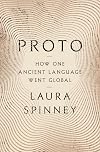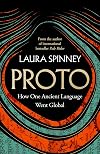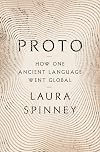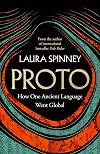
Proto: How One Ancient Language Went Global
by Laura Spinney
On This Page
Description
Named a Best Book of 2025 by the Guardian and Scientific American"The story of how one language left the steppes of Ukraine and became the earth's dominant language family has become clearer and more exciting than ever before. Hooray for a book where the author's curiosity, diligence, and literary craft gets it all down in what will stand as the go-to source for a generation." - John McWhorter, author of The Language Hoax
Daughter. Duhitár-. Dustr. Dukte. Listen to these English, show more Sanskrit, Armenian and Lithuanian words, all meaning the same thing, and you hear echoes of one of history's most unlikely journeys. All four languages-along with hundreds of others, from French and Gaelic, to Persian and Polish-trace their origins to an ancient tongue spoken as the last ice age receded. This language, which we call Proto-Indo-European, was born between Europe and Asia and exploded out of its cradle, fragmenting as it spread east and west. Its last speaker died thousands of years ago, yet Proto-Indo-European lives on in its myriad linguistic offspring and in some of our best loved works of literature, including Dante's Inferno and the Rig Veda, The Lord of the Rings and the love poetry of Rumi. How did this happen?
Acclaimed journalist Laura Spinney set out to answer that question, retracing the Indo-European odyssey across continents and millennia. With her we travel the length of the steppe, navigating the Caucasus, the silk roads and the Hindu Kush. We retrace the epic journeys of nomads and monks, warriors and kings – the ancient peoples who carried these languages far and wide. In the present, Spinney meets the scientists on a thrilling mission to retrieve the lost languages and their speakers: the linguists, archaeologists and geneticists who have reconstructed that ancient diaspora. What they have learned has profound implications for our modern world, because people and their languages are on the move again. Proto is a revelatory portrait of world history in its own words. Language Arts. Nonfiction. History. Science. show less
Tags
Recommendations




Member Reviews
https://fromtheheartofeurope.eu/proto-how-one-ancient-language-went-global-by-la...
I’ve always been fascinated by linguistics, especially the evolution of languages over the millennia, and a friend very rightly recommended this book to me for Christmas. It looks at the history of the Indo-European languages, cross-referencing the evidence from the languages themselves with the latest archaeological findings and, crucially, DNA evidence about the people who lived and died in various places and times.
I just love the concept of Proto-Indo-European, from which six of the top seven languages in the world are descended (not Chinese, obviously, but Spanish, English, Hindi, Portuguese, Bengali and Russian), spoken 5,000 years ago, and some of show more whose words are eerily similar to ours and some startlingly different.
Spinney goes with the standard theory which has been around for decades, that the speakers of PIE were the Yamnaya culture, a subset of the Kurgan culture, north of the Black Sea, and named after their burial practice of funeral pits (яма, yama) with tumuli on top (курган, kurgan). The latest DNA research strongly supports this, though she gives time to other explanations as well (notably the Anatolian and ‘Out Of India’ theories), and gives personal glimpses of Gimbutas and Renfrew in their debates, also citing David Anthony whose book I enjoyed a few years back.
The movements of population and language were initially driven by climate change as Eurasia recovered from the Ice Age, and then by technology as the horse was domesticated, the wheel was developed and agriculture began to be adopted. (NB that in the story of Cain and Abel, Cain is the bad guy and the farmer, Abel is the good guy and the herder.)
She follows up with individual chapters, each prefaced by a helpful map, on the extinct Anatolian and Tocharian languages, on the western Celtic/Germanic/Italic branch, on the eastern Indo-Iranian languages, on the northern Baltic and Slavic groups, and on the isolated Albanian, Armenian and Greek, the last of which has the longest continuous literary tradition. I love little snippets like the extinct Venetic language, known from a few hundred inscriptions, most of which are dedications to Reitia, the goddess of writing.
There’s interesting stuff in the DNA too. Apparently when the Beaker People arrived in Britain in 2450 BC, the result was that they took over 90% of the British gene pool and 100% of British Y-chromosomes, and the same when they reached Ireland 200 years later. Did they speak Celtic? It’s a little too early from the linguistic change point of view, but otherwise it’s not clear how Celtic language came to Ireland. I actually bought J.P. Mallory’s book to find out more.
This is a great book, filled with history, science and literature. Spinney has gone light on the technicalities of linguistics, so as not to deter the faint-hearted, though I would have been happy with more detailed reconstructions; still, these are easy enough to find. Lots to learn. show less
I’ve always been fascinated by linguistics, especially the evolution of languages over the millennia, and a friend very rightly recommended this book to me for Christmas. It looks at the history of the Indo-European languages, cross-referencing the evidence from the languages themselves with the latest archaeological findings and, crucially, DNA evidence about the people who lived and died in various places and times.
I just love the concept of Proto-Indo-European, from which six of the top seven languages in the world are descended (not Chinese, obviously, but Spanish, English, Hindi, Portuguese, Bengali and Russian), spoken 5,000 years ago, and some of show more whose words are eerily similar to ours and some startlingly different.
Spinney goes with the standard theory which has been around for decades, that the speakers of PIE were the Yamnaya culture, a subset of the Kurgan culture, north of the Black Sea, and named after their burial practice of funeral pits (яма, yama) with tumuli on top (курган, kurgan). The latest DNA research strongly supports this, though she gives time to other explanations as well (notably the Anatolian and ‘Out Of India’ theories), and gives personal glimpses of Gimbutas and Renfrew in their debates, also citing David Anthony whose book I enjoyed a few years back.
The movements of population and language were initially driven by climate change as Eurasia recovered from the Ice Age, and then by technology as the horse was domesticated, the wheel was developed and agriculture began to be adopted. (NB that in the story of Cain and Abel, Cain is the bad guy and the farmer, Abel is the good guy and the herder.)
She follows up with individual chapters, each prefaced by a helpful map, on the extinct Anatolian and Tocharian languages, on the western Celtic/Germanic/Italic branch, on the eastern Indo-Iranian languages, on the northern Baltic and Slavic groups, and on the isolated Albanian, Armenian and Greek, the last of which has the longest continuous literary tradition. I love little snippets like the extinct Venetic language, known from a few hundred inscriptions, most of which are dedications to Reitia, the goddess of writing.
There’s interesting stuff in the DNA too. Apparently when the Beaker People arrived in Britain in 2450 BC, the result was that they took over 90% of the British gene pool and 100% of British Y-chromosomes, and the same when they reached Ireland 200 years later. Did they speak Celtic? It’s a little too early from the linguistic change point of view, but otherwise it’s not clear how Celtic language came to Ireland. I actually bought J.P. Mallory’s book to find out more.
This is a great book, filled with history, science and literature. Spinney has gone light on the technicalities of linguistics, so as not to deter the faint-hearted, though I would have been happy with more detailed reconstructions; still, these are easy enough to find. Lots to learn. show less
Essential for anyone who read “The Horse, the Wheel, and Language” >10 years ago and is ready to be delighted, amused, and amazed at the contributions of genetics to PIE studies since then. If a wheel needs at least three spokes to hold its shape – which I kinda think it does – then what we’ve learnt from the analysis of ancient bones and teeth has been the complement that linguistics and archaeology were crying out for. Culture, ethnicity, and language overlap in always-fascinating but never straightforward ways, and the ability to look into ancient genomes feels thrilling and forbidden, somehow.
Spinney has written a damn fine popular linguistics book here. Even my aversion to potsherds, kurgans, and things in general that show more are scraped painstakingly up out of the earth and cleaned with toothbrushes couldn’t dampen my enthusiasm for her breakneck survey of current thinking on how the hell half the world came to speak languages descended from a handful of steppe-dwelling herders 8,000 years ago. show less
Spinney has written a damn fine popular linguistics book here. Even my aversion to potsherds, kurgans, and things in general that show more are scraped painstakingly up out of the earth and cleaned with toothbrushes couldn’t dampen my enthusiasm for her breakneck survey of current thinking on how the hell half the world came to speak languages descended from a handful of steppe-dwelling herders 8,000 years ago. show less
Review of: Proto: How One Ancient Language Went Global, by Laura Spinney
by Stan Prager (1-24-26)
Back in 2011, I was visiting Philly, where my daughter lived in those days, but the timing of my trip was all about the opening day of the exhibit of the Tarim Basin mummies at the University of Pennsylvania Museum of Archaeology and Anthropology. Fans of the history of the storied Silk Road know of the Tarim Basin as once hosting a number of oases that serviced caravans in the otherwise forbidding Taklamakan Desert, now located in the Xinjiang Uygur Autonomous Region in the People’s Republic of China. Naturally mummified, the collection of desiccated remains that was scheduled for display at the museum that day are incredibly old—some show more dating back about four thousand years—but what’s more astonishing is their ancestry: an isolated population of Ancient North Eurasians that once spoke Tocharian, an extinct branch of the Indo-European language family. To put that in perspective, these days in excess of forty percent of the world—more than three billion people—speak some kind of Indo-European language, including German, Italian, Russian, French, Hindi, Bengali, Punjabi, Persian, Greek, Irish, Albanian, Lithuanian, Armenian, and the English employed in the writing of this review. Tocharian was once part of that family! It is believed that all these languages (and hundreds of others) are descended from what once was a common tongue called Proto-Indo-European (PIE).
There is no extant record of PIE, but its elements have been partially identified through linguistic reconstruction, which is a remarkable tale in itself, although perhaps a far more extraordinary one lies in tracing how it is that descendants of this proto-language are spoken today by billions of people at such distant geographies. In Proto: How One Ancient Language Went Global [2025], both stories are expertly woven together in a fast-moving, well-written, if sometimes flawed narrative by science journalist Laura Spinney, which serves as a solid introduction to the global implications of Proto-Indo-European for the past and the present.
I first became intrigued by the Indo-European languages some years ago during my deep dive into the classics and the Bronze Age Mycenaean Greeks who peopled Homer’s Iliad. The Mycenaean script was first discovered (if not identified at the time) in the ruins of the Minoan Palace of Knossos on Crete in 1900 by British archaeologist Sir Arthur Evans, on tablets tagged as Linear B to distinguish it from the other, earlier script found on other tablets that were labeled as Linear A. Linear B also turned up elsewhere on the Greek mainland, but no one could decipher the strange symbols. More than a half century later, Michael Ventris and John Chadwick cracked the code and determined that Linear B was in fact a form of ancient Greek, in use by the Mycenaeans who conquered the Minoans. The Linear B syllabic script seems to have evolved from the still undeciphered Linear A, which was almost certainly Minoan and probably unrelated to Greek, and thus likely a non-Indo-European language.
There are important lessons here that have global implications. First, while the ancient Minoans and Greeks for a time utilized similar scripts, the languages recorded by these scripts were different. Second, and perhaps of even greater significance, that the Minoans learned to speak and write the Greek language of their conquerors does not imply that the two distinct peoples were otherwise related. When Greek written language reemerged after a kind of dark age that followed the collapse of the Bronze Age—one of the earliest literary works recorded was The Iliad—they wrote it down in an alphabetic script borrowed from the Phoenicians, an unrelated people who spoke Canaanite, a Semitic, non-Indo-European language. Thus, the populations that today speak Hindi, French, Albanian, or English are not by necessity genetically related to those who at one time may have overrun them and imposed an Indo-European language upon them, although they may be, and in some cases we can determine that they definitely are.
But long before this—long before there were Greeks—their Indo-European ancestors walked the earth, presumably speaking PIE. Where did they come from? We cannot be certain, but the most widely accepted theory is based upon the Kurgan hypothesis, proposed by Marija Gimbutas, which holds that nomadic pastoralists from the Pontic-Caspian steppe (now southern Ukraine and Russia) moved south and west in the 4th millennium BCE and imposed their culture and language on Neolithic farmers in their paths. Kurgans are the ancient burial mounds archaeologists have linked to these steppe nomads. (Gimbutas’ later reputation suffered due to her fixation on a belief in an "Old Europe" matriarchal civilization dominated by a life-affirming Mother Goddess, which has been panned by archaeologists for lacking evidence, but the central tenets of the Kurgan hypothesis have withstood vigorous scrutiny in subsequent studies.)
Her work was revised and refined by anthropologist David Anthony, whose magnificent book—The Horse, the Wheel, and Language: How Bronze-Age Riders from the Eurasian Steppes Shaped the Modern World [2007]—I read some years ago. Anthony argues that steppe nomad warriors, armed with domesticated horses and the advanced technology of wheeled vehicles, dominated Neolithic cultures in Europe, Anatolia, and beyond, spreading the proto-Indo-European language across continents. Paleogenetics has confirmed the likelihood that Gimbutas and Anthony were on to something, as DNA analysis has demonstrated the presence of a signature Y-chromosome (passed down by males) in modern Europeans, notably the Y-DNA haplogroup R1b that is traceable to steppe nomads. Evidence of mtDNA (the mitochondrial DNA passed down by females) in contemporary populations indicate that migrations of women from the steppes also occurred. Modern Indians are of mixed ancestry, but there too there is no mistaking the paternally inherited Y-chromosome that steppe nomads introduced thousands of years ago.
This was of course not the last time that steppe nomads put their mark on civilizations east and west—think Scythians, Huns, Turks, and Mongols—which certainly puts a lie to the “great man” historiography that dominated the textbooks of my youth, and solidly rebukes the likes of Will Durant, who with some arrogance once pronounced that civilizations rise on stoicism and fall on epicureanism. Really? How about climate change, pandemics—and invasions by steppe nomads?
Spinney deserves high marks for her review of the Kurgan hypothesis and competing theories. She is also on solid ground as she walks the reader through how it is that linguists can be certain that more than four hundred languages spoken by billions of people today—as well as a number of extinct branches of the Indo-European language family—are indeed related and must have descended from the PIE originally spoken by steppe nomads. To that end, she walks the reader through the homology of Indo-European languages to identify their linguistic kinship and common ancestry with PIE, including the correspondence of sounds, similar grammatical structures, and especially the shared vocabulary found, for instance, in ancient Sanskrit and Latin, and their modern descendants like Hindi and French.
Vocabulary that shares common ancestor words from PIE—but may sound altered today due to regular sound changes—are called Indo-European cognates. A popular example is the English “mother,” which is in Latin mater, Greek mētēr, Sanskrit mātṛ, German Mutter, Russian mat'—which share the “*mater-” PIE root. There are many other examples, including “father” which has the PIE root “*pater-” and appears as Latin pater, Sanskrit pitṛ́, Greek patḗr, French père, Spanish padre, Armenian hayr, and Irish athair. A hint of how these two words might have been pronounced in the very distant past may be detected in today’s Lithuanian—the most archaic living Indo-European language with the least sound changes, considered closest to the original PIE—with mother rendered as “motina” and father as “tėvas,” preserving in this “conservative” East Baltic tongue older sounds that changed, for instance, in Latin and English. It is not surprising that words like “mother” and “father” should remain closer to their ancient PIE roots, but there are many other examples of such cognates, although due to sound changes over thousands of years, some may not correspond as elegantly as others.
Indo-European languages are divided into either centum or satem languages according to how the sounds of the dorsal consonants ("K,” "G," and "Y") evolved. At one time, it was believed that there was a neat divide between western and eastern languages with centum and satem, respectively, but then Tocharian was discovered and it turned out to be something like a centum tongue, even if it’s a kind of special case. It’s complicated.
Indo-European is further categorized by its branches, and language divergence began very early on with the oldest branches of Anatolian (Hittite) and Tocharian, and later splits into Hellenic (Greek) and Indo-Iranian (Vedic Sanskrit). To my mind, perhaps most fascinating is the number of extinct languages that were once derived from PIE. The Tocharian of Central Asia is one, of course, which has no modern descendants, and actually the whole Tocharian branch is defunct. Another is its earliest, Hittite, which dates back to 1750 BCE. The Hittites, who once dominated Anatolia, modern Turkey, are famously referenced in the Hebrew Torah, and are notable in the archaeological record for the massive chariot warfare that occurred circa 1274 BCE between armies led by Hittite King Muwatalli II and the Egyptian Pharoah Ramesses II at the Battle of Kadesh, located in modern day Syria, which ended in stalemate and the world's first recorded peace treaty! The Hittite Empire fell with the collapse of the Bronze Age, and eventually their language disappeared, as well.
Like Tocharian, the entire Anatolian branch—that once included Hittite as well as other tongues such as Luwian, Lydian, and Lycian—is entirely extinct, with no successor languages. Surviving main branches—many of which also include now vanished languages—are Indo-Iranian, Germanic, Italic, Hellenic, Balto-Slavic, Celtic, Armenian, and Albanian. Of these, the largest belongs to the 1.7 billion who speak Hindi, Persian, Urdu, and Kurdish, among the more than three hundred Indo-Iranian languages. While reading Proto, I got a kick out of the fact that the guys I buy beer from at my local package store hail from the Indian state of Gujarat, and speak Gujarati—an Indo-European language! There are close to four hundred fifty living languages in the Indo-European family today, but also more than eight hundred others that no longer exist.
Proto serves as a fine introductory course on Indo-European languages and their shared PIE ancestry, although it turns into a kind of travelogue as Spinney takes the reader on a journey to various spots across the globe where IE tongues are spoken, looking to the past and present with captivating excursions into history, archaeology, linguistics, genetics, and culture. On the one hand, this makes the book far more readable—she is a very talented writer—but will leave some wanting more, especially as she exercises the author’s prerogative to devote more emphasis to certain branches of IE than to others.
There are, unfortunately, a couple of glaring errors. The first is when she repeats the discredited notion that the volcanic eruption circa 1628 BCE of Thera (modern Santorini) brought on the collapse of the Minoan civilization, and opened the door to the Mycenean Greeks [p238]. Classicists know that while the catastrophe at Thera significantly weakened the Minoan thalassocracy, Mycenaeans did not conquer Crete until circa 1450 BCE—nearly 180 years later! Worse, Spinny repeats the long-debunked canard that the Egyptian pyramids were constructed by slaves [p.195] rather than skilled, paid laborers—a notion imagined in technicolor by Cecil B. DeMille but repudiated by historians. These are, of course, just two blemishes on an otherwise fine work, but nevertheless made me want to fact-check some of her other material.
Still, those of us who thrive on breaking news in science and history will derive a great deal of enjoyment from Proto, which balances content with readability such that there is an appeal to an academic as well as a general audience—which is an achievement worth an underscore! But those with a focus on politics rather than scholarship might not be on board. Hindu nationalists firmly reject any connection to outside cultural influences, and vehemently deny that Sanskrit and Hindi are Indo-European in origin. Perhaps they share the conceit of the ancient Athenians, who likewise imagined themselves as autochthonous?
There are political sensitivities in the People’s Republic of China, as well. Turning back to my visit to Philadelphia for the opening day exhibit of “Secrets of the Silk Road” and the Tarim mummies: in the end, at the very last minute, to my great disappointment, the Chinese government yanked permission to display the mummies; paper cut-outs of the body forms were substituted. It was never stated out loud, but we all knew the reasons were purely political. The region where the Tocharian-speaking North Eurasians once roamed was now home to the often persecuted Muslim Uyghur minority population. Any challenge to the myth of the homogeneity of a single ancient Chinese people and culture in the wider geography of the PRC is a source of anxiety to the totalitarian regime. Apparently, the double-whammy of Turkic speaking Uyghurs and archaic Indo-Europeans was just too much for the Chinese Communist Party, and they pulled the plug on showcasing the Tocharian mummies.
Later, there was a change of heart, and the mummies were restored to their exhibit cases, but by then I was hundreds of miles away and never got to see them. Yet, that episode hardly dulled my interest in the Tarim mummies, nor the Indo-European language family, and in the last fifteen years I have read fairly deeply about both. Proto is only my latest!
Latest Book Review & Podcast ... Review of: Proto: How One Ancient Language Went Global, by Laura Spinney https://regarp.com/2026/01/24/review-of-proto-how-one-ancient-language-went-glob... show less
by Stan Prager (1-24-26)
Back in 2011, I was visiting Philly, where my daughter lived in those days, but the timing of my trip was all about the opening day of the exhibit of the Tarim Basin mummies at the University of Pennsylvania Museum of Archaeology and Anthropology. Fans of the history of the storied Silk Road know of the Tarim Basin as once hosting a number of oases that serviced caravans in the otherwise forbidding Taklamakan Desert, now located in the Xinjiang Uygur Autonomous Region in the People’s Republic of China. Naturally mummified, the collection of desiccated remains that was scheduled for display at the museum that day are incredibly old—some show more dating back about four thousand years—but what’s more astonishing is their ancestry: an isolated population of Ancient North Eurasians that once spoke Tocharian, an extinct branch of the Indo-European language family. To put that in perspective, these days in excess of forty percent of the world—more than three billion people—speak some kind of Indo-European language, including German, Italian, Russian, French, Hindi, Bengali, Punjabi, Persian, Greek, Irish, Albanian, Lithuanian, Armenian, and the English employed in the writing of this review. Tocharian was once part of that family! It is believed that all these languages (and hundreds of others) are descended from what once was a common tongue called Proto-Indo-European (PIE).
There is no extant record of PIE, but its elements have been partially identified through linguistic reconstruction, which is a remarkable tale in itself, although perhaps a far more extraordinary one lies in tracing how it is that descendants of this proto-language are spoken today by billions of people at such distant geographies. In Proto: How One Ancient Language Went Global [2025], both stories are expertly woven together in a fast-moving, well-written, if sometimes flawed narrative by science journalist Laura Spinney, which serves as a solid introduction to the global implications of Proto-Indo-European for the past and the present.
I first became intrigued by the Indo-European languages some years ago during my deep dive into the classics and the Bronze Age Mycenaean Greeks who peopled Homer’s Iliad. The Mycenaean script was first discovered (if not identified at the time) in the ruins of the Minoan Palace of Knossos on Crete in 1900 by British archaeologist Sir Arthur Evans, on tablets tagged as Linear B to distinguish it from the other, earlier script found on other tablets that were labeled as Linear A. Linear B also turned up elsewhere on the Greek mainland, but no one could decipher the strange symbols. More than a half century later, Michael Ventris and John Chadwick cracked the code and determined that Linear B was in fact a form of ancient Greek, in use by the Mycenaeans who conquered the Minoans. The Linear B syllabic script seems to have evolved from the still undeciphered Linear A, which was almost certainly Minoan and probably unrelated to Greek, and thus likely a non-Indo-European language.
There are important lessons here that have global implications. First, while the ancient Minoans and Greeks for a time utilized similar scripts, the languages recorded by these scripts were different. Second, and perhaps of even greater significance, that the Minoans learned to speak and write the Greek language of their conquerors does not imply that the two distinct peoples were otherwise related. When Greek written language reemerged after a kind of dark age that followed the collapse of the Bronze Age—one of the earliest literary works recorded was The Iliad—they wrote it down in an alphabetic script borrowed from the Phoenicians, an unrelated people who spoke Canaanite, a Semitic, non-Indo-European language. Thus, the populations that today speak Hindi, French, Albanian, or English are not by necessity genetically related to those who at one time may have overrun them and imposed an Indo-European language upon them, although they may be, and in some cases we can determine that they definitely are.
But long before this—long before there were Greeks—their Indo-European ancestors walked the earth, presumably speaking PIE. Where did they come from? We cannot be certain, but the most widely accepted theory is based upon the Kurgan hypothesis, proposed by Marija Gimbutas, which holds that nomadic pastoralists from the Pontic-Caspian steppe (now southern Ukraine and Russia) moved south and west in the 4th millennium BCE and imposed their culture and language on Neolithic farmers in their paths. Kurgans are the ancient burial mounds archaeologists have linked to these steppe nomads. (Gimbutas’ later reputation suffered due to her fixation on a belief in an "Old Europe" matriarchal civilization dominated by a life-affirming Mother Goddess, which has been panned by archaeologists for lacking evidence, but the central tenets of the Kurgan hypothesis have withstood vigorous scrutiny in subsequent studies.)
Her work was revised and refined by anthropologist David Anthony, whose magnificent book—The Horse, the Wheel, and Language: How Bronze-Age Riders from the Eurasian Steppes Shaped the Modern World [2007]—I read some years ago. Anthony argues that steppe nomad warriors, armed with domesticated horses and the advanced technology of wheeled vehicles, dominated Neolithic cultures in Europe, Anatolia, and beyond, spreading the proto-Indo-European language across continents. Paleogenetics has confirmed the likelihood that Gimbutas and Anthony were on to something, as DNA analysis has demonstrated the presence of a signature Y-chromosome (passed down by males) in modern Europeans, notably the Y-DNA haplogroup R1b that is traceable to steppe nomads. Evidence of mtDNA (the mitochondrial DNA passed down by females) in contemporary populations indicate that migrations of women from the steppes also occurred. Modern Indians are of mixed ancestry, but there too there is no mistaking the paternally inherited Y-chromosome that steppe nomads introduced thousands of years ago.
This was of course not the last time that steppe nomads put their mark on civilizations east and west—think Scythians, Huns, Turks, and Mongols—which certainly puts a lie to the “great man” historiography that dominated the textbooks of my youth, and solidly rebukes the likes of Will Durant, who with some arrogance once pronounced that civilizations rise on stoicism and fall on epicureanism. Really? How about climate change, pandemics—and invasions by steppe nomads?
Spinney deserves high marks for her review of the Kurgan hypothesis and competing theories. She is also on solid ground as she walks the reader through how it is that linguists can be certain that more than four hundred languages spoken by billions of people today—as well as a number of extinct branches of the Indo-European language family—are indeed related and must have descended from the PIE originally spoken by steppe nomads. To that end, she walks the reader through the homology of Indo-European languages to identify their linguistic kinship and common ancestry with PIE, including the correspondence of sounds, similar grammatical structures, and especially the shared vocabulary found, for instance, in ancient Sanskrit and Latin, and their modern descendants like Hindi and French.
Vocabulary that shares common ancestor words from PIE—but may sound altered today due to regular sound changes—are called Indo-European cognates. A popular example is the English “mother,” which is in Latin mater, Greek mētēr, Sanskrit mātṛ, German Mutter, Russian mat'—which share the “*mater-” PIE root. There are many other examples, including “father” which has the PIE root “*pater-” and appears as Latin pater, Sanskrit pitṛ́, Greek patḗr, French père, Spanish padre, Armenian hayr, and Irish athair. A hint of how these two words might have been pronounced in the very distant past may be detected in today’s Lithuanian—the most archaic living Indo-European language with the least sound changes, considered closest to the original PIE—with mother rendered as “motina” and father as “tėvas,” preserving in this “conservative” East Baltic tongue older sounds that changed, for instance, in Latin and English. It is not surprising that words like “mother” and “father” should remain closer to their ancient PIE roots, but there are many other examples of such cognates, although due to sound changes over thousands of years, some may not correspond as elegantly as others.
Indo-European languages are divided into either centum or satem languages according to how the sounds of the dorsal consonants ("K,” "G," and "Y") evolved. At one time, it was believed that there was a neat divide between western and eastern languages with centum and satem, respectively, but then Tocharian was discovered and it turned out to be something like a centum tongue, even if it’s a kind of special case. It’s complicated.
Indo-European is further categorized by its branches, and language divergence began very early on with the oldest branches of Anatolian (Hittite) and Tocharian, and later splits into Hellenic (Greek) and Indo-Iranian (Vedic Sanskrit). To my mind, perhaps most fascinating is the number of extinct languages that were once derived from PIE. The Tocharian of Central Asia is one, of course, which has no modern descendants, and actually the whole Tocharian branch is defunct. Another is its earliest, Hittite, which dates back to 1750 BCE. The Hittites, who once dominated Anatolia, modern Turkey, are famously referenced in the Hebrew Torah, and are notable in the archaeological record for the massive chariot warfare that occurred circa 1274 BCE between armies led by Hittite King Muwatalli II and the Egyptian Pharoah Ramesses II at the Battle of Kadesh, located in modern day Syria, which ended in stalemate and the world's first recorded peace treaty! The Hittite Empire fell with the collapse of the Bronze Age, and eventually their language disappeared, as well.
Like Tocharian, the entire Anatolian branch—that once included Hittite as well as other tongues such as Luwian, Lydian, and Lycian—is entirely extinct, with no successor languages. Surviving main branches—many of which also include now vanished languages—are Indo-Iranian, Germanic, Italic, Hellenic, Balto-Slavic, Celtic, Armenian, and Albanian. Of these, the largest belongs to the 1.7 billion who speak Hindi, Persian, Urdu, and Kurdish, among the more than three hundred Indo-Iranian languages. While reading Proto, I got a kick out of the fact that the guys I buy beer from at my local package store hail from the Indian state of Gujarat, and speak Gujarati—an Indo-European language! There are close to four hundred fifty living languages in the Indo-European family today, but also more than eight hundred others that no longer exist.
Proto serves as a fine introductory course on Indo-European languages and their shared PIE ancestry, although it turns into a kind of travelogue as Spinney takes the reader on a journey to various spots across the globe where IE tongues are spoken, looking to the past and present with captivating excursions into history, archaeology, linguistics, genetics, and culture. On the one hand, this makes the book far more readable—she is a very talented writer—but will leave some wanting more, especially as she exercises the author’s prerogative to devote more emphasis to certain branches of IE than to others.
There are, unfortunately, a couple of glaring errors. The first is when she repeats the discredited notion that the volcanic eruption circa 1628 BCE of Thera (modern Santorini) brought on the collapse of the Minoan civilization, and opened the door to the Mycenean Greeks [p238]. Classicists know that while the catastrophe at Thera significantly weakened the Minoan thalassocracy, Mycenaeans did not conquer Crete until circa 1450 BCE—nearly 180 years later! Worse, Spinny repeats the long-debunked canard that the Egyptian pyramids were constructed by slaves [p.195] rather than skilled, paid laborers—a notion imagined in technicolor by Cecil B. DeMille but repudiated by historians. These are, of course, just two blemishes on an otherwise fine work, but nevertheless made me want to fact-check some of her other material.
Still, those of us who thrive on breaking news in science and history will derive a great deal of enjoyment from Proto, which balances content with readability such that there is an appeal to an academic as well as a general audience—which is an achievement worth an underscore! But those with a focus on politics rather than scholarship might not be on board. Hindu nationalists firmly reject any connection to outside cultural influences, and vehemently deny that Sanskrit and Hindi are Indo-European in origin. Perhaps they share the conceit of the ancient Athenians, who likewise imagined themselves as autochthonous?
There are political sensitivities in the People’s Republic of China, as well. Turning back to my visit to Philadelphia for the opening day exhibit of “Secrets of the Silk Road” and the Tarim mummies: in the end, at the very last minute, to my great disappointment, the Chinese government yanked permission to display the mummies; paper cut-outs of the body forms were substituted. It was never stated out loud, but we all knew the reasons were purely political. The region where the Tocharian-speaking North Eurasians once roamed was now home to the often persecuted Muslim Uyghur minority population. Any challenge to the myth of the homogeneity of a single ancient Chinese people and culture in the wider geography of the PRC is a source of anxiety to the totalitarian regime. Apparently, the double-whammy of Turkic speaking Uyghurs and archaic Indo-Europeans was just too much for the Chinese Communist Party, and they pulled the plug on showcasing the Tocharian mummies.
Later, there was a change of heart, and the mummies were restored to their exhibit cases, but by then I was hundreds of miles away and never got to see them. Yet, that episode hardly dulled my interest in the Tarim mummies, nor the Indo-European language family, and in the last fifteen years I have read fairly deeply about both. Proto is only my latest!
Latest Book Review & Podcast ... Review of: Proto: How One Ancient Language Went Global, by Laura Spinney https://regarp.com/2026/01/24/review-of-proto-how-one-ancient-language-went-glob... show less
We’re communicating right now in English, which itself derived from Old English, a Germanic language, with contributions from French and Latin, Romance languages. By the 19th century, it had become apparent all these languages, and many more, were a very large and widely dispersed language family.
In Proto: How One Ancient Language Went Global (galley received as part of early review program), Laura Spinney seeks to understand proto-Indo-European and how it became so widely distributed throughout first Asia and Europe, and eventually, the world.
The author tells the story both of the language development itself as well as the story of how we have come to understand it this way. After introducing the theme, the author brings us back show more four thousand years so we might meet the Yamnaya, a steppe people who were not numerically that strong or in many ways civilizationally compelling, and, in fact, a smaller group on the periphery of what passed for civilization in the Copper/Early Bronze Age in Eurasia. The author related the very possible climactic trends and human developments which led to a major reordering of how people throughout Europe and Asia spoke, leading to the Yamnaya’s descendants distributing themselves widely through Europe and parts of the Middle East and central Asia. The Yamnaya are believed to be the first to speak Indo-European, and the language would spread from there.
The author then went through the various branches of the Indo-European family tree. Hittite is reckoned as perhaps a cousin language, one which broke off around the time of the Yamnaya, and its story is fully told. The author also considers the Indo-Iranic family, the Celtic/Iberian etc. family, the Greek family, the Italic/Romance family, and the Slavic family of Indo-European languages.
In all of these stories the author provides the latest in linguistic and archaeological research. We are shown how the languages relate to one another, and how we can tell when languages spin off or develop into new ones based on which words are maintained in common and which words are coined or developed on the basis of contact with other languages, either fellow Indo-European languages or the languages of the people with whom Indo-European speakers came into contact.
The author presents the story of the advancement of Indo-European as the unlikely result of plucky groups of people who are resourceful and whose language becomes the primary tongue of Europe and a good portion of Asia. It’s an understandably compelling story: if you surveyed the state of the world and its languages around 2500 BCE, you would not have put your money on the Yamnaya language as the one which would predominate, and with the likely diversity in language families, you would not have necessarily expected it to become as dominant as it has in Europe and portions of Asia.
But it would also be impossible to deny how Indo-European languages are, at their core, colonial. The people who originally spoke them were not numerous; it would seem they traveled, took over in terms of prominence if not power, and whole groups of people not originally biologically related would end up speaking Indo-European languages. What we can perhaps see happening in Britannia to England in the first millennium BCE with the shift from Brittonic to English might well have been playing out with proto-Indo-European in many parts of Europe beforehand: a shift in the dominant culture leads to a shift in language, even among people who were not ancestrally part of the dominant language culture.
However you want to look at how it came to be, what cannot be denied is how English, and most European languages, are part of our steppe ancestry, and powerful testimony to how steppe people and their invasions have powerfully shaped the lives and cultures of Europe and many parts of Asia. This book is a highly recommended resource to better understand the Indo-European language family. show less
In Proto: How One Ancient Language Went Global (galley received as part of early review program), Laura Spinney seeks to understand proto-Indo-European and how it became so widely distributed throughout first Asia and Europe, and eventually, the world.
The author tells the story both of the language development itself as well as the story of how we have come to understand it this way. After introducing the theme, the author brings us back show more four thousand years so we might meet the Yamnaya, a steppe people who were not numerically that strong or in many ways civilizationally compelling, and, in fact, a smaller group on the periphery of what passed for civilization in the Copper/Early Bronze Age in Eurasia. The author related the very possible climactic trends and human developments which led to a major reordering of how people throughout Europe and Asia spoke, leading to the Yamnaya’s descendants distributing themselves widely through Europe and parts of the Middle East and central Asia. The Yamnaya are believed to be the first to speak Indo-European, and the language would spread from there.
The author then went through the various branches of the Indo-European family tree. Hittite is reckoned as perhaps a cousin language, one which broke off around the time of the Yamnaya, and its story is fully told. The author also considers the Indo-Iranic family, the Celtic/Iberian etc. family, the Greek family, the Italic/Romance family, and the Slavic family of Indo-European languages.
In all of these stories the author provides the latest in linguistic and archaeological research. We are shown how the languages relate to one another, and how we can tell when languages spin off or develop into new ones based on which words are maintained in common and which words are coined or developed on the basis of contact with other languages, either fellow Indo-European languages or the languages of the people with whom Indo-European speakers came into contact.
The author presents the story of the advancement of Indo-European as the unlikely result of plucky groups of people who are resourceful and whose language becomes the primary tongue of Europe and a good portion of Asia. It’s an understandably compelling story: if you surveyed the state of the world and its languages around 2500 BCE, you would not have put your money on the Yamnaya language as the one which would predominate, and with the likely diversity in language families, you would not have necessarily expected it to become as dominant as it has in Europe and portions of Asia.
But it would also be impossible to deny how Indo-European languages are, at their core, colonial. The people who originally spoke them were not numerous; it would seem they traveled, took over in terms of prominence if not power, and whole groups of people not originally biologically related would end up speaking Indo-European languages. What we can perhaps see happening in Britannia to England in the first millennium BCE with the shift from Brittonic to English might well have been playing out with proto-Indo-European in many parts of Europe beforehand: a shift in the dominant culture leads to a shift in language, even among people who were not ancestrally part of the dominant language culture.
However you want to look at how it came to be, what cannot be denied is how English, and most European languages, are part of our steppe ancestry, and powerful testimony to how steppe people and their invasions have powerfully shaped the lives and cultures of Europe and many parts of Asia. This book is a highly recommended resource to better understand the Indo-European language family. show less
Spinney aims at a general audience and mostly does a pretty good job, although it might be a bit challenging for those who don't have a background in languages/linguistics. I already knew a little about Proto Indo-European (IE) but it is largely tangential to my academic training in classical philology. Still, it helps to know most of the terminology.
Unlike older books that focus primarily on historical linguistics and archaeology, Spinney includes the results of recent DNA studies of IE remains which have helped clarify things, bolstering some theories and disposing of others. She starts with a general introduction to IE and its origins. This includes a number of connections with mythology. In a chapter called Genesis, appropriately show more enough, she discusses massive flooding of the Black Sea (due to melting glaciers) something like 10,000 years ago as a possible origin for the flood myth in Gilgamesh, Genesis, etc. In the Caucasus,the Colchis of the Greeks, sheep fleeces were used to pan for gold. Even for those not particularly into languages, there is a lot of interest. She identifies the nomadic Yamnaya people of the steppes of Central Asia as the original IE speakers. Horsemen, metal workers, and general purveyors of language and myth to the world. There is a fair amount of evidence, including DNA, to support this. But Spinney's greatest weakness is her tendency to pick her theory and stick with it, not always giving full attention to the others.
She then proceeds to address each major IE family in its linguistic and geographic context: Anatolian; Tocharian; Celtic, Germanic, Italic; Indo-Iranian; Baltic and Slavic; Albanian, Armenian, and Greek. It ends up being a wide-ranging cultural survey of prehistoric peoples, edging into historical periods for the modern linguistic descendants of IE. She brings in some of the history of Indo-European studies and some of the personalities of the field.
I enjoyed the book, not that I agree with everything in it. It reminded me of things I used to know and introduced a number that I didn't know. And I now have a list of other books to read when I get around to it. show less
Unlike older books that focus primarily on historical linguistics and archaeology, Spinney includes the results of recent DNA studies of IE remains which have helped clarify things, bolstering some theories and disposing of others. She starts with a general introduction to IE and its origins. This includes a number of connections with mythology. In a chapter called Genesis, appropriately show more enough, she discusses massive flooding of the Black Sea (due to melting glaciers) something like 10,000 years ago as a possible origin for the flood myth in Gilgamesh, Genesis, etc. In the Caucasus,the Colchis of the Greeks, sheep fleeces were used to pan for gold. Even for those not particularly into languages, there is a lot of interest. She identifies the nomadic Yamnaya people of the steppes of Central Asia as the original IE speakers. Horsemen, metal workers, and general purveyors of language and myth to the world. There is a fair amount of evidence, including DNA, to support this. But Spinney's greatest weakness is her tendency to pick her theory and stick with it, not always giving full attention to the others.
She then proceeds to address each major IE family in its linguistic and geographic context: Anatolian; Tocharian; Celtic, Germanic, Italic; Indo-Iranian; Baltic and Slavic; Albanian, Armenian, and Greek. It ends up being a wide-ranging cultural survey of prehistoric peoples, edging into historical periods for the modern linguistic descendants of IE. She brings in some of the history of Indo-European studies and some of the personalities of the field.
I enjoyed the book, not that I agree with everything in it. It reminded me of things I used to know and introduced a number that I didn't know. And I now have a list of other books to read when I get around to it. show less
In another life I might have been a linguist so I read about it from time to time. I’m fascinated by how languages change and how we track them. I thoroughly enjoyed this 21st-century update on the Indo-European languages and their proto-pre-cursors. It’s exciting to learn about how the intersection of linguistics, ancient DNA research and new archaeological finds/re-discoveries has furthered our knowledge. The conclusion is particularly interesting and I recommend reading it even if you don’t read the book—I appreciated the author’s perspective and insights about the impact of the current war in Ukraine and current immigration pressures around the world on research and language changes.
Proto-Indo-European is the origin of all languages of Europe, Iran, and India. It was probably first spoken by the Yamaya people in the south western steppe regions of Ukraine and Russia. It spread along ancient trade routes for copper and bronze, and by migration of peoples forced out of their homelands by waves of invaders. The evidence for this evolution is in the similarity of many words in these modern languages. The most ancient words deal with horses, wagons, weapons, and tents, suggesting the people who spoke them were pastoral and nomadic. Archeology of burial mounds revealed metal implements and ornaments. The author skillfully weaves myths, linguistic details and archeological finds into the tale of the evolutionary tree of show more the language. I would have liked more explanation of the some of the rules of linguistic derivations, and some pronunciation guides to all the letters with diacritical marks in the book. Very readable and fascinating, but I struggle to recall all of the interesting facts. show less
Members
- Recently Added By
Published Reviews
ThingScore 100
A smart, dense, detailed account.
added by timspalding
Lists

Great Books About Language
73 works; 45 members

2024-2025 Ezra Klein Guest Recommendations
213 works; 6 members
Talk Discussions
Past Discussions
An Author Interview with Laura Spinney in Talk about LibraryThing (May 2025)
Author Information

8+ Works 1,284 Members
Awards and Honors
Awards
Distinctions
Notable Lists
Common Knowledge
- Original publication date
- 2025-05-13
- Epigraph
- Men go abroad to wonder at the heights of mountains, at the huge waves of the sea, at the long courses of the rivers, at the vast compass of the ocean, at the circular motions of the stars, and they pass by themselves without... (show all) wondering.
The Confessions of Saint Augustine, c. 400CE - Dedication
- For Ryszard
- First words
- The most powerful god in the ancient Indian pantheon was Father Sky.
- Last words
- (Click to show. Warning: May contain spoilers.)The past is a lighthouse, not a port.
- Blurbers
- McWhorter, John; Bellos, David; Crystal, David; Gordon, Helen; Ridley, Matt
- Original language
- English
- Canonical DDC/MDS
- 417.7
Classifications
- Genres
- Anthropology, History, Nonfiction, General Nonfiction, Science & Nature
- DDC/MDS
- 417.7 — Language Linguistics Dialectology and historical linguistics Historical linguistics (Diachronic linguistics)
- LCC
- P572 .S65 — Language and Literature Philology. Linguistics Indo-European (Indo-Germanic) philology
- BISAC
Statistics
- Members
- 430
- Popularity
- 71,429
- Reviews
- 10
- Rating
- (4.04)
- Languages
- English, German
- Media
- Paper, Audiobook, Ebook
- ISBNs
- 12
- ASINs
- 5