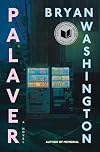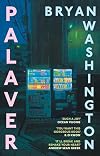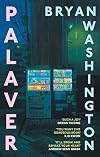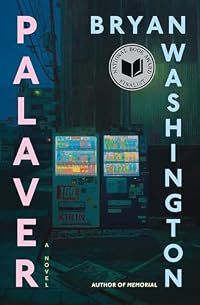
Palaver
by Bryan Washington
On This Page
Description
"The story of a mother and a son, estranged for ten years, reconnecting in the son's chosen city of Tokyo in the weeks leading up to Christmas"-- Provided by publisher.Tags
Recommendations




















Member Reviews
I adored Bryan Washington’s novel, Palaver. I found the book surprising although not technically dazzling. But I do not actually read books for their technical qualities. Washington does take risks here. The novel is the story of two characters, a mother and son, referred to throughout the book as “the mother” and “the son” even though every other character in the novel has a name. The pair have a difficult relationship, and they have not been in contact for a number of years, not until the mother feels compelled to visit the son in Tokyo. They have trouble connecting, not only with each other here, but I increasinlgly think, as I read the novel, with themselves. Washington uses their inner musings, as well as their show more interactions with others (named) and with food, to explore their relationship. They are like two ships, two people who, despite their blood relationship, seem to have no shared culture or even language in which to communicate. I get the impression that this disconnection is not what drives this novel, but rather the way that we bridge the gaps between us. Thus the use of two separate spheres of influence, two unnamed characters and the way their circles overlap, as they learn to know each other, and in a very real sense themselves. In the end our two protagonists begin to grow into a new relationship, beyond the parent/child relationship which has defined much of the novel. It is an interesting path, a good one, and one that often does not develop. It is hard to see our parents, and our children, as the people they are, apart from the parent/child relationship. I think Washington explores this process really well. I initially read Palaver last November, and think it stands up well to rereading, revealing more with continued acquaintance. show less
If it wasn't for the amazing narration by Andre Santana, I may not have pushed on through Palaver. He has a soft, non-strident American voice.
I see a man like "the son" fitting in in Japan. Not "the mother" however. She is a piece of work! Unpleasant. Negative. Ungenerous. Why does she visit if she seems to hate the son, who she hasn't seen for 10 years?
Her life is in Houston, which he has clearly left, preferring Tokyo. By the time she leaves, after too long a visit in anyone's books, she does seem to have softened minutely, towards the son, who was amazingly good to her during her visit, considering they had so little in common.
I loved Bryan Washington's nomenclature for his two leads: son and mother. Addressing them like this spoke show more volumes - pulling the purpose of the story back to their dysfunctional relationship whatever other goings on each had.
The bits about life in Tokyo - the restaurants, the bars, the trains stations, the tiny apartments, changing trains at Shinjuku and Shibuya to get to where people live in the outer suburbs of Tokyo - all so evocative of Tokyo.
This is a lazy cop out of any specifics, but the writing was beautiful, poignant. For this it is worth 4 stars. When happiness came the son's way, I felt relief and gladness - it was enough to keep me going in what is a fairly stark, unflinching look at "family". But that's it, because I did have to push through the not so uplifting material (my taste), it's lost a half star.
A few days after finishing, I was listening to a New Yorker podcast where he chose and read a short story previously published in the magazine - OMG! the author was Bryan Washington! joining the program from Tokyo! The story was about a flower girl - someone bought all her roses to stop her annoying them, then threw them in bushes, where she retrieved them to sell again... show less
I see a man like "the son" fitting in in Japan. Not "the mother" however. She is a piece of work! Unpleasant. Negative. Ungenerous. Why does she visit if she seems to hate the son, who she hasn't seen for 10 years?
Her life is in Houston, which he has clearly left, preferring Tokyo. By the time she leaves, after too long a visit in anyone's books, she does seem to have softened minutely, towards the son, who was amazingly good to her during her visit, considering they had so little in common.
I loved Bryan Washington's nomenclature for his two leads: son and mother. Addressing them like this spoke show more volumes - pulling the purpose of the story back to their dysfunctional relationship whatever other goings on each had.
The bits about life in Tokyo - the restaurants, the bars, the trains stations, the tiny apartments, changing trains at Shinjuku and Shibuya to get to where people live in the outer suburbs of Tokyo - all so evocative of Tokyo.
This is a lazy cop out of any specifics, but the writing was beautiful, poignant. For this it is worth 4 stars. When happiness came the son's way, I felt relief and gladness - it was enough to keep me going in what is a fairly stark, unflinching look at "family". But that's it, because I did have to push through the not so uplifting material (my taste), it's lost a half star.
A few days after finishing, I was listening to a New Yorker podcast where he chose and read a short story previously published in the magazine - OMG! the author was Bryan Washington! joining the program from Tokyo! The story was about a flower girl - someone bought all her roses to stop her annoying them, then threw them in bushes, where she retrieved them to sell again... show less
A warm, loving story of a different world.
A confession that I really like Washington’s authorial voice and have read his previous two novels and short stories, including those in the New Yorker, so I’m not impartial. As with his previous books, the subject matter is totally outside my experience, but fascinating for its difference, and the style is beautiful.
Initially the style can read a little distant, but if you relax into the rhythm, the layering of time, then it is another warm book of love and family, whether biological or logical.
Washington calls the protagonists, “the mother” and “the son” throughout, and although it perhaps indicates their Everyman qualities, it can be awkward at times and once completely broke my show more flow trying to understand the sentence.
There are some cheesy sentimental quotes, but I loved the book enough to accept them.
I received a Netgalley copy of this book, but this review is my honest opinion. show less
A confession that I really like Washington’s authorial voice and have read his previous two novels and short stories, including those in the New Yorker, so I’m not impartial. As with his previous books, the subject matter is totally outside my experience, but fascinating for its difference, and the style is beautiful.
Initially the style can read a little distant, but if you relax into the rhythm, the layering of time, then it is another warm book of love and family, whether biological or logical.
Washington calls the protagonists, “the mother” and “the son” throughout, and although it perhaps indicates their Everyman qualities, it can be awkward at times and once completely broke my show more flow trying to understand the sentence.
There are some cheesy sentimental quotes, but I loved the book enough to accept them.
I received a Netgalley copy of this book, but this review is my honest opinion. show less
Rereading this after five months, as the story of the son and the mother kept resurfacing in my mind. Just savouring the language and style, such rhythm, flowing and seemingly effortlessly changing perspective, back and forth in time.
May be a little too optimistic, too much, but why not have something uplifting.
May be a little too optimistic, too much, but why not have something uplifting.
Ratings
Members
- Recently Added By
Lists

Sexuality & Gender
160 works; 3 members

2026 Tournament of Books Longlist
70 works; 2 members
Author Information

11+ Works 2,010 Members
Awards and Honors
Awards
Distinctions
The Guardian Book of the Day (2025-12-22)
Common Knowledge
- Canonical title
- Palaver
Classifications
Statistics
- Members
- 167
- Popularity
- 195,085
- Reviews
- 4
- Rating
- (3.29)
- Languages
- English
- Media
- Paper, Ebook
- ISBNs
- 7
- ASINs
- 2