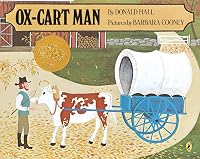
Ox-Cart Man
by Donald Hall
On This Page
Description
Describes the day-to-day life throughout the changing seasons of an early 19th-century New England family.Tags
Recommendations



Member Reviews
This is a simple story of a man whose life consists mainly of what he makes with his hands, who then sells those things and starts again the following year. He doesn't amass material goods or wealth. Those things are unimportant. Emphasized instead is the rhythm of life, the quiet deliberation of a life free from harried schedules, worry, and danger. Keeping in mind that author Donald Hall is a poet will prevent the reader from expecting a dynamic plot. Rather, Hall creates a mood through vivid detail and selected information. Illustrator Barbara Cooney contributes to the story, emphasizing the passing of time, the personalities of the family (notice, for example, that he cares for his ox before he sells his goods), and the simple way show more of life depicted in the text. This book makes an excellent read aloud for a classroom, a good book to check out at the library, but not necessarily an essential book for one's library. What's missing, is a reason for living beyond mere simplicity, which can become an inadequate and ultimately unsatisfying ideal to strive for. show less
I loved the story and illustrations in this one, and the taste that we get of what life was like back then - there was no Wal-Mart or convenience store to get groceries or other supplies, so it was important to take care of what you had, as well as work hard to produce crops (or other viable goods) for sale just to eke out a basic living. Barbara Cooney is also a fantastic illustrator, any book that features art of hers always adds gorgeous visuals to the story.
A lyrical journey through the days and weeks, the months, and the changing seasons in the life of one New Englander and his family. The oxcart man packs his goods - the wool from his sheep, the shawl his wife made, the mittens his daughter knitted, and the linen they wove. He packs the birch brooms his son carved, and even a bag of goose feathers from the barnyard geese.
He travels over hills, through valleys, by streams, past farms and villages. At Portsmouth Market he sells his goods, one by one - even his beloved ox. Then, with his pockets full of coins, he wanders through the market, buying provisions for his family, and returns to his home. And the cycle begins again.
He travels over hills, through valleys, by streams, past farms and villages. At Portsmouth Market he sells his goods, one by one - even his beloved ox. Then, with his pockets full of coins, he wanders through the market, buying provisions for his family, and returns to his home. And the cycle begins again.
The illustrations of [a:Barbara Cooney|191976|Barbara Cooney|https://d202m5krfqbpi5.cloudfront.net/authors/1304790937p2/191976.jpg] really "make" this book. But the "dated" story is touching, how the farmer and his family work the land, harvest and make, knit, carve, weave things to sell at the market, how they make the utmost use of everything the farm and the land give them. It was a great opportunity to explain how people used to live in the "olden days" and how there used to be an age where people did not have stoves (well, okay, some people may still not have stoves), cars, supermarkets, TV, iPads ... All references to gender roles are of course very old fashioned, the daughter knits, the son carves and the father goes to the show more market and takes care of business. That makes one more thing to talk about, as we read the book. Finally, and again, the pictures are so beautiful, especially the big spreads, depicting the seasons. Some of the pages made me want to tear them out of the book to frame and hang, such as the sunset scene where the farmer is finally making his way home, or the winter scene with the low rising sun putting the clouds on fire. The vocabulary is a little bit challenging for a four year old, especially since so many of the terms and objects described are not part of our modern day reality. Other than that, it could even be an early reader book. show less
Ox-Cart Man tells the story of a farmer and his family. The story starts off, in October, with the farmer packing his ox-cart with many different items made by his family to sell. He packs a shawl made by his wife, mittens made by his daughter, a bag of wool, brooms carved by his soon, and many more items.The farmer goes to the market in town and sells everything that he had brought with him, including his ox-cart and ox. Before he heads home, he buys his wife, daughter, and son each something that will be useful for the things they make. He even buys two pounds of peppermint candies for the while family to enjoy together. When he goes back home, he gives his family their gifts, and together they do it it all over again, making items to show more sell for next October. The farmer even raises a new ox. Being a Caldecott winner, the illustrations are absolutely phenomenal. The pictures are filled with many colors and every small detail is shown. The illustrations really tell the story of this colonial family and will appeal to all readers. A wonderful story about a family who does everything they can to help each other. show less
Hall’s extended version of his poem illustrated by Cooney depicts the annual cycle of life on a 19th century New Hampshire farm. The farmer hitches his ox to an ox-cart laden with the produce of the farm, potatoes, apples, brooms, maple sugar, candles, and the linen spun by his wife from the flax grown on the farm and embroidered by his daughter, and travels for days to reach the seaport at Portsmouth. There he sells all their goods, including the ox and cart, purchases an iron kettle, a knife, an imported embroidery needle from England, and two pounds of wintergreen peppermint candies. With his purchases he walks slowly home to the farm, where the family after enjoying a hot dinner from the new cooking pot followed by some show more wintergreen peppermint candies while sitting around the fireplace, begins the next year’s work, making farm produce for next year’s market.
It is a beautiful book. show less
It is a beautiful book. show less
Told simply this story of one family who lives on a farm in New England is a great way to introduce early history to children. The illustrations are almost primitive in nature, reminding me of Grandma Moses, and the slow deliberate tale of a family's work and the results of their labors rings true.
Members
- Recently Added By
Lists

Caldecott Medal Books
91 works; 15 members

Honey For a Child's Heart
1,152 works; 25 members

Best Picture Books You Haven't Read
6 works; 2 members
Ambleside Books
459 works; 18 members

Brightly Beaming Curriculum Books
281 works; 8 members

Reading Rainbow
193 works; 10 members

American Revolution
7 works; 1 member

Books Read in 2016
4,666 works; 199 members

Early Picture Books
467 works; 9 members

Recommended Reading List
219 works; 1 member

LLATL Red Book List
10 works; 1 member
HMS: Make Your Child a Lover of Books, Ages 3-5
14 works; 2 members

Read Aloud Revival
108 works; 4 members

The Peaceful Preschool Curriculum
58 works; 1 member
Author Information

102+ Works 12,614 Members
Donald Andrew Hall Jr. was born in New Haven, Connecticut on September 20, 1928. He received a bachelor's degree from Harvard University in 1951. His first collection of poetry, Exiles and Marriages, was published in 1955. His other collections included Without, The Museum of Clear Ideas, and The Painted Bed. He received several awards including show more the National Book Critics Circle Award for The One Day, the Lenore Marshall Poetry Prize for The Happy Man, the Poetry Society of America's Robert Frost Silver medal, and the Ruth Lilly Prize for poetry. He served as poetry editor of The Paris Review from 1953 to 1962 and was the United States poet laureate for 2006-2007. He was also a memoirist, an essayist, and the author of textbooks and children's books. His memoirs were entitled Life Work and Unpacking the Boxes. His children's book, Ox-Cart Man illustrated by Barbara Cooney, won the Caldecott Medal. He received a National Medal of Arts in 2011. He died on June 23, 2018 at the age of 89. (Bowker Author Biography) show less
All Editions
Some Editions
Awards and Honors
Awards
Distinctions
Work Relationships
Is contained in
Has as a student's study guide
Common Knowledge
- Original publication date
- 1979
- Dedication
- For Paul and Bertha Fenton
D. H.
For Elijah
B. C. - First words
- In October he backed his ox into his cart and he and his family filled it up with everything they made or grew all year long that was left over.
- Last words
- (Click to show. Warning: May contain spoilers.)and geese squawked in the barnyard dropping feathers as soft as clouds.
- Original language
- English
Classifications
Statistics
- Members
- 4,619
- Popularity
- 3,136
- Reviews
- 106
- Rating
- (4.16)
- Languages
- Chinese, English, French, Swedish
- Media
- Paper, Audiobook, Ebook
- ISBNs
- 33
- UPCs
- 1
- ASINs
- 19