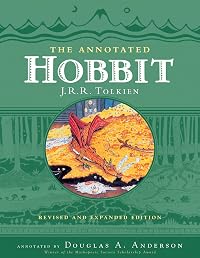
The Annotated Hobbit
by J. R. R. Tolkien
On This Page
Description
J.R.R. Tolkien's beloved novel The hobbit has deep roots in European folklore, mythology, and language. As a reader's introduction to Tolkien's Middle-earth, it contains references to the ancient history of this imaginary world which, though rarely explained, contribute greatly to the effect of Tolkien's art. This revised and expanded edition of The annotated hobbit unobtrusively and authoritatively illuminates the novel's antecedents and curiosities. Douglas Anderson has also collected here show more wonderful illustrations from all over the world. The many new annotations in this edition reflect more than a decade's additional scholarship on the history and evolution of The hobbit, and the annotations and illustrations are newly integrated with the core text in a handsome reader-friendly format. This edition also reproduces the fully corrected text of The hobbit as J.R.R. Tolkien approved it before his death, in 1973. Anderson has compared every page from every major edition of The hobbit with Tolkien's own last checking copy in the restoration work for this definitive edition. show lessTags
Recommendations






Member Reviews
What Tolkien had described [in the prologue to The Lord of the Rings] is the scenario for the first edition of The Hobbit; and the statement that "this is not the story as Bilbo first told it to his companions" contradicts the statement given here, that Bilbo "sat down and told them everything, except about the finding of the ring," and the statement given later (in the spiders episode), that the dwarves, after hearing about the ring, insist on "having the Gollum story, riddles and all, told over again, with the ring in its proper place." Bilbo's dishonesty, of great importance in The Lord of the Rings, is nowhere explicitly present in The Hobbit.
On picking this up, I did not think The Hobbit particularly needed annotating; it is not a show more story of riddles and layers (as with [b:The Annotated Alice: The Definitive Edition|176972|The Annotated Alice The Definitive Edition|Lewis Carroll|https://d.gr-assets.com/books/1367782378s/176972.jpg|15777985]); its antecedents are clear and its making well known. Having now read this, I am pleased to report I was wrong. The documentation of Tolkien's changes to the "Riddles in the Dark" chapter alone are worth the book, showing as they do the evolution of the story as Tolkien (inadvertently, as it turns out) retconned the story of the ring back into his earlier tale. The illustrations of different editions from around the world and the inclusion of snippets of Tolkien's sources are very nice as well. Worth a read for any fan of Middle Earth.
As to the primary text itself? This is the first time I have actually reread The Hobbit since I was a kid, I think, although I have reread The Lord of the Rings a number of times. I am pleased to say it holds up; Gollum and the spiders and Smaug and Beorn and Bard and all of it. I get the same chills now as I always have when the cry goes up that the Eagles are coming. I know it is not fashionable, among the seriously literary lovers of fantasy, to love Tolkien unironically. But I do. All I can say is that if any of the naysayers who want to call him a wart on a horse's butt (or a wanna-be fascist or whatever the going thing is) ever write anything as good as this little tale of an Everyman, I will read it and love it, too. show less
On picking this up, I did not think The Hobbit particularly needed annotating; it is not a show more story of riddles and layers (as with [b:The Annotated Alice: The Definitive Edition|176972|The Annotated Alice The Definitive Edition|Lewis Carroll|https://d.gr-assets.com/books/1367782378s/176972.jpg|15777985]); its antecedents are clear and its making well known. Having now read this, I am pleased to report I was wrong. The documentation of Tolkien's changes to the "Riddles in the Dark" chapter alone are worth the book, showing as they do the evolution of the story as Tolkien (inadvertently, as it turns out) retconned the story of the ring back into his earlier tale. The illustrations of different editions from around the world and the inclusion of snippets of Tolkien's sources are very nice as well. Worth a read for any fan of Middle Earth.
As to the primary text itself? This is the first time I have actually reread The Hobbit since I was a kid, I think, although I have reread The Lord of the Rings a number of times. I am pleased to say it holds up; Gollum and the spiders and Smaug and Beorn and Bard and all of it. I get the same chills now as I always have when the cry goes up that the Eagles are coming. I know it is not fashionable, among the seriously literary lovers of fantasy, to love Tolkien unironically. But I do. All I can say is that if any of the naysayers who want to call him a wart on a horse's butt (or a wanna-be fascist or whatever the going thing is) ever write anything as good as this little tale of an Everyman, I will read it and love it, too. show less
On my second Christmas, my uncle gave me a copy of this text. Understandably, it has taken me awhile to finally get around to reading it.
The last time I heard “The Hobbit" was during fifth or sixth grade, when my teacher Ann-Mary went through it as a read aloud. I can recall the scene near the beginning with the three trolls around the fire, but not much else. Around that era, I also saw a clip of the animated film while at a friend’s place cutting down a Christmas tree; it was the goblin war near the end.
After the Lord of the Rings films, I remember reading the Wikipedia page for the upcoming Hobbit film—this was about two years before it premiered. I ended up watching it in theaters with my friend Gracie; it was so terrible I show more didn’t watch another.;
As a child, I remember thinking of “The Chronicles of Narnia” in the same genre as “The Hobbit.” In reading this annotated version, I’ve learned why: Tolkien and C. S. Lewis were both part of a Oxford literary group, the Inklings. Another notable member was Owen Barfield—a man worth looking up if you aren’t familiar.
During the first half of the book, I felt as though Tolkien was being glib, maybe even ironic, especially regarding his humor. The book has a bit of self-deprecating silliness too it—from the songs, to the use of language. Also, the way the book moves encounter to encounter feels a bit formulaic. At times, the journey feels like less of a grand adventure, and more a string of moments.
At the beginning of the book, I so expected Bilbo to be brought off on his adventure in the middle of the night. I was quite surprised when Bilbo got a good nights sleep, and then almost missed the departure; an inauspicious beginning. Aside from that, the dwarfs arrival is quite archetypal—reminiscent of Rumi’s “The Guest House."
I become frustrated with Tolkien’s repeated refrain, “and at this point, your protagonist has a lovely time, so there is nothing much to report, and I’ll skip ahead a month to the next battle scene.” Is this some artifact of colonial plot-development? The book is supposedly about a hobbit—one of the most homely of creatures. Why does Tolkien willfully deprive us of basking in such a merry stupor?
It is interesting to contemplate the relationship between myth and story. The mythologist Martin Shaw recommends that, in retelling a myth, we feed it and build a relationship with it, but take care not to modify any of the essence. Is Tolkien a defiler of indigenous wisdom? Potentially. Is there an appropriate way to remix traditional myths and themes into contemporary literature? Well, everyone does it. But I’m still contemplating the repurcussions. Disney is infamous for this.
About half way through the book, my attitude and outlook changed; maybe this is some great work of literature? By the end of the book, I felt quite contented. Now I want to reread “The Lord of the Rings." show less
The last time I heard “The Hobbit" was during fifth or sixth grade, when my teacher Ann-Mary went through it as a read aloud. I can recall the scene near the beginning with the three trolls around the fire, but not much else. Around that era, I also saw a clip of the animated film while at a friend’s place cutting down a Christmas tree; it was the goblin war near the end.
After the Lord of the Rings films, I remember reading the Wikipedia page for the upcoming Hobbit film—this was about two years before it premiered. I ended up watching it in theaters with my friend Gracie; it was so terrible I show more didn’t watch another.;
As a child, I remember thinking of “The Chronicles of Narnia” in the same genre as “The Hobbit.” In reading this annotated version, I’ve learned why: Tolkien and C. S. Lewis were both part of a Oxford literary group, the Inklings. Another notable member was Owen Barfield—a man worth looking up if you aren’t familiar.
During the first half of the book, I felt as though Tolkien was being glib, maybe even ironic, especially regarding his humor. The book has a bit of self-deprecating silliness too it—from the songs, to the use of language. Also, the way the book moves encounter to encounter feels a bit formulaic. At times, the journey feels like less of a grand adventure, and more a string of moments.
At the beginning of the book, I so expected Bilbo to be brought off on his adventure in the middle of the night. I was quite surprised when Bilbo got a good nights sleep, and then almost missed the departure; an inauspicious beginning. Aside from that, the dwarfs arrival is quite archetypal—reminiscent of Rumi’s “The Guest House."
I become frustrated with Tolkien’s repeated refrain, “and at this point, your protagonist has a lovely time, so there is nothing much to report, and I’ll skip ahead a month to the next battle scene.” Is this some artifact of colonial plot-development? The book is supposedly about a hobbit—one of the most homely of creatures. Why does Tolkien willfully deprive us of basking in such a merry stupor?
It is interesting to contemplate the relationship between myth and story. The mythologist Martin Shaw recommends that, in retelling a myth, we feed it and build a relationship with it, but take care not to modify any of the essence. Is Tolkien a defiler of indigenous wisdom? Potentially. Is there an appropriate way to remix traditional myths and themes into contemporary literature? Well, everyone does it. But I’m still contemplating the repurcussions. Disney is infamous for this.
About half way through the book, my attitude and outlook changed; maybe this is some great work of literature? By the end of the book, I felt quite contented. Now I want to reread “The Lord of the Rings." show less
Si uno se contextualiza con el fin del libro "una historia escrita para sus hijos" y justamente ese echo de que es un libro para niños, esta aventura crece en la consideración, seria una de las mejores jamas escritas aunque si tienen que tener algunos conceptos ya claros los infantes.
En lo particular peco de haber visto todas las películas eso quizás me da unos sabores en el paladar que no puedo sacarme siendo todos ellos positivos. Noto la solidez y lo fluido del relato, sin volverse denso, siempre intrigante, avanzando en cada paso, mostrando la complejidad de las creaciones en las que pensó toda su vida Tolkien y que dio un impulso enérgico a la fantasía en general.
La edicion que toque tiene ademas el plus de explicar el show more proceso creativo, anotaciones al pie que dan mas significados a lo que ocurre, la historia de lo dibujos de varias ediciones internacionales y tambien un anexo con la historia de como Gandalf planeo todo lo que pasa en este libro.
Todo aquello suma mucho y hace que la lectura sea mas objetiva. show less
En lo particular peco de haber visto todas las películas eso quizás me da unos sabores en el paladar que no puedo sacarme siendo todos ellos positivos. Noto la solidez y lo fluido del relato, sin volverse denso, siempre intrigante, avanzando en cada paso, mostrando la complejidad de las creaciones en las que pensó toda su vida Tolkien y que dio un impulso enérgico a la fantasía en general.
La edicion que toque tiene ademas el plus de explicar el show more proceso creativo, anotaciones al pie que dan mas significados a lo que ocurre, la historia de lo dibujos de varias ediciones internacionales y tambien un anexo con la historia de como Gandalf planeo todo lo que pasa en este libro.
Todo aquello suma mucho y hace que la lectura sea mas objetiva. show less
An excellent version for those Hobbit fans wishing to RE-read the book. I wouldn't recommend this edition to first-timers, simply because it may take away from the wonder of reading "The Hobbit" in its unspoiled splendor. However, I did find the annotations fascinating and hence why I think anyone looking to re-read the novel will benefit from it more.
I decided to reread this in preparation for the upcoming movie, and since I probably hadn't read it since childhood. It was exactly as fun and exciting as I remembered it, but there was a lot more to the story that I didn't pick up on as a kid. I was surprised at how much this is really a story about the growth of Bilbo. Tolkien makes it very satisfying to watch his transformation from a bungling tourist to a confident adventurer. It's a powerful moment when the dwarves (who are very experienced themselves) turn to Bilbo as their leader. This was definitely worth the time investment to revist as an adult.
So yeah, I'm 36 years old, have read LoTR a couple of times, seen the movies a bunch, played lots of D&D, and somehow never got around to reading The Hobbit. I did see the movie once, at the library when I was a little kid, and I think one more time in the last decade or so.
It's a damn clever story; the locales are quite vivid, and I'm intrigued by the characters who weren't in LoTR. (Beorn in particular.)
I do wish I hadn't gotten the annotated version, though. Fascinating stuff, some of it, but also terribly distracting. And I'm still not so much for Tolkien's poetry.
All in all, I'm glad I finally got around to it.
It's a damn clever story; the locales are quite vivid, and I'm intrigued by the characters who weren't in LoTR. (Beorn in particular.)
I do wish I hadn't gotten the annotated version, though. Fascinating stuff, some of it, but also terribly distracting. And I'm still not so much for Tolkien's poetry.
All in all, I'm glad I finally got around to it.
The Hobbit remains one of my favorite books, and I highly recommend the annotated edition for adults who are interested in learning more about the background of this wonderful story. One of the elements I found most interesting were the reproductions of artwork from different editions and translations of The Hobbit -- some of them are marvelous, some of them are downright cringe-worthy.
Members
- Recently Added By
Lists

Satori Smiles Children's Book List
262 works; 7 members

Books Read in 2014
2,343 works; 89 members

Books Read in 2023
5,638 works; 147 members
Author Information

613+ Works 518,372 Members
A writer of fantasies, Tolkien, a professor of language and literature at Oxford University, was always intrigued by early English and the imaginative use of language. In his greatest story, the trilogy The Lord of the Rings (1954--56), Tolkien invented a language with vocabulary, grammar, syntax, even poetry of its own. Though readers have show more created various possible allegorical interpretations, Tolkien has said: "It is not about anything but itself. (Certainly it has no allegorical intentions, general, particular or topical, moral, religious or political.)" In The Adventures of Tom Bombadil (1962), Tolkien tells the story of the "master of wood, water, and hill," a jolly teller of tales and singer of songs, one of the multitude of characters in his romance, saga, epic, or fairy tales about his country of the Hobbits. Tolkien was also a formidable medieval scholar, as evidenced by his work, Beowulf: The Monster and the Critics (1936) and his edition of Anciene Wisse: English Text of the Anciene Riwle. Among his works published posthumously, are The Legend of Sigurd and Gudrún and The Fall of Arthur, which was edited by his son, Christopher. In 2013, his title, TheHobbit (Movie Tie-In) made The New York Times Best Seller List. (Bowker Author Biography) show less
All Editions
Some Editions
Awards and Honors
Awards
Notable Lists
Work Relationships
Is an expanded version of
Common Knowledge
- Original title
- The Annotated Hobbit: The Hobbit, or, There and Back Again
- Original publication date
- 1988
- People/Characters
- Bilbo Baggins; Elrond Half-elven; Gandalf; Gollum; Thorin Oakenshield; Smaug (show all 14); Bifur; Bofur; Bombur; Fíli; Glóin; Kíli; Óin; Ori
- Important places
- Middle-earth; The Shire; Mirkwood; Lonely Mountain; Misty Mountains; Rivendell
- Epigraph
- I cannot imagine a pleasanter old age than one spent in the not too remote country where I could reread and annotate my favorite books. - ANDRE MAUROIS
What we read with pleasure we read again with pleasure. - HORACE - First words
- In a hole in the ground there lived a hobbit.
- Original language
- English
- Disambiguation notice
- J.R.R. Tolkien's complete work The Lord of the Rings consists of six Books, frequently bound in three Volumes, as follow:
- Volume I: The Fellowship of the Ring, consisting of Book 1, "The Ring Sets Out... (show all)" and Book 2, "The Ring Goes South";
- Volume II: The Two Towers, consisting of Book 3, "The Treason of Isengard," and Book 4, "The Ring Goes East"; and
- Volume III: The Return of the King, consisting of Book 5, "The War of the Ring," and Book 6, "The End of the Third Age," with Appendices.
Classifications
Statistics
- Members
- 2,154
- Popularity
- 9,489
- Reviews
- 20
- Rating
- (4.64)
- Languages
- 8 — English, French, German, Italian, Japanese, Portuguese, Spanish, Turkish
- Media
- Paper, Ebook
- ISBNs
- 21
- UPCs
- 2
- ASINs
- 13