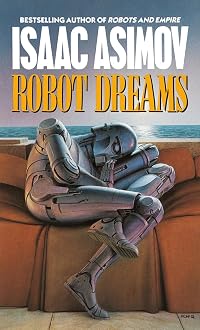
Robot Dreams
by Isaac Asimov
Isaac Asimov's Robot Series (Collections and Selections — 3.1), Asimov's Universe (Collections and Selections — 3.1)
On This Page
Description
Robot Dreams spans the body of Asimov's fiction from the 1940s to the mid-80s, and features classic Asimovian themes, from the scientific puzzle to the extraterrestrial thriller, all introduced in an exclusive essay written especially for this collection.Tags
Recommendations












Member Reviews
Robot Dreams is a collection of stories from the latter half of Asimov's career, studded with some genuine gems (The Last Question, The Ugly Little Boy, Franchise, Hostess), and display his considerable amount of talent. There are a few robot stories at the beginning, but this book centers mostly around Multivac, the great mainframe computer, and a tingling sense of cosmological alienation. Humankind repeatedly turns over vital creative and communal tasks to invisible and arcane machinery, separated from the great masses by a cadre of technician-priests. Or it turns out that our whole civilization is an experiment by cold and vasty intelligence, and we are nearing the point where they decide data collection is over. Asimov is usually show more seen as one of the cuddlier of the 'greats', less militaristic than Heinlein, less mathematical than Clarke. A more thorough assessment reveals a stark and chilly author, with a deep streak of misanthropy.
And for my own records, that Asimov story about using humans trained in mental math to replace expensive military computers is "The Feeling of Power." show less
And for my own records, that Asimov story about using humans trained in mental math to replace expensive military computers is "The Feeling of Power." show less
http://nwhyte.livejournal.com/2712342.html
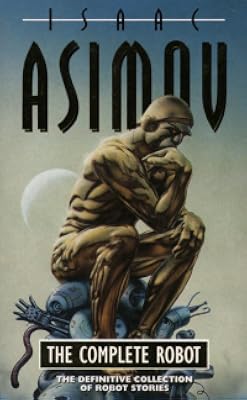
I have fallen out of love with Asimov much more than any of the other authors whose work I inhaled as a teenager, mainly because I hate cute robots, for which he may not be single-handedly responsible but for which he clearly bears the lion's share of the blame. However, this collection went some way to reconciling me. The stories I liked least were those I had read last year in The Complete Robot; I remembered reading about half of the others from my teenage years; and the rest were new to me, as far as I could remember. I was particularly struck by "Hostess", in which, for once, Asimov looks at an unhappy marriage from the point of view of an intelligent woman rather than an intelligent man; show more also by the alternate history twist of "Spell My Name With An S". And both "The Martian Way" and "Franchise" retained more of their attraction than I had hoped. It is also beautifully illustrated by Ralph McQuarry, which certainly helped my appreciation of the book. I started it with uneasy anticipation of disappointment, but actually was glad to have read it. show less
I have fallen out of love with Asimov much more than any of the other authors whose work I inhaled as a teenager, mainly because I hate cute robots, for which he may not be single-handedly responsible but for which he clearly bears the lion's share of the blame. However, this collection went some way to reconciling me. The stories I liked least were those I had read last year in The Complete Robot; I remembered reading about half of the others from my teenage years; and the rest were new to me, as far as I could remember. I was particularly struck by "Hostess", in which, for once, Asimov looks at an unhappy marriage from the point of view of an intelligent woman rather than an intelligent man; show more also by the alternate history twist of "Spell My Name With An S". And both "The Martian Way" and "Franchise" retained more of their attraction than I had hoped. It is also beautifully illustrated by Ralph McQuarry, which certainly helped my appreciation of the book. I started it with uneasy anticipation of disappointment, but actually was glad to have read it. show less
Surprise!
Davvero non mi aspettavo quello che mi sono trovata sotto gli occhi. Asimov mi ha sorpreso. Credevo fosse un autore di fantascienza più attento ad immaginare i progressi della tecnologia che altro. Invece, accanto a spunti futuristici curiosi, fantasiosi ed attraenti, non dimentica il "core" dell'umanità, quel "nucleo" imprescindibile dell'orma umana che rende le cose uniche e non asettiche come potrebbero essere le procedure robotizzate. I "sogni di robot" sono sogni molto molto umanoidi...
Davvero non mi aspettavo quello che mi sono trovata sotto gli occhi. Asimov mi ha sorpreso. Credevo fosse un autore di fantascienza più attento ad immaginare i progressi della tecnologia che altro. Invece, accanto a spunti futuristici curiosi, fantasiosi ed attraenti, non dimentica il "core" dell'umanità, quel "nucleo" imprescindibile dell'orma umana che rende le cose uniche e non asettiche come potrebbero essere le procedure robotizzate. I "sogni di robot" sono sogni molto molto umanoidi...
Brilliant. Considering some of these short stories were written in the 1940s, Asimov is shockingly prophetic about our time - not in terms of specific technological advances (though he nails a few of those as well), but more in terms of how 21st century humans would think and interact with that technology and with each other.
As most folks note, there are surprisingly few robot stories within, though the first few in the collection and the title set the reader up to expect more. To be fair, there are a fair number of stories here focused on a computer AI, often with either malevolent intent or cluelessness about humans amounting to the same thing. Some of the stories are dated, not in their Science Fiction quotient but in the provinciality of the human characters. Asimov's rare imagination is regularly on display. Another cool element, the illustrations were created by Ralph McQuarrie, who worked on the original Star Wars movies and won an Academy Award for special effects for Coccon. They are a nice addition to the book.
3 1/2 bones!!!
3 1/2 bones!!!
Dang. Many of these are *not* robot stories. I mean, I love Asimov, period, but I really wanted a big old sustained dose of interpretations & misinterpretations of the three laws....
Also, most of the stories seemed (and probably were) familiar. Time to let this one go....
(I, Robot, is the first collection of short stories. Second is The Rest of the Robots. Robot Dreams only has one new story in it. The Complete Robot is reported to be truly complete.)
Also, most of the stories seemed (and probably were) familiar. Time to let this one go....
(I, Robot, is the first collection of short stories. Second is The Rest of the Robots. Robot Dreams only has one new story in it. The Complete Robot is reported to be truly complete.)
Regarding "Franchise":
A couple of paragraphs in, I was hooked. A futuristic tale involving a presidential election… this should be interesting, given our current world. Cut to the date of the vote in Asimov’s story: November 4, 2008. I begin to wonder how close to home this tale will be, given Asimov’s foresight as to so many other issues in our current world.
This story is too perfect for me to ruin it for you. Go find a copy of it. While we don’t have a Multivac crunching numbers and evaluating data for each election, I believe that Asimov was closer to our current truth than I would like in a perfect world. Elected officials are not chosen by issues or counts as they should be. I think the 2000 and 2004 elections could be show more considered evidence of this.
I am not a political activist. I do not want to be; I don’t even want to pretend to be. But I have to pose one question to you: How long until all of our elections are based on how one person feels about the price of eggs? show less
A couple of paragraphs in, I was hooked. A futuristic tale involving a presidential election… this should be interesting, given our current world. Cut to the date of the vote in Asimov’s story: November 4, 2008. I begin to wonder how close to home this tale will be, given Asimov’s foresight as to so many other issues in our current world.
This story is too perfect for me to ruin it for you. Go find a copy of it. While we don’t have a Multivac crunching numbers and evaluating data for each election, I believe that Asimov was closer to our current truth than I would like in a perfect world. Elected officials are not chosen by issues or counts as they should be. I think the 2000 and 2004 elections could be show more considered evidence of this.
I am not a political activist. I do not want to be; I don’t even want to pretend to be. But I have to pose one question to you: How long until all of our elections are based on how one person feels about the price of eggs? show less
Members
- Recently Added By
Lists

Want to Read — open list
55 works; 2 members
Author Information

2,404+ Works 294,197 Members
Isaac Asimov was born in Petrovichi, Russia, on January 2, 1920. His family emigrated to the United States in 1923 and settled in Brooklyn, New York, where they owned and operated a candy store. Asimov became a naturalized U.S. citizen at the age of eight. As a youngster he discovered his talent for writing, producing his first original fiction at show more the age of eleven. He went on to become one of the world's most prolific writers, publishing nearly 500 books in his lifetime. Asimov was not only a writer; he also was a biochemist and an educator. He studied chemistry at Columbia University, earning a B.S., M.A. and Ph.D. In 1951, Asimov accepted a position as an instructor of biochemistry at Boston University's School of Medicine even though he had no practical experience in the field. His exceptional intelligence enabled him to master new systems rapidly, and he soon became a successful and distinguished professor at Columbia and even co-authored a biochemistry textbook within a few years. Asimov won numerous awards and honors for his books and stories, and he is considered to be a leading writer of the Golden Age of science fiction. While he did not invent science fiction, he helped to legitimize it by adding the narrative structure that had been missing from the traditional science fiction books of the period. He also introduced several innovative concepts, including the thematic concern for technological progress and its impact on humanity. Asimov is probably best known for his Foundation series, which includes Foundation, Foundation and Empire, and Second Foundation. In 1966, this trilogy won the Hugo award for best all-time science fiction series. In 1983, Asimov wrote an additional Foundation novel, Foundation's Edge, which won the Hugo for best novel of that year. Asimov also wrote a series of robot books that included I, Robot, and eventually he tied the two series together. He won three additional Hugos, including one awarded posthumously for the best non-fiction book of 1995, I. Asimov. "Nightfall" was chosen the best science fiction story of all time by the Science Fiction Writers of America. In 1979, Asimov wrote his autobiography, In Memory Yet Green. He continued writing until just a few years before his death from heart and kidney failure on April 6, 1992. (Bowker Author Biography) show less
Some Editions
Awards and Honors
Awards
Series

Isaac Asimov's Robot Series
4 works (Collections and Selections — 3.1)

Asimov's Universe
14 works (Collections and Selections — 3.1)
Belongs to Publisher Series
J'ai lu (2388)
Work Relationships
Is contained in
Contains
Common Knowledge
- Canonical title
- Robot Dreams
- Original title
- Robot Dreams
- Original publication date
- 1986-11-01
- Dedication
- To Bryon Preiss,
who made me do it. - First words
- Measures on Hyper Base had been taken in a sort of rattling fury----the muscular equivalent of an hysterical shriek.
- Last words
- (Click to show. Warning: May contain spoilers.)"Yes, dear," whispered Johnny, humbly.
- Original language*
- Anglais
- Disambiguation notice
- This is the first half of Robot Dreams, NOT the complete book, so this edition shouldn't be combined with the complete one.
*Some information comes from Common Knowledge in other languages. Click "Edit" for more information.
Classifications
Statistics
- Members
- 2,421
- Popularity
- 8,099
- Reviews
- 30
- Rating
- (4.00)
- Languages
- 9 — Czech, Dutch, English, French, German, Italian, Portuguese, Russian, Spanish
- Media
- Paper, Audiobook, Ebook
- ISBNs
- 42
- UPCs
- 1
- ASINs
- 16