On This Page
Description
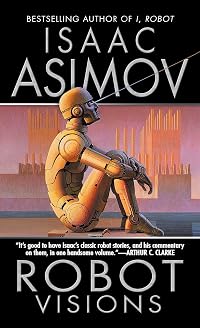
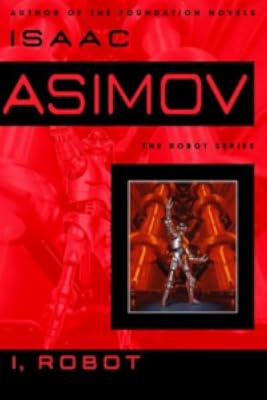
From the writer whose name is synonymous with the science of robotics comes five decades of robot visions-36 landmark stories and essays, plus three rare tales-gathered together in one volume.Tags
Recommendations













Member Reviews
This collection of Asimov's deathless Robot series, shorter works that add up to a guiding vision of what Humanity strives for in the creation of a computerized mechanical slave class, starts with an essay entitled "The Robot Chronicles." As I assume most everyone reading Asimov in this day and time is reasonably familiar with the stories that make up the series, I'll confine my observations to the essay which is not otherwise available in print, though it exists on audio for your edification.
Asimov, a lecherous old hump with a *terrible* (richly deservedly so) reputation among female fandom, made some conceptual leaps in his career that have remained extremely relevant to the modern world. His centenary was this past second of January. show more His reputation is such that the jollifications in fandom were...muted. This is understandable, even laudable, but still regrettable. The Three Laws of Robotics, with which his essay deals in a way I did not expect, alone should guarantee his place on the podium of Authors of Merit. But as sensitivity and awareness and the need for all of us to do better now that we know better are in operation, there must needs be a period of desuetude for famous offenders against our new order.
Nothing will knock his contributions out of use. His name will, whether temporarily or permanently, be expunged from the common usage of the robotics conversation (or so I predict). But he remains the originator of the modern technical and social conception of the Robot.
This essay is a personal history of how and why and who and what led Isaac Asimov to develop the Laws, the concept of the robot that he adopted and adapted so thoroughly from [author:Karel Čapek|439723]'s 1920 play [book:R.U.R.|6589334], and the enduring trope of the machine that longs to be human. (No, he was not the first to bring that idea to the table. Please spare me comments about Galatea and other inanimate objects of personification. They are all stipulated as predecessors to Asimov's creation and influences thereon, conscious or unconscious, herewith.) As a personal essay reflecting on Asimov's reasons for and responses to his robotics work, I found the half-hour or so of reading deeply pleasurable.
Not five-star's worth, though. I found a smugness, arguably earned, in his telling (retelling, more like, since he had given this text as talks over the years he was lionized) that is a fundamentally squicky emotion for me. I don't think anyone really intelligent is ever free of smugness. I also think it ill becomes the intelligent not to include some self-deprecation in their smugness, some overt and clear signal that they understand and are sorry for the feeling of irritation and annoyance their (however well-earned) expertise elicits in the hearer/reader. Asimov does not do that here...his response, for example, to the OFTEN brought charge that Roddenberry used Asimov's Bicentennial Man as source material for Lt. Cmdr. Data: "I didn't mind."
Aren't you kind.
Still, there it is. Along with being a handsy old letch he was an arrogant bastard. And a genius at some things (though not particularly at the *craft* of writing). And a light gone out too soon. He was a stripling of seventy-two when he died, and I for one would give a not-very-affordable decade off my life to hear what he'd have to say about the modern world.
If you don't want to read his Robot stories, listen to the essay on audio. But I think you'll want to read them once you do. show less
Asimov, a lecherous old hump with a *terrible* (richly deservedly so) reputation among female fandom, made some conceptual leaps in his career that have remained extremely relevant to the modern world. His centenary was this past second of January. show more His reputation is such that the jollifications in fandom were...muted. This is understandable, even laudable, but still regrettable. The Three Laws of Robotics, with which his essay deals in a way I did not expect, alone should guarantee his place on the podium of Authors of Merit. But as sensitivity and awareness and the need for all of us to do better now that we know better are in operation, there must needs be a period of desuetude for famous offenders against our new order.
Nothing will knock his contributions out of use. His name will, whether temporarily or permanently, be expunged from the common usage of the robotics conversation (or so I predict). But he remains the originator of the modern technical and social conception of the Robot.
This essay is a personal history of how and why and who and what led Isaac Asimov to develop the Laws, the concept of the robot that he adopted and adapted so thoroughly from [author:Karel Čapek|439723]'s 1920 play [book:R.U.R.|6589334], and the enduring trope of the machine that longs to be human. (No, he was not the first to bring that idea to the table. Please spare me comments about Galatea and other inanimate objects of personification. They are all stipulated as predecessors to Asimov's creation and influences thereon, conscious or unconscious, herewith.) As a personal essay reflecting on Asimov's reasons for and responses to his robotics work, I found the half-hour or so of reading deeply pleasurable.
Not five-star's worth, though. I found a smugness, arguably earned, in his telling (retelling, more like, since he had given this text as talks over the years he was lionized) that is a fundamentally squicky emotion for me. I don't think anyone really intelligent is ever free of smugness. I also think it ill becomes the intelligent not to include some self-deprecation in their smugness, some overt and clear signal that they understand and are sorry for the feeling of irritation and annoyance their (however well-earned) expertise elicits in the hearer/reader. Asimov does not do that here...his response, for example, to the OFTEN brought charge that Roddenberry used Asimov's Bicentennial Man as source material for Lt. Cmdr. Data: "I didn't mind."
Aren't you kind.
Still, there it is. Along with being a handsy old letch he was an arrogant bastard. And a genius at some things (though not particularly at the *craft* of writing). And a light gone out too soon. He was a stripling of seventy-two when he died, and I for one would give a not-very-affordable decade off my life to hear what he'd have to say about the modern world.
If you don't want to read his Robot stories, listen to the essay on audio. But I think you'll want to read them once you do. show less
https://nwhyte.livejournal.com/3051481.html
As with the companion anthology, Robot Dreams, this included a lot of stories which I had fairly recently returned to in The Complete Robot and did not especially like; a smaller number of stories which were new to me and which I generally liked a bit more; and some lovely illustrations by Ralph McQuarry. It also ends with a number of essays on robots by Asimov, most of which are about how clever he was to have invented the Three Laws. What really struck me was how little adaptation he felt he needed to make to the changing times; Alan Turing completed his PhD in 1938, just before Asimov started publishing, and in real life artificial intelligence has followed Turing's path and never come close show more to Asimov's. Likewise, the ethical and even political dilemmas faced by Asimov's characters seem rather pale now; I don't see much reference, even implicit, to John Rawls (who in fairness published A Theory of Justice only in 1971, almost three decades after the Laws of Robotics). show less
As with the companion anthology, Robot Dreams, this included a lot of stories which I had fairly recently returned to in The Complete Robot and did not especially like; a smaller number of stories which were new to me and which I generally liked a bit more; and some lovely illustrations by Ralph McQuarry. It also ends with a number of essays on robots by Asimov, most of which are about how clever he was to have invented the Three Laws. What really struck me was how little adaptation he felt he needed to make to the changing times; Alan Turing completed his PhD in 1938, just before Asimov started publishing, and in real life artificial intelligence has followed Turing's path and never come close show more to Asimov's. Likewise, the ethical and even political dilemmas faced by Asimov's characters seem rather pale now; I don't see much reference, even implicit, to John Rawls (who in fairness published A Theory of Justice only in 1971, almost three decades after the Laws of Robotics). show less
This is a retrospective collection of many of Asimov's most famous and significant robot short stories that were written and published over a period of half a century, including seven of the nine stories in his classic "I, Robot" collection, from his first imagination of a robot childminder in 1939's "Robbie", through the early articulation of the three laws of robotics in "LIar" and "Runaround", and later examinations where loopholes in the laws drive some ingenious plots. One story features the return of Elijah Baley and R. Daneel Olivaw from the classic robot novels "The Caves of Steel" and "The Naked Sun". There is one new story in the collection, the title story which, unusually for Asimov, features time travel. The book is topped show more off by a collection of Asimov's short essays and articles, again published over a period of several decades, on his thoughts about how real robots might work, and how they might relate to humans and improve our life experiences. This sequence begins with a 1954 article on his approach to the conceptualisation of robots in his fiction compared to the approaches of earlier authors. The other articles are from the 1970s and 1980s, fascinatingly exploring the relationship between the fictional and real development of robots and computers. Asimov's writing is never less than engaging and the length of his writing career and his prolific output during 50 years of huge technological advance enable much interesting reflection and speculation about both positive and negative human reactions to technology.
Finally, the stories contain a number of slightly odd illustrations of robots depicted in various scenes, but nearly all of which look exactly the same, not matching the very varied descriptions of robots given in the stories, which in fictional terms take place over probably two or three centuries of human development of robots. show less
Finally, the stories contain a number of slightly odd illustrations of robots depicted in various scenes, but nearly all of which look exactly the same, not matching the very varied descriptions of robots given in the stories, which in fictional terms take place over probably two or three centuries of human development of robots. show less
Substance: Because these are stories of philosophy, psychology, and detection as much as they are stories of science, they out-live the anachronisms inherent in work that stays viable past the dates of its "internal future".
I don't always agree with Asimov's position that somehow an elite corps of reasoning machines will somehow engender Utopia; we have seen that human elites with similar "good intentions" just screw things up. See Jack Williamson's story "With Folded Hands" for the end-game.
Style: Asimov is bluntly subtle.
STORIES: "Robot Visions"; "Too Bad!";
"Robbie" the first robot story he wrote, in 1939, sets up his premise of "safe" robots, and is still engaging.
"Reason" attempts to parody religion, but actually supports the need show more for it; explanations are less important than performance; chronachronism: robots working slide rules.
"Liar" demonstrates how difficult it can be to define "do no harm".
"Runaround";
"Evidence" p. 146: some people also follow the Three Laws (see one of his essays in this book).
"Little Lost Robot" p. 146: modifying the First Law causes problems; p. 167: government functionaries can make the Devil's Bargain look good.
"The Evitable Conflict" p. 195: welcome to the ultimate Nanny State; p. 215: minor modifications in Law 1 makes machines into gods; p. 16: false premises?
"Feminine Intuition" p. 243: robopsychologist Susan Calvin deals with men as if they were robots.
""The Bicentennial Man" still makes me cry.
"Someday"; "Think!"; "Segregationist";
"Mirror Image" R. Daneel brings Lije a mystery, which he solves on the basis of human psychology but must figure out how to get the robots to provide proof; it is very unsettling to know that robots will lie to protect humans from harm, because they have to be the ones who decide what is harmful.
"Lenny" is still one of the most affecting of the Susan Calvin stories; chronachronism: perforated tape input to computers.
"Galley Slave" p. 394: despite Asimov's (possible) sympathy with the problems nascent in robotic monopolies over "boring" tasks, he needn't worry - humans will always want to do creative things on their own (look at the move of women, and some men, back into home-made everything and crafting).
"Christmas Without Rodney" p. 398: "Rambo" a name invented by Asimov in 1988, or after the movie as a joke?
p. 404: does wishing always lead to action?
ESSAYS:
p. 409: there were several stories of robots lying and manipulating people "for their own good"; does this imply that supporters of government intervention are like robots?
P. 416: not quite right - welfare puts many people "at leisure" who do no learning.
p. 441: defines science fiction
p. 442: invents internet schools
p. 453: his robots were made as tools
p. 455: genesis of the Three Laws of Robotics; he makes a big deal out of the convention that other writers can USE the laws, but not QUOTE them directly.
p. 455: "clear ambiguities" - plots lie in the ambiguities of the laws or their application: what is the balance?
p. 456: humanity vs. individuals - which one gets the preference if harm must be done to one or the other, in the robot's view, or by order of a human? important if robots to be used in politics or war.
p. 458: Lays of Humanics - there are none yet, but he suggests some (what about religion and ethics?)
p. 459: robots think ethical humans should make life easier for the robots by removing ambiguities.
p. 460: shows one of the ambiguities by example.
p. 461: some of his stories depend on a wide definition of "harm" (leads to the Nanny Universe)
(that's the problem with definitions: either "it's all just word" or "it's not just words")
p. 466: cyborgs of two kinds (1) a human brain in a mechanical body; or (2) a robot brain in a biological body.
p. 468: proving someone is human because they disobey the First Law.
p. 470: self-awareness (compare Greg Bear's book, "Slant").
p. 472: humor is typically human (compare Spock, Data in the Star Trek series)
p. 473: "It is my feeling, to put it as succinctly as possible, that the one necessary ingredient in every successful joke is a sudden alteration in point of view. The more radical the alteration, the more suddenly it is demanded, the more quickly it is seen, the louder the laugh and the greater the joy."
p. 474: why robots can't have a sense of humor: "Now, if a robot is designed to have a brain that responds logic only (and of what use would any other kind robot brain be to humans who are hoping to employ robots for their own purposes?), a sudden change in point of view would be hard to achieve. It would imply that the rules of logic were wrong in the first place. or were capable of a flexibility that they obviously don't have. In addition, it would be dangerous to build ambivalence into a robot brain."...
"In fact, some jokes actually depend on the illogical responses of human beings." show less
I don't always agree with Asimov's position that somehow an elite corps of reasoning machines will somehow engender Utopia; we have seen that human elites with similar "good intentions" just screw things up. See Jack Williamson's story "With Folded Hands" for the end-game.
Style: Asimov is bluntly subtle.
STORIES: "Robot Visions"; "Too Bad!";
"Robbie" the first robot story he wrote, in 1939, sets up his premise of "safe" robots, and is still engaging.
"Reason" attempts to parody religion, but actually supports the need show more for it; explanations are less important than performance; chronachronism: robots working slide rules.
"Liar" demonstrates how difficult it can be to define "do no harm".
"Runaround";
"Evidence" p. 146: some people also follow the Three Laws (see one of his essays in this book).
"Little Lost Robot" p. 146: modifying the First Law causes problems; p. 167: government functionaries can make the Devil's Bargain look good.
"The Evitable Conflict" p. 195: welcome to the ultimate Nanny State; p. 215: minor modifications in Law 1 makes machines into gods; p. 16: false premises?
"Feminine Intuition" p. 243: robopsychologist Susan Calvin deals with men as if they were robots.
""The Bicentennial Man" still makes me cry.
"Someday"; "Think!"; "Segregationist";
"Mirror Image" R. Daneel brings Lije a mystery, which he solves on the basis of human psychology but must figure out how to get the robots to provide proof; it is very unsettling to know that robots will lie to protect humans from harm, because they have to be the ones who decide what is harmful.
"Lenny" is still one of the most affecting of the Susan Calvin stories; chronachronism: perforated tape input to computers.
"Galley Slave" p. 394: despite Asimov's (possible) sympathy with the problems nascent in robotic monopolies over "boring" tasks, he needn't worry - humans will always want to do creative things on their own (look at the move of women, and some men, back into home-made everything and crafting).
"Christmas Without Rodney" p. 398: "Rambo" a name invented by Asimov in 1988, or after the movie as a joke?
p. 404: does wishing always lead to action?
ESSAYS:
p. 409: there were several stories of robots lying and manipulating people "for their own good"; does this imply that supporters of government intervention are like robots?
P. 416: not quite right - welfare puts many people "at leisure" who do no learning.
p. 441: defines science fiction
p. 442: invents internet schools
p. 453: his robots were made as tools
p. 455: genesis of the Three Laws of Robotics; he makes a big deal out of the convention that other writers can USE the laws, but not QUOTE them directly.
p. 455: "clear ambiguities" - plots lie in the ambiguities of the laws or their application: what is the balance?
p. 456: humanity vs. individuals - which one gets the preference if harm must be done to one or the other, in the robot's view, or by order of a human? important if robots to be used in politics or war.
p. 458: Lays of Humanics - there are none yet, but he suggests some (what about religion and ethics?)
p. 459: robots think ethical humans should make life easier for the robots by removing ambiguities.
p. 460: shows one of the ambiguities by example.
p. 461: some of his stories depend on a wide definition of "harm" (leads to the Nanny Universe)
(that's the problem with definitions: either "it's all just word" or "it's not just words")
p. 466: cyborgs of two kinds (1) a human brain in a mechanical body; or (2) a robot brain in a biological body.
p. 468: proving someone is human because they disobey the First Law.
p. 470: self-awareness (compare Greg Bear's book, "Slant").
p. 472: humor is typically human (compare Spock, Data in the Star Trek series)
p. 473: "It is my feeling, to put it as succinctly as possible, that the one necessary ingredient in every successful joke is a sudden alteration in point of view. The more radical the alteration, the more suddenly it is demanded, the more quickly it is seen, the louder the laugh and the greater the joy."
p. 474: why robots can't have a sense of humor: "Now, if a robot is designed to have a brain that responds logic only (and of what use would any other kind robot brain be to humans who are hoping to employ robots for their own purposes?), a sudden change in point of view would be hard to achieve. It would imply that the rules of logic were wrong in the first place. or were capable of a flexibility that they obviously don't have. In addition, it would be dangerous to build ambivalence into a robot brain."...
"In fact, some jokes actually depend on the illogical responses of human beings." show less
In this collection of short stories, Asimov explores the seemingly impossible paradoxical situations that may arise in the human/robot or robot/robot cohabitation, despite the 3 fundamental laws of robotics (did you know Asimov invented this word?) meant to prevent any harmful situations.
Concise, strikingly simple yet every time surprising, these stories form a must read for the casual reader as well as for the sci-fi fan.
Concise, strikingly simple yet every time surprising, these stories form a must read for the casual reader as well as for the sci-fi fan.
Many of the classic stories from I, Robot and several of the newer ones from the 1970s and 80s. Worth the time for an Asimov fan or classic Science fiction fan.
Pre-reading research reveals that I, Robot, is the first collection of short stories. Second is The Rest of the Robots. Robot Dreams only has one new story in it. The Complete Robot is reported to be truly complete.
This, I dunno. Another selection of some of the musty favorites and dusty rarities, but nothing actually new?
-------------
Read. I did read Complete a few months ago, and so nothing here was new (I don't think). I did skip the non-fiction essays at the end. And I skimmed the stories that I remembered clearly enough. Of course, if this is the only collection of Asimov's Robot shorts you have available, I recommend it as a five star must read. And if you're a hard-core completist, the pictures add enough interest that you won't show more likely feel you're wasting your time. The rest of us can stick with other collections. show less
This, I dunno. Another selection of some of the musty favorites and dusty rarities, but nothing actually new?
-------------
Read. I did read Complete a few months ago, and so nothing here was new (I don't think). I did skip the non-fiction essays at the end. And I skimmed the stories that I remembered clearly enough. Of course, if this is the only collection of Asimov's Robot shorts you have available, I recommend it as a five star must read. And if you're a hard-core completist, the pictures add enough interest that you won't show more likely feel you're wasting your time. The rest of us can stick with other collections. show less
Members
- Recently Added By
Lists

One Book, Many Authors
441 works; 40 members

Books Read in 2008
335 works; 8 members
Author Information

2,400+ Works 293,098 Members
Isaac Asimov was born in Petrovichi, Russia, on January 2, 1920. His family emigrated to the United States in 1923 and settled in Brooklyn, New York, where they owned and operated a candy store. Asimov became a naturalized U.S. citizen at the age of eight. As a youngster he discovered his talent for writing, producing his first original fiction at show more the age of eleven. He went on to become one of the world's most prolific writers, publishing nearly 500 books in his lifetime. Asimov was not only a writer; he also was a biochemist and an educator. He studied chemistry at Columbia University, earning a B.S., M.A. and Ph.D. In 1951, Asimov accepted a position as an instructor of biochemistry at Boston University's School of Medicine even though he had no practical experience in the field. His exceptional intelligence enabled him to master new systems rapidly, and he soon became a successful and distinguished professor at Columbia and even co-authored a biochemistry textbook within a few years. Asimov won numerous awards and honors for his books and stories, and he is considered to be a leading writer of the Golden Age of science fiction. While he did not invent science fiction, he helped to legitimize it by adding the narrative structure that had been missing from the traditional science fiction books of the period. He also introduced several innovative concepts, including the thematic concern for technological progress and its impact on humanity. Asimov is probably best known for his Foundation series, which includes Foundation, Foundation and Empire, and Second Foundation. In 1966, this trilogy won the Hugo award for best all-time science fiction series. In 1983, Asimov wrote an additional Foundation novel, Foundation's Edge, which won the Hugo for best novel of that year. Asimov also wrote a series of robot books that included I, Robot, and eventually he tied the two series together. He won three additional Hugos, including one awarded posthumously for the best non-fiction book of 1995, I. Asimov. "Nightfall" was chosen the best science fiction story of all time by the Science Fiction Writers of America. In 1979, Asimov wrote his autobiography, In Memory Yet Green. He continued writing until just a few years before his death from heart and kidney failure on April 6, 1992. (Bowker Author Biography) show less
Some Editions
Series

Belongs to Publisher Series
Work Relationships
Contains
Common Knowledge
- Canonical title
- Robot Visions
- Original title
- Robot Visions
- Original publication date
- 1990-04
- People/Characters
- Susan Calvin; Elijah Baley
- Dedication
- To Gardner Dozois and Stan Schmidt,
colleagues and friends. - First words
- What is a robot?
- Last words
- (Click to show. Warning: May contain spoilers.)In other words, the robots had reached a stage of complexity where they had begun to lose the distinction between robots and human beings, where they could see each other as "friends," and have the urge to save each other's existence.
- Blurbers
- Clarke, Arthur C.; Anthony, Piers; Bova, Ben; Harrison, Harry; Anderson, Poul
- Original language
- English
Classifications
Statistics
- Members
- 1,961
- Popularity
- 10,800
- Reviews
- 16
- Rating
- (3.98)
- Languages
- 6 — Czech, English, German, Italian, Portuguese, Spanish
- Media
- Paper, Audiobook, Ebook
- ISBNs
- 25
- UPCs
- 1
- ASINs
- 8