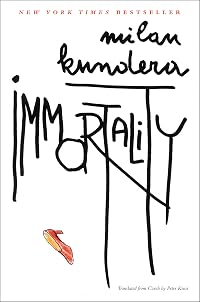
Immortality (Perennial Classics)
by Milan Kundera
On This Page
Description
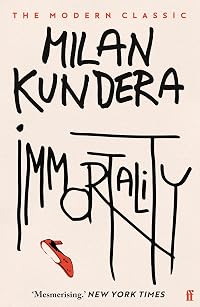
"Milan Kundera's sixth novel springs from a casual gesture of a woman to her swimming instructor, a gesture that creates a character in the mind of a writer named Kundera. Like Flaubert's Emma or Tolstoy's Anna, Kundera's Agnes becomes an object of fascination, of indefinable longing. From that character springs a novel, a gesture of the imagination that both embodies and articulates Milan Kundera's supreme mastery of the novel and its purpose: to thoroughly explore the great themes of show more existence. A work in seven parts, Immortality involves four contemporary characters-- Agnes, her husband Paul, her sister Laura, and the sad hedonist Rubens-- as well as the curious historic couple of Goethe and Bettina von Arnim. Through these characters, Kundera reflects with powerful insight on modern life and Western society. But, as always with Kundera, the true theme of the novel is elsewhere; his subject is existential and metaphysical. The cult of sentimentality, its role in our lives and in the history of the West, and the conflict between the individual and his image: here, in an unforgettable scene, we encounter our own Hemingway in heaven with Goethe, discussing the sorrows of immortality, the powerlessness of man before an image of himself over which he has no control. Immortality, intelligent, original, funny, and entirely captivating, is a major novel by one of the most acclaimed writers of our time." -- show lessTags
Recommendations



























Member Reviews
It starts off beautifully. The narrator is poolside, watching an older woman make a playful, girlish, and even flirty gesture to her swim instructor as she is leaving. Watching her act so young, so unaware of her actual age prompts the narrator to ponder ageism and what it would mean to be truly ageless. From there the novel meanders through fact and fiction, weaving real historical figures like Goethe and Hemingway with fictional ones like the woman from the pool, Agnes. Kundera's writing breaks boundaries because the style is a conversation with the reader, a philosophical journey through topics like relationships, sex and of course, immortality.
The author is sitting by the pool of his health club when he sees a woman make a gesture that brings on a flood of speculations about her life. Mixed in with these fantasies are anecdotes that may or may not be true about the lives of Goethe, Hemingway, Rimbaud, Rubens, Beethoven, and other famous artists. Along the way, Kundera attempts to deconstruct the novel as an art form.
This book really requires a lot of concentration and thought, and I just didn’t have it in me to put the necessary amount of work into reading it. I appreciate what Kundera was trying to do with deconstructing the novel, but I didn’t enjoy it. I also disagree with a lot of what his characters said about the nature of life and humanity, so it was difficult to show more empathize with them. show less
This book really requires a lot of concentration and thought, and I just didn’t have it in me to put the necessary amount of work into reading it. I appreciate what Kundera was trying to do with deconstructing the novel, but I didn’t enjoy it. I also disagree with a lot of what his characters said about the nature of life and humanity, so it was difficult to show more empathize with them. show less
While The Unbearable Lightness of Being is my favorite of Kundera's novels, Immortality is clearly the superior work. Here Kundera shies away from the political preoccupations that figure so heavily into his earlier works and magically weaves together so many disparate characters (his primary fictional set, the author himself, and various historical personalities) and situations (Goethe and Hemingway's discussion of their views of immortality is priceless!) into a cohesive narrative so that the result is positively dizzying and profoundly rewarding. Immortality is replete with Kundera's usual clever observations as well as his offbeat, wry humor (not the first thing that comes to mind when discussing this author!). Immortality is best show more appreciated once a reader has a couple of other Kundera works under his belt. show less
This is the third Kundera book I've read. I'd recommend The Unbearable Lightness of Being before either this or Forever Waltz. There are many characters in this book, including Kundera himself, and sometimes the narrative is lost. This is something that makes the book interesting, and threatens it strength. In a line when Kundera is speaking as himself he says that if even one sentence is missed one will not understand the book, and recognizes that he himself never reads every line of a book, and so his book will never be understood. This line is toward the second half and you wonder, "what, wait?"
There are many great passages, beautiful images, deep thoughts, tricky plays in this book. If only its continuity wasn't disrupted so often.
There are many great passages, beautiful images, deep thoughts, tricky plays in this book. If only its continuity wasn't disrupted so often.
Whatever I did not like in the "Unbearable Lightness of Being" was developed here; whatever I liked in the mentioned book "Immortality" explained away, severed its connection with Kundera, his form and his content. To a person who wants to read Kundera and wants my opinion (which is a contradiction as it is) I would advice not to touch this book.
I had more objections to Kundera's style, narrative technique, presentation and subject, but, fortunately, I have happily forgotten most of it.
I had more objections to Kundera's style, narrative technique, presentation and subject, but, fortunately, I have happily forgotten most of it.
I loved this book's fictional-documentary-philosophical style, as well as Kundera's writing.
Kundera's second strongest book after ULofB, this is a natural follow-up to those under the spell of Kundera.
Members
- Recently Added By
Lists

20th Century Literature
1,161 works; 55 members

1990s
309 works; 17 members

Experimental Literature
141 works; 19 members

A Novel Cure
742 works; 23 members

Paris, City of Lights
103 works; 17 members

Books Set in Rome
98 works; 2 members
Author Information

53+ Works 61,414 Members
One of the foremost contemporary Czech writers, Kundera is a novelist, poet, and playwright. His play The Keeper of the Keys, produced in Czechoslovakia in 1962, has long been performed in a dozen countries. His first novel, The Joke (1967), is a biting satire on the political atmosphere in Czechoslovakia in the 1950s. It tells the story of a show more young Communist whose life is ruined because of a minor indiscretion: writing a postcard to his girlfriend in which he mocks her political fervor.The Joke has been translated into a dozen languages and was made into a film, which Kundera wrote and directed. His novel Life Is Elsewhere won the 1973 Prix de Medicis for the best foreign novel. Kundera has been living in France since 1975. His books, for a long time suppressed in his native country, are once again published.The Unbearable Lightness of Being (1984), won him international fame and was a successful English-language film. In this work Kundera moves toward more universal and philosophically tinged themes, thus transforming himself from a political dissident into a writer of international significance. (Bowker Author Biography) show less
Classifications
- Genres
- Fiction and Literature, General Fiction
- DDC/MDS
- 891.8635 — Literature & rhetoric Literatures of other languages East Indo-European and Celtic literatures West and South Slavic languages (Bulgarian, Slovene, Polish, Czech, Slovak, Serbo-Croatian, and Macedonian) Czech Czech fiction 1900–1989
- LCC
- PG5039.21 .U6 — Language and Literature Slavic languages and literatures. Baltic languages. Albanian language Slavic. Baltic. Albanian Slavic Czech
- BISAC
Statistics
- Members
- 1,170
- Popularity
- 21,454
- Reviews
- 9
- Rating
- (4.06)
- Languages
- English
- Media
- Paper
- ISBNs
- 1