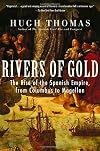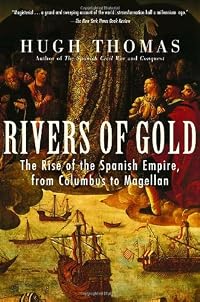
Rivers of Gold: The Rise of the Spanish Empire, from Columbus to Magellan
by Hugh Thomas
The Spanish Empire (1)
On This Page
Description
A history of Spain's first thirty years in the Americas traces Columbus's pioneering voyage through Magellan's first circumnavigation of the earth.Tags
Recommendations



Member Reviews
This isn't so much the story of the Conquistadors themselves (although they play a large part) as of the political and social background to Spanish ventures into the New World between 1492 and 1522, i.e. from Columbus to Magellan. How did Spain get from giving an eccentric foreigner minimal sponsorship to go and look for China in the wrong direction to, barely a generation later, funding a much more serious foreigner to go and look for a way around the southern end of that "new" continent whose existence Columbus never accepted...? And perhaps more to the point, how did they manage to exercise any kind of control over what people were doing in the name of Spain on the other side of the Atlantic.
There are a lot more thrilling tales of show more document-drafting in back-rooms of Castilian monasteries than there are of shipwrecks or of men in armour marching thorough tropical rain-forests, but it's by no means dry and stodgy. It soon becomes clear that it was decisions taken in those thirty years that shaped the way South America and the Caribbean would develop, and led unintentionally or not to the wiping-out of the indigenous people of the Caribbean and the start of the transatlantic slave-trade. You can see Thomas finally losing patience with Bartolomé de las Casas, whose well-intentioned but flagrantly inaccurate reporting must be an irritation to all historians, at the moment when he suggests that the best way to protect the indigenous people would be to permit the import of black slaves from Africa. Somehow the alternative strategy, of restricting migration from Spain to people whose social status doesn't make it impossible for them to do manual work, never seems to have been considered seriously by anyone.
Very interesting, and certainly a good book to read before a visit to Seville... show less
There are a lot more thrilling tales of show more document-drafting in back-rooms of Castilian monasteries than there are of shipwrecks or of men in armour marching thorough tropical rain-forests, but it's by no means dry and stodgy. It soon becomes clear that it was decisions taken in those thirty years that shaped the way South America and the Caribbean would develop, and led unintentionally or not to the wiping-out of the indigenous people of the Caribbean and the start of the transatlantic slave-trade. You can see Thomas finally losing patience with Bartolomé de las Casas, whose well-intentioned but flagrantly inaccurate reporting must be an irritation to all historians, at the moment when he suggests that the best way to protect the indigenous people would be to permit the import of black slaves from Africa. Somehow the alternative strategy, of restricting migration from Spain to people whose social status doesn't make it impossible for them to do manual work, never seems to have been considered seriously by anyone.
Very interesting, and certainly a good book to read before a visit to Seville... show less
Hugh Thomas has come through again! The Spanish Empire was not only a romantic idea, but an organization, and an enterprise which involved a relatively few people in the continental Spanish structure. Leading the reader through a sometimes confusing welter of religious, familial, and economic interactions, this is a very helpful companion to Samuel Eliot Morison's treatment of the nuts and bolts of oceanic exploration in the late fifteenth and early sixteenth centuries. The thorough man requires both, and the rewards of absorbing the two strands are tremendous.
sadly, the mapping is relatively poor, but the genealogical charts are just the thing to base even deeper reading on. Do start here, and the the second volume, about the Empire show more after the 1520's. show less
sadly, the mapping is relatively poor, but the genealogical charts are just the thing to base even deeper reading on. Do start here, and the the second volume, about the Empire show more after the 1520's. show less
In an age when the historical trend has been to focus on the suffering of the Indians rather than the adventures of the Spanish, Hugh Thomas has written a massive tome detailing the lives and accomplishments of the people who created the Spanish empire in the Americas.
Although Thomas recognizes the frequent butality of the Spanish in their persistant exploitation of the Inidians, he is simply not that interested. The following typical quote describes the conquest of Cuba, "As elsewhere in the Americas, bows and arrows and stones flung by slings were no match for Spanish weapons, including ... those long steel swords that even now cause a shiver of anxiety when we see them in military museums. How curious to imagine all these knights show more from Cuéllar, and other cities of Old Castile, riding across the beautiful tropical island. Unfortunately, the only real source for the feelings of the conquistadores is the history of Las Casas, who had his own priorities when he came to write his book." Aparently Thomas would have prefered Las Casas to have revelled in the imagined chivalry of the Spanish instead of protesting their abuse of the Indians.
But in the end, Thomas doesn't produce a very good adventure story either. In hewing close to the (extremely well researched) documents, Thomas primarily gives us endless lists of the Spanish and other travelers to the New World, with frequent mini-biographies of even the most minor characters. This wealth of personal background is a poor substitute for historical context. As an example, Thomas seems to be at pains to note each and every Spainiard with Jewish heratige (conversos) and yet he never tells us why he thinks this is important (barring a rather disconected summary of the inquisition early in the book).
But perhaps my greatest disapointment was the lack of institutional history. Thomas offers us very little understanding of how the Spanish managed their precarious empire. An encomienda in theory is different from one in practice, especially in these new colonies. This was a crucial time when the Spanish developed the institutions of power that would mold the Americas for centuries, but Thomas tells us little of this.
Also missing is an analysis of the impact of the new empire on the home country. The fantastic flow of wealth and power into Europe begun in the Spanish Empire arguably initiated the transformations that would propel Europe to dominate the world for centuries to come.
I had hoped that these were the "Rivers of Gold" of the title. But for Thomas the most important "Rivers of Gold" were those found in Balboa's 1513 letter to the crown describing the Darien (the modern border between Panama and Colombia). There was little gold in the Darien, but fabrications or no, Balboa's "Rivers of Gold" inspired the Spanish to daring deeds across a vast ocean.
Perhaps Thomas would have been better off writing a novel; for a history of the Spanish Empire, look elsewhere. show less
Although Thomas recognizes the frequent butality of the Spanish in their persistant exploitation of the Inidians, he is simply not that interested. The following typical quote describes the conquest of Cuba, "As elsewhere in the Americas, bows and arrows and stones flung by slings were no match for Spanish weapons, including ... those long steel swords that even now cause a shiver of anxiety when we see them in military museums. How curious to imagine all these knights show more from Cuéllar, and other cities of Old Castile, riding across the beautiful tropical island. Unfortunately, the only real source for the feelings of the conquistadores is the history of Las Casas, who had his own priorities when he came to write his book." Aparently Thomas would have prefered Las Casas to have revelled in the imagined chivalry of the Spanish instead of protesting their abuse of the Indians.
But in the end, Thomas doesn't produce a very good adventure story either. In hewing close to the (extremely well researched) documents, Thomas primarily gives us endless lists of the Spanish and other travelers to the New World, with frequent mini-biographies of even the most minor characters. This wealth of personal background is a poor substitute for historical context. As an example, Thomas seems to be at pains to note each and every Spainiard with Jewish heratige (conversos) and yet he never tells us why he thinks this is important (barring a rather disconected summary of the inquisition early in the book).
But perhaps my greatest disapointment was the lack of institutional history. Thomas offers us very little understanding of how the Spanish managed their precarious empire. An encomienda in theory is different from one in practice, especially in these new colonies. This was a crucial time when the Spanish developed the institutions of power that would mold the Americas for centuries, but Thomas tells us little of this.
Also missing is an analysis of the impact of the new empire on the home country. The fantastic flow of wealth and power into Europe begun in the Spanish Empire arguably initiated the transformations that would propel Europe to dominate the world for centuries to come.
I had hoped that these were the "Rivers of Gold" of the title. But for Thomas the most important "Rivers of Gold" were those found in Balboa's 1513 letter to the crown describing the Darien (the modern border between Panama and Colombia). There was little gold in the Darien, but fabrications or no, Balboa's "Rivers of Gold" inspired the Spanish to daring deeds across a vast ocean.
Perhaps Thomas would have been better off writing a novel; for a history of the Spanish Empire, look elsewhere. show less
An enormous history of the 16th-century Spanish conquest and rise to global dominance; Spain profited greatly from this period of exploration, both by growing its empire and raising European consciousness of the future Americas. A remarkable account, masterfully narrated by a distinguished historian.
3921. Rivers of Gold The Rise of the Spanish Empire, from Columbus to Magellan, by Hugh Thomas (read 16 Aug 2004) This is not "popular" history, has oodles of footnotes (84 pages of them), and a 23 page bibliography. It is full of detail, much of which really doesn't tell a story but sets a scene. Thomas' attitude to Columbus is not bad--he is not of the denigrating school devilizing Columbus--and he tends to question those who say how terrible the Spanish descent into the Caribbean was. He tells the story of Spain in the Caribbean and in Mexico in much detail, and some of it was of interest, especially his account of Father Bartolme de Las Casas' efforts to have Indians treated decently. This book had too little drama in it, and I have show more to admit it was not nearly as interesting as I had hoped it would be. show less
El Imperio Español fue una de las más grandes creaciones políticas europeas. Fue concebido a principios del siglo XVI como una obra maestra renacentista construida por conquistadores como Pizarro y Cortés y modelada por administradores de gran talento como Antonio de Mendoza en México y Francisco de Toledo en Perú. El Imperio Español perduró trescientos años en la América continental y casi otros setenta en el Caribe y Filipinas. Hugh Thomas, con el estilo serio a la par que ameno que le ha granjeado tantos lectores en nuestro país, emprende un estudio completo de la génesis de este Imperio, mostrándonos como nunca hasta ahora las vidas y las hazañas de las dos primeras generaciones de exploradores, colonizadores, show more gobernadores y misioneros que abrieron el camino al enorme imperio americano de España. Desde la caída de Granada al viaje de Magallanes, pasando por el descubrimiento de Colón o la coronación de Carlos V, Hugh Thomas se embarca en una narración épica de una de las más grandes aventuras de la humanidad. show less
Jan 5, 2023Spanish
Sinopsis:
Esta obra narra una historia irrepetible en el devenir de la humanidad: los treinta años extraordinarios en que un puñado de hombres conquistaron un nuevo mundo, convirtiendo a España en el primer imperio moderno. Por las páginas de este fascinante libro desfilan personajes y acontecimientos transcendentales para comprender nuestro pasado.
Esta obra narra una historia irrepetible en el devenir de la humanidad: los treinta años extraordinarios en que un puñado de hombres conquistaron un nuevo mundo, convirtiendo a España en el primer imperio moderno. Por las páginas de este fascinante libro desfilan personajes y acontecimientos transcendentales para comprender nuestro pasado.
Sep 19, 2014 (Edited)Spanish
Members
- Recently Added By
Lists

Renacimiento
24 works; 1 member
Author Information

51+ Works 4,986 Members
Hugh Swynnerton Thomas was born in Windsor, England on October 21, 1931. After studying history at Cambridge University, he worked at the British Foreign Office and was secretary to the British delegation at major disarmament talks. He lectured at the Royal Military Academy in Sandhurst, Britain's premier officer training establishment. From 1979 show more to 1990, he served as the chairman of the Center for Policy Studies, a right-wing policy institute. He was an unofficial adviser to Margaret Thatcher during the Falklands war against Argentina, enlisted because of his deep knowledge of South America. He wrote numerous fiction and nonfiction works. His novels included The World's Game, The Oxygen Age, and Klara. His nonfiction books included Cuba: The Pursuit of Freedom, A History of the World, Rivers of Gold, The Golden Empire, and World Without End. The Spanish Civil War won the Somerset Maugham Prize in 1962. He was made a life peer in 1981 as Baron Thomas of Swynnerton. He died after having a stroke on May 7, 2017 at the age of 85. (Bowker Author Biography) show less
Some Editions
Series

Common Knowledge
- Canonical title*
- El Imperio español : de Colón a Magallanes
- Original title
- Empire: How Spain Became a World Power, 1492-1763
- People/Characters
- Ferdinand II of Aragon; Isabella I, Queen of Castile and León; Christopher Columbus; Juan Ponce de León; Ferdinand Magellan
- Important places
- Spain
- Important events
- Conquest of Latin America
- Original language*
- Inglés
*Some information comes from Common Knowledge in other languages. Click "Edit" for more information.
Classifications
- Genres
- History, Nonfiction, General Nonfiction, Religion & Spirituality
- DDC/MDS
- 980.01 — History & geography History of South America History of South America History of South America Early history to 1806
- LCC
- E123 .T56 — History of the United States America Discovery of America and early explorations Post-Columbian period. El Dorado
- BISAC
Statistics
- Members
- 639
- Popularity
- 45,159
- Reviews
- 8
- Rating
- (3.62)
- Languages
- English, Italian, Spanish, Swedish
- Media
- Paper, Audiobook, Ebook
- ISBNs
- 17
- ASINs
- 4