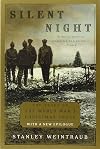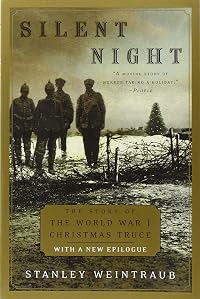
Silent Night: The Story of the World War I Christmas Truce
by Stanley Weintraub
On This Page
Description
From an acclaimed historian and National Book Award finalist comes the poignant story of World War I's 1914 Christmas truce, the spontaneous and tantalizingly brief moment when mortal enemies came together as friends. Photos. Illustrations. It was one of history's most powerful, yet forgotten- Christmas stories. It took place in the improbable setting of the mud, cold rain and senseless killing of the trenches of World War I. It happened in spite of orders to the contrary by superiors; it show more happened in spite of language barriers. And it still stands as the only time in history that peace spontaneously arose from the lower ranks in a major conflict, bubbling up to the officers and temporarily turning sworn enemies into friends. Silent Night, by renowned military historian Stanley Weintraub, magically restores the 1914 Christmas truce to history. It had been lost in the tide of horror that filled the battlefields of Europe for months and years afterward. Yet in December 1914 the great war was still young, and the men who suddenly threw down their arms and came together across the front lines, to sing carols, exchange gifts and letters, eat and drink and even play friendly games of soccer, naively hoped that the war would be short-lived, and that they were fraternizing with future friends. It began when German soldiers lit candles on small Christmas trees, and British, French, Belgian and German troops serenaded each other on Christmas Eve. Soon they were gathering and burying the dead, in an age-old custom of truces. But as the power of Christmas grew among them, they broke bread, exchanged addresses and letters and expressed deep admiration for one another. When angry superiors ordered them to recommence the shooting, many men aimed harmlessly high overhead. Sometimes the greatest beauty emerges from deep tragedy. Surely the forgotten Christmas truce was one of history's most beautiful moments, made all the more beautiful in light of the carnage that followed it. Stanley Weintraub's moving re-creation demonstrates that peace can be more fragile than war, but also that ordinary men can bond with one another despite all efforts of politicians and generals to the contrary. show lessTags
Recommendations







Member Reviews
I picked up Stanley Weintraub's brief account of the 1914 Christmas truce after setting it down without completing it a couple of years ago. It is a good account of this odd anomaly of the Great War. Weintraub does a fine job of setting the scene: soldiers a settling down into their trenches, replete with the discomfort of the wet winter weather, the rats, bad food, and the nearness of the enemy lines divided by a No Man's Land littered with bodies-friends and foes alike. He contrasts this with the incongruities of the Christmas season-British and German soldiers alike receive government-sponsored goodies from home, which, while appreciated, do little to alleviate the suffering of those in the trenches-they don't drain the trenches, show more some waist high in mud, they don't reduce the danger from sniper's bullets or artillery shells.
That is left to the men themselves. From December 24th through December 26th, chiefly German and British soldiers informally agree to a lull in the fighting, first to bury their dead, and then to trade petty luxuries, souvenirs, trade pleasantries, and even to kick around a football. What the governments and generals will not do, the front line troops do themselves. Weintraub, importantly, points out that the truce wasn't universal, but many, many units in the trenches sent home accounts of the several days of quiet and fraternization.
If the book has a failing it is not fully exploring the fear of the governments and the generals that the truce could lead to an outbreak of peace-and what they did to insure it did not happen again.
Well told, with an eye to humanize an inhuman conflict. A special nod goes to Weintraub's use of English, German and French source. show less
That is left to the men themselves. From December 24th through December 26th, chiefly German and British soldiers informally agree to a lull in the fighting, first to bury their dead, and then to trade petty luxuries, souvenirs, trade pleasantries, and even to kick around a football. What the governments and generals will not do, the front line troops do themselves. Weintraub, importantly, points out that the truce wasn't universal, but many, many units in the trenches sent home accounts of the several days of quiet and fraternization.
If the book has a failing it is not fully exploring the fear of the governments and the generals that the truce could lead to an outbreak of peace-and what they did to insure it did not happen again.
Well told, with an eye to humanize an inhuman conflict. A special nod goes to Weintraub's use of English, German and French source. show less
This account of the spontaneous World War I Christmas truce is mildly disappointing. Had I not read other World War I histories earlier this year, I wouldn't have had enough context for the events described in the book. It also bothered me that Weintraub intersperses accounts of fictional characters with those of real people. I had a hard time sorting out which events were real and which were fictional but based on real events. I think it would have been better if Weintraub had discussed fictional accounts of the truce in a single chapter. The book is worth reading for those with a strong interest in the topic, but readers should already have a basic familiarity with World War I history and chronology.
The Christmas truce of WWI has gained fame through movies and historical fiction but how does one separate truth from fiction? This is a wonderful work based on research of journals and letters written by the soldiers and officers who were there when it happened.
Only a few months into the First World War, troops from Scotland, India, Germany, France, Prussia, England and Belgium on the rain soaked battlefields of Flanders were already sick of the soggy, cold and muddy conditions of war. They were in the front line and under constant fire from, their trenches were constantly flooding, they had nowhere dry to sleep, rats were running around, they were surrounded by filth and now dead bodies of their fallen comrades.
By tacit understanding show more and overtures started apparently by the Germans who took Christmas extremely seriously and were shipped little Christmas trees which they lit with candles and then placed on their parapets, there was less fighting in the days coming up to Christmas Eve. Some soldiers clearly started to adopt a live and let live attitude to the war, trading vocal insults with the opposite enemy but without much heat behind their words. Then signboards with Christmas greetings went up and responded to by the opposite side. Some soldiers and officers gradually stood on their parapets, clearly unarmed, and asked for a truce to celebrate Christmas Eve and Christmas Day. They understood that the war would have to resume at some point, but they just wanted to celebrate Christmas and to bury their dead.
I had previously thought that the Christmas Truce took place only between a particular German troop and an opposing English platoon. It came as a surprise to me to learn that this truce was conducted across multiple sections of the Flanders and between the Germans and some of their enemies even up to New Year's. Not all embraced the truce and there were a few French and German officers who spurned overtures.
The emerging stories highlighted that decisions for wars are often decided on by leaders sitting far away from the action while those on the front line bear the worst consequences of their decisions. show less
Only a few months into the First World War, troops from Scotland, India, Germany, France, Prussia, England and Belgium on the rain soaked battlefields of Flanders were already sick of the soggy, cold and muddy conditions of war. They were in the front line and under constant fire from, their trenches were constantly flooding, they had nowhere dry to sleep, rats were running around, they were surrounded by filth and now dead bodies of their fallen comrades.
By tacit understanding show more and overtures started apparently by the Germans who took Christmas extremely seriously and were shipped little Christmas trees which they lit with candles and then placed on their parapets, there was less fighting in the days coming up to Christmas Eve. Some soldiers clearly started to adopt a live and let live attitude to the war, trading vocal insults with the opposite enemy but without much heat behind their words. Then signboards with Christmas greetings went up and responded to by the opposite side. Some soldiers and officers gradually stood on their parapets, clearly unarmed, and asked for a truce to celebrate Christmas Eve and Christmas Day. They understood that the war would have to resume at some point, but they just wanted to celebrate Christmas and to bury their dead.
I had previously thought that the Christmas Truce took place only between a particular German troop and an opposing English platoon. It came as a surprise to me to learn that this truce was conducted across multiple sections of the Flanders and between the Germans and some of their enemies even up to New Year's. Not all embraced the truce and there were a few French and German officers who spurned overtures.
The emerging stories highlighted that decisions for wars are often decided on by leaders sitting far away from the action while those on the front line bear the worst consequences of their decisions. show less
I've been fascinated with the Xmas Truce since I first heard the Carol. I had heard some rumblings that it was entirely fictitious and did not actually happen and I've heard counterarguments on the other side of the debate. This was the first history book I read on the topic. I actually enjoyed it much more than the Audible full cast production of Christmas 1914. It was a little confusing for a non-ww1 buff to keep the different encampments and locations separate. I particularly enjoyed the what-if scenarios at the end of the book.
During World War I, German, French, British and Belgian soldiers found solace in the “enemy” for a brief period. On Christmas Eve in 1914 the men were dug into miserable trenches, up to their ankles in mud and filth. Despite warnings from their superiors and even at the risk of losing their own lives, the soldiers declared a momentary truce and enjoyed the holiday.
They crossed into no man’s land and swapped cigarettes and food. They ever played soccer and buried their dead. This occurred all along the front, with different groups of men deciding to initiate a cease-fire.
Weintaub’s book is wonderfully researched, pulling information from soldiers’ letters, newspaper articles, etc. he recreates the scenes. The details are what show more really stuck with me, a German soldier giving a British soldier buttons from his uniform, a soldier who was accidently shot in the midst of the peace. The event itself is so unbelievable that’s it’s fascinating to read about, but the author’s writing is a bit dry. To me, it was still worth it, because it shows a gleaming light of humanity in the face of an awful war, but it’s not a page-turner. show less
They crossed into no man’s land and swapped cigarettes and food. They ever played soccer and buried their dead. This occurred all along the front, with different groups of men deciding to initiate a cease-fire.
Weintaub’s book is wonderfully researched, pulling information from soldiers’ letters, newspaper articles, etc. he recreates the scenes. The details are what show more really stuck with me, a German soldier giving a British soldier buttons from his uniform, a soldier who was accidently shot in the midst of the peace. The event itself is so unbelievable that’s it’s fascinating to read about, but the author’s writing is a bit dry. To me, it was still worth it, because it shows a gleaming light of humanity in the face of an awful war, but it’s not a page-turner. show less
Fascinating account of the Christmas truce in 1914 during the First World War. 'Each side had encountered men much like themselves, drawn from the same walks of life - and led, alas, by professionals who saw the world through different lenses.'
Really interesting subject, but the book misses the mark.
The book is a series of anecdotes, which, although related under the big umbrella "Christmas Truce of 1914," still manages to feel quite disconnected.
The narrative pushes both forward and backward in the time line, which is confusing at times.
I'll keep looking for a better book on this subject.
More reviews at my WordPress site, Ralphsbooks.
The book is a series of anecdotes, which, although related under the big umbrella "Christmas Truce of 1914," still manages to feel quite disconnected.
The narrative pushes both forward and backward in the time line, which is confusing at times.
I'll keep looking for a better book on this subject.
More reviews at my WordPress site, Ralphsbooks.
Members
- Recently Added By
Lists

Stories of War and Revolution
143 works; 54 members

Christmas Books
370 works; 40 members
Author Information

62+ Works 3,784 Members
Stanley Weintraub is Evan Pugh Professor Emeritus of Arts & Humanities at Pennsylvania State University. He has written acclaimed works of military history on World Wars I & II. He lives in Boalsburg, Pennsylvania. (Publisher Provided) Stanley Weintraub was born in Philadelphia, Pennsylvania on April 17, 1929. He received a B.S. in education from show more West Chester State Teachers College in 1949 and a M. A. in English from Temple University. He served in the Army during the Korean Conflict where he was awarded the Bronze Star and the Korean Ribbon with five battle stars. Upon his return, he received a Ph.D. from Pennsylvania State University where he went on to teach until his retirement. He wrote over 40 books during his lifetime including Private and Public Shaw: A Dual Portrait of Lawrence of Arabia and George Bernard Shaw, Beardsley: A Biography, 11 Days in December, Silent Night: The Story of the World War I Christmas Truce, MacArthur's War, Long Day's Journey into War, and A Stillness Heard Round the World: The End of the Great War. He received the George Freedley Award in 1971 for Journey to Heartbreak: The Crucible Years of Bernard Shaw, 1914-1918 and the Freedom Foundation Award in 1980 for The London Yankees: Portraits of American Writers and Artists in London, 1894-1914. (Bowker Author Biography) show less
Common Knowledge
- Original title
- Silent night : The Story of the World War I Christmas Truce
- Original publication date
- 2002-11
- Important events
- World War I (1914-1918); World War I, Christmas Truce
Classifications
Statistics
- Members
- 798
- Popularity
- 34,876
- Reviews
- 19
- Rating
- (3.45)
- Languages
- English, Swedish
- Media
- Paper, Audiobook, Ebook
- ISBNs
- 15
- ASINs
- 4