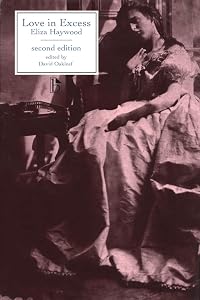
Love in Excess
by Eliza Haywood
On This Page
Description
Eliza Haywood (1693-1756) was one of the most successful writers of her time; indeed, the two most popular English novels in the early eighteenth-century were Robinson Crusoeand Haywood's first novel, Love in Excess. As this edition enables modern readers to discover, its enormous success is easy to understand. Love in Excessis a well crafted novel in which the claims of love and ambition are pursued through multiple storylines until the heroine engineers a melodramatic conclusion. Haywood's show more frankness about female sexuality may explain the later neglect of Love in Excess. (In contrast, her accomplished domestic novel, The History of Miss Betsy Thoughtless, has remained available.) Love in Excessand its reception provide a lively and valuable record of the challenge that female desire posed to social decorum. For the second Broadview edition, the appendix of eighteenth-century responses to Haywood has been considerably expanded. show lessTags
Recommendations
















Member Reviews
I never got to write a proper review about this book, and I still don't really have the time, but let me try: Love in Excess is delightful. It took a while to get through, seeing as it was published in 1719, but it was the most fun "historical" and "classic" books I've ever read.
If you need any other proof that 18th-century mass culture was bawdy, fun, and downright frivolous compared to their Victorian descendants, this is the text for you. It's camp really--Here we have bodice-ripping, disguised identities, fatal love triangles, and every and other ribald and ridiculous scenario you can basically think off. Modern day romance novels have much to owe to Haywood, and seeing the seeds of such a lusty genre was worth the page-long show more paragraphs that truly tested me at times. I laughed a lot, groaned a lot, rolled my eyes a lot, and yet still kept turning the pages to see what would happen. I loved it.
Thank you Ms. Haywood, you wrote a gem. show less
If you need any other proof that 18th-century mass culture was bawdy, fun, and downright frivolous compared to their Victorian descendants, this is the text for you. It's camp really--Here we have bodice-ripping, disguised identities, fatal love triangles, and every and other ribald and ridiculous scenario you can basically think off. Modern day romance novels have much to owe to Haywood, and seeing the seeds of such a lusty genre was worth the page-long show more paragraphs that truly tested me at times. I laughed a lot, groaned a lot, rolled my eyes a lot, and yet still kept turning the pages to see what would happen. I loved it.
Thank you Ms. Haywood, you wrote a gem. show less
‘God! With what an air he walked! What new attractions dwelt in every motion – And when he returned the salutes of any that passed by him, how graceful was his bow! How lofty his mien, and yet, how affable! A sort of an inexpressible awful grandeur, blended with tender languishments, strikes the amazed beholder at once with fear and joy! Something beyond humanity shines around him! Such looks descending angels wear, when sent on heavenly embassies to some favourite mortal! Such is their form! Such radiant beams they dart; and with such smiles they temper their divinity with softness! Oh! With what pain did I restrain myself from flying to him! From rushing into his arms! From hanging on his neck, and wildly uttering all the furious show more wishes of my burning soul – I trembled – panted – raged with inward agonies.’
That is the effect Count D’Elmont – basically a eighteenth century Spencer from Made in Chelsea - has on just one woman in this lively novel about female desire, love and its consequences. He marries for ambition and the plot is the slow revealing to him of what really matters; loving a woman without a care for her fortune or position – although clearly it helps him if she is an exquisite beauty. Of the women who are his victims, each has a story to tell from the proud beauty Alovysa, foolish, deluded Amena and the virtuous but tempted Melliora. The comic, interfering female role is played by the intriguing Melantha who does not get her just desserts (hurray). ‘Melantha who was not of a humour to take anything to heart, was married in a short time, and had the good fortune not to be suspected by her husband, though she brought him a child in seven months after her wedding.’
Disgraces, cast-off daughters, duels to the death, kidnapped beauties and convents all feature in this exciting work. Haywood’s is a witty, entertaining pen writing stories that eighteenth-century young ladies must have sighed over – especially the dénouement when d’Elmont is alone in bed and his love comes to wake him and tell him her story. ‘Forgetting all decorum, he flew out of the bed, catched her in his arms, and almost stifled her with kisses; which she returning with pretty near an equal eagerness, ‘you will not chide me from me now?’ she cried. show less
That is the effect Count D’Elmont – basically a eighteenth century Spencer from Made in Chelsea - has on just one woman in this lively novel about female desire, love and its consequences. He marries for ambition and the plot is the slow revealing to him of what really matters; loving a woman without a care for her fortune or position – although clearly it helps him if she is an exquisite beauty. Of the women who are his victims, each has a story to tell from the proud beauty Alovysa, foolish, deluded Amena and the virtuous but tempted Melliora. The comic, interfering female role is played by the intriguing Melantha who does not get her just desserts (hurray). ‘Melantha who was not of a humour to take anything to heart, was married in a short time, and had the good fortune not to be suspected by her husband, though she brought him a child in seven months after her wedding.’
Disgraces, cast-off daughters, duels to the death, kidnapped beauties and convents all feature in this exciting work. Haywood’s is a witty, entertaining pen writing stories that eighteenth-century young ladies must have sighed over – especially the dénouement when d’Elmont is alone in bed and his love comes to wake him and tell him her story. ‘Forgetting all decorum, he flew out of the bed, catched her in his arms, and almost stifled her with kisses; which she returning with pretty near an equal eagerness, ‘you will not chide me from me now?’ she cried. show less
The title of Eliza Haywood’s novel is very apt – the characters all do love to excess, sometimes to annoyance. The double standard is alive and well in her work, though she does have some interesting comments about it. While the tension in the book rarely flags – always something melodramatic going on – there are way too many coincidences for the plot to hold water. Some of the characters suffer from too-good-to-be-true syndrome while some bad characters are a bit flat. But many of her characters actually have, well, “character” and she has an encouragingly wide variety of female characters – not just divided into saints and whores. The “good” characters can be just as concerned with sex as the “bad” characters and show more the latter often come off as more interesting or sympathetic than the former. The writing is certainly overblown at times (for example, some characters are incoherent in their letters in order to express their wild emotions – but seriously, people should be able to control themselves in letters. They can rewrite and take time before sending them off). Perhaps the best way to handle that is to do some skimming over the parts where people go off on love or hate in letters.
The book is divided into three parts and follows the loves and relationships of Count d’Elmont, his various partners and his friends and relations. In the first part, the Count is pursued by the aggressive Alovisa and the genial Amena. His brother falls in love with Alovisa’s sister encounters obstacle in the way to their happiness. In the second, d’Elmont has married Alovisa but falls in love with his ward Melliora. The pair struggles with their attraction while their neighbors attempt to pursue the married couple. In the third part, the Count is in Italy and encounters more mixed-pair lovers and identity confusion while separated from Melliora.
The plot is entertaining enough, though too convoluted with a lot of predictable tropes for the time. However, those are all tolerable problems. The thing that really annoyed me was the repetitive side plot in Part III. In Part I, the Count’s brother describes his romance and in the Part III Frankville takes on that role. The stories are too similar – both make friends, who they take pains to criticize, then describe how they fell in love with the friend’s love/fiancé – love at first sight, especially bathetic in Frankville’s story – and how the former friend turned on them with violence. Really, the author didn’t seem too concerned with keeping the story in the realm of realism, so there was no need for repetition.
Although the Count is the hero and the author takes pains to describe all his good qualities, he is rather annoying. If the author had been a man, I’d think it was some sort of wish-fulfillment character or how the author delusionally saw himself. Pretty much every woman falls in love with d’Elmont, often at first sight or without even talking to him. He makes a marriage of convenience, then starts mistreating his wife when he falls in love with another woman. Alovisa is portrayed as manipulative and overly passionate, and she does some things that he later finds out about which make him angry – but he still comes off as a cad dumping his wife – who he married for her money – for someone else. Also, he’s a hypocrite – really, he’s just going along with the values of the time, but still makes him unlikeable. For example, it was not acceptable for a woman to pursue a man – when some women openly pursue him, he has only scorn for them (though, because he’s so perfect, he doesn’t out and out say it – just thinks it) but when he pursues Amena and Melliora, of course that’s acceptable even though there are several good reasons for him not to. In the case of Amena, he doesn’t love her, puts her in a compromising position, lies openly to her, is indifferent to her when she goes to a convent, but then decides he wants her to come back when he gets mad at Alovisa. Melliora is his true love, at least the author constantly reminds readers of the fact, but he still treats her badly. Of course as a man, married, in a position of authority over her – he’d be sexually harassing her today. But he manages to compounds it. Sneaking into her room at night makes him come off like some Mr. B from Pamela. Also, he keeps talking to his friend the Baron about his relationship with Melliora. In those scenes he comes off like some stereotypical insensitive frat boy high-fiving his frat buddies over date-raping a freshman. At least he’s not too perfect to be true, like some heroes – say in Evelina, where her eventual true love was unbelievably good. But the author’s insistence on his perfection makes this annoying.
The female characters are interesting and, as with another Haywood – The Injured Husband – the bad characters can be more appealing than the good ones. In that book, the hero and heroine were a rather dull lot, redeemed only by a spate of murdering and cross-dressing at the end. The real interest lay with the villainess of the piece, who, along with her servant, was endlessly inventive in designing stratagems to keep adding to her collection of lovers. Alovisa is probably the bad girl of the first two books, but her plots are more high-school bitchery levels, not like the murdering in the third part (because apparently all Italians are prone to it, according to Haywood). She is a bit like the bad Baroness from the Injured Husband – intelligent, attractive, intent on getting what she wants. Unfortunately, she gets what she wants but can’t keep it. After her husband falls in love with Melliora, he starts treating her badly. She does intercept one of his letters to Amena, but to be honest it seemed like an excuse so that he could have a reason to ignore her – having already decided it. She was quite manipulative in sabotaging his relationship to Amena, but he knew about that when he married her. Her despair over losing him does make one reflect on the fact that he knew she loved him, married her, was content for a while, then did a sudden change to coldness. It’s hard to go along with his Melliora infatuation for various reasons mentioned above. So Alovisa does come off like the mistreated wife, he like some cold withholding Victorian husband. She somewhat paradoxically is the one representing duty and fidelity, dull virtues that one would more likely associate with Melliora – she’s the only one of the group of herself, the Count, the Baron, Melantha and Melliora that isn’t trying to break up their marriage.
Melliora is the too-good heroine of the book, but even she is shown to have strong sexual desires. Pretty much every woman demonstrates some sexual passion, a contrast to the strictures of the time which said that a woman shouldn’t show any preference or affection for a man who hadn’t been approved by her family as a suitor. And it’s not just that Melliora is strongly attracted to the Count – after he sneaks in to her bedroom but is interrupted, she prevents him from coming back by blocking the door. He can’t make a repeated attempt. Instead of relief, however, she is actually disappointed. She does show some goody-goody behavior by blaming herself for many of the negative consequences and running off to a convent, but it is clear that she really wants to have sex with d’Elmont and only says no because of social reasons – and that she might have been willing to let that go except for the interruptions. Even the fact that he is married seems less of a deterrent to her than the implications of losing her virginity. In this book, Haywood doesn’t punish her female characters too much for this slipup. One of the sympathetic side characters sleeps with the man she loves but after overcoming a number of obstacles, they end up happily married. Even Melantha, the Baron’s sister, who pursues the Count and has a one-hour stand with him, ends up comfortably married with a husband who doesn’t seem to mind a baby after 7 months. (Her behavior does raise the question – is Melantha a rapist? If a man had done what she did – pretend to be someone else to sleep with a woman – he might be considered one. An incident like that in Georgiana Spencer’s The Sylph – the guy pretty much came off as a rapist). Haywood did have some punishment in the short novel Lasselia, where a woman had an affair with a married man. She was discovered and packed off to a convent, but in the end it seemed like she was happy where she was. Not like, say, Pamela, where though it never happens, the implication is that the main character would be irreparable ruined or The Monk, where after the main female character is raped, she is then murdered, and another pretty, well-connected female character is quickly shoved in the plot to replace her as the love interest for the main non-evil male character (the main male character being the evil rapist monk). But Melliora's situation is Pamela-like in that she and d'Elmont keep getting interrupted. It does give the impression that the central character at least shouldn't be sleeping with anyone, even if it is the man she eventually marries.
So an interesting and entertaining book, but plenty of plot and character problems. Makes good reading when you’ve read too many depressing Communism and Holocaust books. show less
The book is divided into three parts and follows the loves and relationships of Count d’Elmont, his various partners and his friends and relations. In the first part, the Count is pursued by the aggressive Alovisa and the genial Amena. His brother falls in love with Alovisa’s sister encounters obstacle in the way to their happiness. In the second, d’Elmont has married Alovisa but falls in love with his ward Melliora. The pair struggles with their attraction while their neighbors attempt to pursue the married couple. In the third part, the Count is in Italy and encounters more mixed-pair lovers and identity confusion while separated from Melliora.
The plot is entertaining enough, though too convoluted with a lot of predictable tropes for the time. However, those are all tolerable problems. The thing that really annoyed me was the repetitive side plot in Part III. In Part I, the Count’s brother describes his romance and in the Part III Frankville takes on that role. The stories are too similar – both make friends, who they take pains to criticize, then describe how they fell in love with the friend’s love/fiancé – love at first sight, especially bathetic in Frankville’s story – and how the former friend turned on them with violence. Really, the author didn’t seem too concerned with keeping the story in the realm of realism, so there was no need for repetition.
Although the Count is the hero and the author takes pains to describe all his good qualities, he is rather annoying. If the author had been a man, I’d think it was some sort of wish-fulfillment character or how the author delusionally saw himself. Pretty much every woman falls in love with d’Elmont, often at first sight or without even talking to him. He makes a marriage of convenience, then starts mistreating his wife when he falls in love with another woman. Alovisa is portrayed as manipulative and overly passionate, and she does some things that he later finds out about which make him angry – but he still comes off as a cad dumping his wife – who he married for her money – for someone else. Also, he’s a hypocrite – really, he’s just going along with the values of the time, but still makes him unlikeable. For example, it was not acceptable for a woman to pursue a man – when some women openly pursue him, he has only scorn for them (though, because he’s so perfect, he doesn’t out and out say it – just thinks it) but when he pursues Amena and Melliora, of course that’s acceptable even though there are several good reasons for him not to. In the case of Amena, he doesn’t love her, puts her in a compromising position, lies openly to her, is indifferent to her when she goes to a convent, but then decides he wants her to come back when he gets mad at Alovisa. Melliora is his true love, at least the author constantly reminds readers of the fact, but he still treats her badly. Of course as a man, married, in a position of authority over her – he’d be sexually harassing her today. But he manages to compounds it. Sneaking into her room at night makes him come off like some Mr. B from Pamela. Also, he keeps talking to his friend the Baron about his relationship with Melliora. In those scenes he comes off like some stereotypical insensitive frat boy high-fiving his frat buddies over date-raping a freshman. At least he’s not too perfect to be true, like some heroes – say in Evelina, where her eventual true love was unbelievably good. But the author’s insistence on his perfection makes this annoying.
The female characters are interesting and, as with another Haywood – The Injured Husband – the bad characters can be more appealing than the good ones. In that book, the hero and heroine were a rather dull lot, redeemed only by a spate of murdering and cross-dressing at the end. The real interest lay with the villainess of the piece, who, along with her servant, was endlessly inventive in designing stratagems to keep adding to her collection of lovers. Alovisa is probably the bad girl of the first two books, but her plots are more high-school bitchery levels, not like the murdering in the third part (because apparently all Italians are prone to it, according to Haywood). She is a bit like the bad Baroness from the Injured Husband – intelligent, attractive, intent on getting what she wants. Unfortunately, she gets what she wants but can’t keep it. After her husband falls in love with Melliora, he starts treating her badly. She does intercept one of his letters to Amena, but to be honest it seemed like an excuse so that he could have a reason to ignore her – having already decided it. She was quite manipulative in sabotaging his relationship to Amena, but he knew about that when he married her. Her despair over losing him does make one reflect on the fact that he knew she loved him, married her, was content for a while, then did a sudden change to coldness. It’s hard to go along with his Melliora infatuation for various reasons mentioned above. So Alovisa does come off like the mistreated wife, he like some cold withholding Victorian husband. She somewhat paradoxically is the one representing duty and fidelity, dull virtues that one would more likely associate with Melliora – she’s the only one of the group of herself, the Count, the Baron, Melantha and Melliora that isn’t trying to break up their marriage.
Melliora is the too-good heroine of the book, but even she is shown to have strong sexual desires. Pretty much every woman demonstrates some sexual passion, a contrast to the strictures of the time which said that a woman shouldn’t show any preference or affection for a man who hadn’t been approved by her family as a suitor. And it’s not just that Melliora is strongly attracted to the Count – after he sneaks in to her bedroom but is interrupted, she prevents him from coming back by blocking the door. He can’t make a repeated attempt. Instead of relief, however, she is actually disappointed. She does show some goody-goody behavior by blaming herself for many of the negative consequences and running off to a convent, but it is clear that she really wants to have sex with d’Elmont and only says no because of social reasons – and that she might have been willing to let that go except for the interruptions. Even the fact that he is married seems less of a deterrent to her than the implications of losing her virginity. In this book, Haywood doesn’t punish her female characters too much for this slipup. One of the sympathetic side characters sleeps with the man she loves but after overcoming a number of obstacles, they end up happily married. Even Melantha, the Baron’s sister, who pursues the Count and has a one-hour stand with him, ends up comfortably married with a husband who doesn’t seem to mind a baby after 7 months. (Her behavior does raise the question – is Melantha a rapist? If a man had done what she did – pretend to be someone else to sleep with a woman – he might be considered one. An incident like that in Georgiana Spencer’s The Sylph – the guy pretty much came off as a rapist). Haywood did have some punishment in the short novel Lasselia, where a woman had an affair with a married man. She was discovered and packed off to a convent, but in the end it seemed like she was happy where she was. Not like, say, Pamela, where though it never happens, the implication is that the main character would be irreparable ruined or The Monk, where after the main female character is raped, she is then murdered, and another pretty, well-connected female character is quickly shoved in the plot to replace her as the love interest for the main non-evil male character (the main male character being the evil rapist monk). But Melliora's situation is Pamela-like in that she and d'Elmont keep getting interrupted. It does give the impression that the central character at least shouldn't be sleeping with anyone, even if it is the man she eventually marries.
So an interesting and entertaining book, but plenty of plot and character problems. Makes good reading when you’ve read too many depressing Communism and Holocaust books. show less
What a delightful, unique novel! The novel is comprised of three sections, each of which is almost a complete story. In the first part, the protagonist Alovisa falls in love with the charming D'Elmont. As a woman in 18th century Paris, social etiquette forbids her from indicating her interest (until after he proposes!). So Alovisa sends him an anonymous, flirtatious note. At the next ball D'Elmont, meets and begins to court Amena. With the help of devious servants and unfortunate circumstances, eventually D'Elmont is convinced to marry. In the second part, D'Elmont, now married, falls hopelessly in love with a young women of whom he is a legal guardian. His marriage quickly become an unhappy one with a jealous wife maneuvering to show more discover her rival and the husband plotting seduction. Hijinks ensue, resulting in tragedy for all concerned. In the final section, D'Elmont is in Italy, where once again several woman fall madly in love with him and even more unlikely hijinks ensue.
While the plots are operatic in scope and almost laugh-out-loud ridiculous, many of the female characters were developed into something more than stereotyped temptresses and convent girls (although some were caricatures designed to move the convoluted plots forward). For some reason, I expected the novel to be Alovisa's story and so it felt quite disjointed in the reading. The other major drawback is the complete lack of chapters or line-breaks, making it hard to read in short sessions as it is hard to pick up the story line again. Other than those minor complaints, I thoroughly enjoyed this novel. show less
While the plots are operatic in scope and almost laugh-out-loud ridiculous, many of the female characters were developed into something more than stereotyped temptresses and convent girls (although some were caricatures designed to move the convoluted plots forward). For some reason, I expected the novel to be Alovisa's story and so it felt quite disjointed in the reading. The other major drawback is the complete lack of chapters or line-breaks, making it hard to read in short sessions as it is hard to pick up the story line again. Other than those minor complaints, I thoroughly enjoyed this novel. show less
How is this any different from Princess of Cleves? It's just as dull, boring, uninteresting, uncompelling, and dreadful. The only difference is that a few elements were ratcheted up several degrees, such as the note-passing, bodice-ripping, and general, deplorable, ghastly, objectionable whoredom. It's too overt a conceit that women who are frank about their sexuality and desires conveniently drop dead, while those who are chaste get to skate. No fair that D'elmont gets to live happily ever after while leaving ruined lives in his wake. How good looking IS this guy anyway, that so many surrendered themselves to him to the ultimate fault? Ladies, there are other gentlemen available on earth, go find one. Jeez, nobody deserves to have so show more much vaginal pining offered up to him. The book is garbage. show less
Eliza Haywood was a hugely popular novelist contemporary of Daniel Defoe. She was prolific and multi-talented, also working in the theater as both an actress and playwright. This was her first published novel. David Oakleaf, who wrote the Introduction for this edition, describes it as "the first bodice-ripper". I experienced it more as an overwrought soap opera and thought Haywood's familiarity with theater highly evident. She included a number of plot devices familiar from Shakespeare's romantic comedies: pairs of brothers and sisters in love with each other, a female character taking on the role of a male in pursuit of her love, and multiple weddings at the end to wrap everybody up tidily and happily. Oakleaf makes the point that show more Haywood's tale is unusual for its time because of the extent to which female characters are depicted as sexually passionate beings. I highly enjoyed the Introduction, really appreciated having the footnotes at the bottom of the page instead of tucked at the back of the book, and do not envision ever rereading the novel. Interesting experience but not a keeper show less
How is this any different from Princess of Cleves? It's just as dull, boring, uninteresting, uncompelling, and dreadful. The only difference is that a few elements were ratcheted up several degrees, such as the note-passing, bodice-ripping, and general, deplorable, ghastly, objectionable whoredom. It's too overt a conceit that women who are frank about their sexuality and desires conveniently drop dead, while those who are chaste get to skate. No fair that D'elmont gets to live happily ever after while leaving ruined lives in his wake. How good looking IS this guy anyway, that so many surrendered themselves to him to the ultimate fault? Ladies, there are other gentlemen available on earth, go find one. Jeez, nobody deserves to have so show more much vaginal pining offered up to him. The book is garbage. show less
Members
- Recently Added By
Lists

1,001 BYMRBYD Concensus
723 works; 27 members

1710s
2 works; 1 member

1001 Books You Must Read Before You Die
1,448 works; 1,134 members
Author Information

61+ Works 1,220 Members
Some Editions
Awards and Honors
Series
Belongs to Publisher Series
Common Knowledge
- Canonical title
- Love in Excess
- Original publication date
- 1719
- Epigraph
- - in vain from Fate we fly,
For first or last, as all must die,
So 'tis as much decreed above,
That first or last, we all must love. Lansdown - Dedication
- To Mrs Oldfield
- First words
- In the late war between the French and the confederate armies, there were two brothers, who had acquired a more than ordinary reputation under the command of the great and intrepid Luxembourgh.
- Last words
- (Click to show. Warning: May contain spoilers.)Both he and Frankville, are still living, blest with a numerous and hopeful issue, and continue, with their fair wives, great and lovely examples of conjugal affection.
Classifications
Statistics
- Members
- 446
- Popularity
- 68,812
- Reviews
- 8
- Rating
- (3.18)
- Languages
- English
- Media
- Paper, Ebook
- ISBNs
- 12
- ASINs
- 2