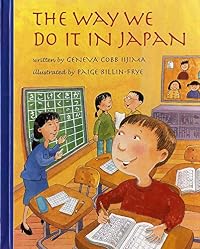
The Way We Do It in Japan
by Geneva Cobb Iijima
On This Page
Description
Gregory experiences a new way of life when he moves to Japan with his American mother and his Japanese father.Tags
Recommendations




Member Reviews
The book, The Way We Do It in Japan, was incredibly interesting to read, especially if you want to learn about Japanese culture. I loved the entire book, but one of my favorite aspects of the book is their use of multi-cultural language. The author added phrases in Japanese throughout the book, along with a pronunciation and the meaning. For example, the author wrote "'Do itashimashite'** replied his dad. **(you're welcome): doh ee-tahsh-ee-ma-she-te" Upon reading this, I could now add a new Japanese phrase to my knowledge of different phrases. Even a simple phrase like this could make students feel connected to possible Japanese students in their classroom. Another example was, "Dad pointed to some pillows around a low table. 'Those show more are zabuton,'* he said. 'They're to sit or kneel on while eating or visiting.' *zah-boo-tohn" In this case, the author interwove the definition into the dialogue where that dad is explaining to his son what zabuton is used for. This also showed unfamiliar words in asterisks to draw attention to them. In this case, the author is not only exposing readers to new words through language, but also exposing them to the Japanese culture.
The characters shown in this book were very strong in helping give off the overall message of the story. The dad played a huge role in getting his son adapted to the Japanese lifestyle by showing his son how to shower or bath and informing him that it is culturally appropriate to leave your shoes at the door and wear slippers around the house. He also showed the differences between American culture and Japanese culture when talking about the monetary unit, the yen, used in Japan. The son's teacher, Teacher Inoue-sensei, also helped him get adapted to life in Japan by speaking English to him during lessons and teaching him how to write Japanese letters outside of class. This character showed dedication to all of his students, especially those unfamiliar with Japanese education. The student's friend, Yuuki, played a key part in the boy's socialization process at school. Yuuki became a close friend who shared a love of soccer. This similarity was something that they both were able to quickly bond over. The central message of the story is that cultures can be integrated together and that all people should show an appreciation for multiple different cultures. This was shown when the Japanese school decided to have peanut butter and jelly sandwiches for lunch instead of their usual rice and fish. show less
The characters shown in this book were very strong in helping give off the overall message of the story. The dad played a huge role in getting his son adapted to the Japanese lifestyle by showing his son how to shower or bath and informing him that it is culturally appropriate to leave your shoes at the door and wear slippers around the house. He also showed the differences between American culture and Japanese culture when talking about the monetary unit, the yen, used in Japan. The son's teacher, Teacher Inoue-sensei, also helped him get adapted to life in Japan by speaking English to him during lessons and teaching him how to write Japanese letters outside of class. This character showed dedication to all of his students, especially those unfamiliar with Japanese education. The student's friend, Yuuki, played a key part in the boy's socialization process at school. Yuuki became a close friend who shared a love of soccer. This similarity was something that they both were able to quickly bond over. The central message of the story is that cultures can be integrated together and that all people should show an appreciation for multiple different cultures. This was shown when the Japanese school decided to have peanut butter and jelly sandwiches for lunch instead of their usual rice and fish. show less
At first, I did not enjoy reading this book because the main character, Gregory, tried to assimilate into Japanese culture. He changed his school food preference from peanut butter and jelly to rice in order to fit in with his peers. It is important to be respectful of other cultures, but must we change ourselves in the process? I loved Paige Billin-Frye’s authentic illustrations of the Japanese characters. Gregory had great characterization while he moved from excited to nervous to adjustment in the moving process from California to Japan. My favorite part of the contemporary realistic fiction story was when the lunch ladies served peanut butter and jellies to the entire Japanese school. This acts show the main idea of sharing and show more accepting other cultures rather than assimilating or tolerating. show less
If you want to know some of the customs in Japan, then this book is for you. The story is about a little boy who goes to live in Japan and he must learn some of their ways. I know a lot about Japanese Culture and was happy to know that the author didn't stray from that. The story was excellent but the illustrations were not. Most of the paintings were bland and the faces of the people look horrendous ,which was disappointing because had the illustrator took more time and tried a new method, then maybe I would have felt like I was in Japan.
This book is about a Japanese-American family moving to Japan. Gregory's dad is Japanese and his mom is American. One day his mom and dad tell him that his dad got a job in Japan so they are moving there. Gregory is not very open-minded at first but comes to realize that he can succeed in Japan. The way Japanese people do things is odd to him. One day at school during lunch he gets stared at because he is eating a peanut butter and jelly sandwich while all the other children are eating fish and rice. Later in the story all the kids warm up to Gregory and include them in what they do. One day during lunch they all have peanut butter and jelly sandwiches instead of what they normally eat. Gregory comes to a realization at the end of the show more story that the way they do it in Japan is not so bad after all. I enjoyed this book. It gives a great insight into the life of a child going into a place where they know nothing about. I really liked how the author included some Japanese words in the story and showed the reader how to pronounce them. I also liked how the author had an American adapt to another country because it is usually the other way around. A classroom extension could be to have students write about a place in the world they would like to learn more about and why. Another could be to have students draw a picture of what it would be like to go to a new school where you did not even speak the same language as the others. show less
I liked this book because I have not read a book before about a child immigrating from the U.S. to another country. I’m glad that picture books exists for those children who are leaning a new language. The other personal connection I made was that the children accepted the main character at the end. I had that happen in a classroom where I was new and it is a wonderful feeling. I liked the text structure because it had repetition, “This is how we do it in Japan”. This got the reader to focus on what was different between the Japanese culture and the American culture. I also liked the note at the end that talked about the different cultures and how they interact. The main message of the book was that it is hard to move to a show more different country from the U.S. and learn a new language especially one that is non-alphabetic. show less
There are three reasons why I like this book. One reason is that in the story, they say certain words in Japanese. When they do this, at the bottom of the page, they have a pronunciation key for how to say the word. For example, When Gregory’s dad tells the cab driver, “Domo arrigatoo”., the guide at the bottom of the page breaks the word down to “doh-moh-ah-ri-gah-toh”. This way, the teacher can pronounce the word as he/she reads it. This is a great addition to the book because the reader can now correctly say the words when reading, which adds to the cultural experience. Another reason I like this book is because it is very creative in how they use the phrase, “That’s the way we do it in Japan”. Throughout the story, show more Gregory is moving to Japan and is learning the way that people in Japan live. Every time he experiences something new such as a new school, a new apartment, etc., his dad always reminds him the Japanese do things a little bit differently. The final reason I like this book is because it talks about moving to a new place which can be relatable to all students. Moving to somewhere new can make people very anxious regardless of whether you are moving to a new school or even a new country. This book confronts those anxieties in an engaging way making all enjoy the story. show less
I really enjoyed reading this book, because of the comparison from American culture versus Japanese culture. The language was very descriptive when describing how different the classrooms are in Japan, versus America. The characters in the book are very believable due to the pictures depicted in the story. When moving from a country, often times children can feel sad and alone. The images in the story showed the little boy being sad and alone. The boy just followed the other children around, and followed the flow of the classroom. The illustrations also enhance how different Japanese schools actually are, and pushes readers to think about how every culture is different depending on what country you are in.
Members
- Recently Added By
Lists

A Child's Book Tour of Japan
58 works; 4 members
Author Information

4 Works 158 Members
Common Knowledge
- Dedication
- To my grandsons, Jonathan Toshiro and John Paul. With special appreciation to my son, Timothy, whose childhood experience in Japan prompted the writing of this story. -G.C.I
To my kids, Marty and Tony. -P.B-F. - First words
- This story is about Gregory, whose mother, Jane came from Kansas and whose father, Hidiaki, came from Japan.
- Last words
- (Click to show. Warning: May contain spoilers.)"Amerikawa sugoi!" shouted the children.
Classifications
Statistics
- Members
- 124
- Popularity
- 260,063
- Reviews
- 31
- Rating
- (4.24)
- Languages
- English
- Media
- Paper, Ebook
- ISBNs
- 4