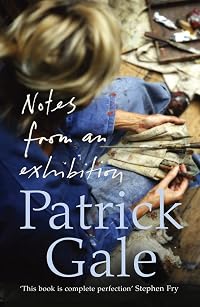
Notes from an Exhibition
by Patrick Gale
On This Page
Description
When troubled artist Rachel Kelly dies she leaves behind an extraordinary body of work - but for her family there is a legacy of secrets and painful revelations. To her children she is both curse and blessing, as they cope with the inheritance of her passions - and demons. Only their father's gift of stillness can withstand Rachel's destructive influence and the suspicion that her family came second to her art. Piecing together the clues of her life - as artist, lover, mother, wife and show more patient - takes the reader from Cornwall to Canada across a span of forty years. What emerges is a tender story of enduring love, and a portrait of a family coping with the sometimes too dazzling brilliance of a genius. show lessTags
Recommendations

















Member Recommendations
Member Reviews
Patrick Gale is quite a well-known author in the UK, but, as far as I can tell, appears to be mostly unknown outside of Britain. Going by Notes from an Exhibition - the first of his novels I have read - I am certain why this would be the case: While there certainly is a good amount of Britishness to the novel, it is not to a greater degree or more offensively than in, say, the Harry Potter novels - and those blatantly had no issues with being popular outside of the UK.
Maybe it is not so much the content, but that Patrick Gale's works speaks to a certain, particularly English sensibility which, the occasional anglophile apart, just does not appeal to non-British readers. I think it would probably be interesting to explore that question - show more is there, apart from the language, an identifiable, formal or structural element in fiction that makes it particularly attractive to one nation rather than others? - and in all likelihood it has actually been done. But this would obviously take us too far away from the subject at hand, which is Patrick Gale's novel Notes from an Exhibition, so I shall just leave this standing as idle musing on my part and move on.
Notes from an Exhibition, then: The novel is ostensibly about the fictive painter Rachel Kelly, who dies in the first chapter (or, more precisely, off stage right after it ends); the novel then alternates between chapters depicting the reactions of her family to Rachel's death and flashbacks to the lives both of herself and her family before her death (in non-chronological order). Viewpoints change between chapters, and one of the things Gale does really well is to give each of them their distinctive voice - distinctive not just between characters, but also between the same character at different phases in their lives. Not everything is revealed to the reader right from the start - there are dark spots in Rachel's past her family is not aware of and only finds out about after her death, and there are spots the family knows about but the reader is kept in the dark about and only told about towards the end of the novel. As the existence and outline of those unexplored areas is pointed out quite early, Notes from an Exhibition turns into a bit of a mystery novel, with the reader in suspense as to what has actually happened - admittedly, this does not exactly generate nail-biting tension, but it does help the readability of the novel which chugs along at a very pleasant speed and is quite an enjoyable read.
Which - as you may not be surprised by if you have read around my reviews a bit - is actually somewhat of an issue for me, namely that the novel's form and language are so very conventional and unimaginative.
It may not look like it on first sight - true to its title, the novel at first literally presents itself as notes from an exhibition, and exhibition on the life and work of Rachel Kelly. Each chapter starts off with such a note describing either one of Rachel's pictures or an item relating to her life, like a piece of clothing she liked to wear. It is notable that most if not all Goodreads reviews of Gale's novel entirely miss the difference between the two and only talk of pictures, which sheds a rather dim light on how much attention most readers seem to be paying the books they are reading. To their defense, however, it has to be said that Gale does not appear to make anything of that distinction, either. And generally the relationship between the notes and the following chapter are very straightforward - if the note is about a picture, the chapter will show what is depicted on it or deal with the time it was created, and if it is a piece of clothing, Rachel will wear it. There is no tension between introductory notes and chapters at all, which makes it all very predictable and the notes end up being rather redundant, ornamental rather than essential to the novel.
Also it has to be said that the exhibition Gale presents is either singularly disorganised or that its imaginary visitor is zig-zagging through it a random. The novel starts with a death, and ends with another death, and as far as I can tell (with the - big - caveat that I just may have missed something) this is about all the structure Notes from an Exhibition has, apart from placing some revelations at the end to produce a mystery. The novel has an air of "just telling a good yarn" about it that I find very 19th century, and even its apparent breaking up of chronology is somewhat half-hearted, as the present-day parts are actually told in order, with flashbacks inserted between their orderly progress.
And finally, and most disappointingly, the language: Notes from an Exhibition is very well written, but in a very conventional way that never even attempts to push the reader out of their comfort zone. Admittedly, the novel may have been unlucky in that only a few weeks before I read Going Home by Doris Lessing. While that is mainly a book of political journalism it does start out with a lengthy description of the Africa of the author's youth, descriptions that are very painterly and quite abstract, dissolving the visible world into light, colour and shape - quite reminiscent, in fact, of the paintings of Rachel Kelly as Gale describes them but described in a way that would be appropriate to the way a painter of abstract pictures might perceive the world. As beautiful as Gale's language is, it falls flat when it comes to tackling his more extreme subjects, just seems too well-mannered to come to grips with things like abstract painting or bipolar disorder.
But I do not want to sound too grumpy: Notes from an Exhibition is by no means a bad novel; quite to the contrary. The characters have considerable depth, and the reader follows their fates with unflagging interest; also, as I mentioned before, they novel really excels at giving each his or her unique voice. It is also a very emotionally involving novel, it draws the reader in and lets them share in the life of Rachel and her family, the happy moments as well as the struggle and grief; and I doubt anyone can read the novel without being moved by it in several places, possibly even to tears (I at least had to reach for a tissue once or twice). Where Notes from an Exhibition really shines, however, is on the thematic - the way Gale weaves together his central subjects of art, life, mental disorder and family, gives each its proper weight and lets them all illuminate each other is exceptionally well done. But the real centre of the novel seems to - and noticing that did come as a surprise - Quakerism. The Quakers and their particular attitude to life and the world (of which I knew next to nothing before reading Gale's novel) are omnipresent throughout; even characters who are not Quakers themselves attend Meetings, and everything that happens stands in some relation to that experience and in particular to the silence happening in them which bears a special significance for Quakers. Gale manages to make it sound quite attractive even to a die-hard agnostic like myself, and, more importantly, he makes it the unobtrusive focal point of his novel by which everything is measured and to which everything eventually returns.
In short, I really liked Notes from an Exhibition and am looking forward to reading other works by Patrick Gale. But I also think it could have been a better novel if it wasn't so comfortable in its own confines, if it would risk more and not be so damnably... well, cozy. And maybe that is the answer to why this novel seems so very British - after all, England gave us cozy crimes and cozy catastrophes, so it may not be too far-fetched that this is a state of mind particularly well-suited to the English national character. Assuming, of course, that there even is such a thing. show less
Maybe it is not so much the content, but that Patrick Gale's works speaks to a certain, particularly English sensibility which, the occasional anglophile apart, just does not appeal to non-British readers. I think it would probably be interesting to explore that question - show more is there, apart from the language, an identifiable, formal or structural element in fiction that makes it particularly attractive to one nation rather than others? - and in all likelihood it has actually been done. But this would obviously take us too far away from the subject at hand, which is Patrick Gale's novel Notes from an Exhibition, so I shall just leave this standing as idle musing on my part and move on.
Notes from an Exhibition, then: The novel is ostensibly about the fictive painter Rachel Kelly, who dies in the first chapter (or, more precisely, off stage right after it ends); the novel then alternates between chapters depicting the reactions of her family to Rachel's death and flashbacks to the lives both of herself and her family before her death (in non-chronological order). Viewpoints change between chapters, and one of the things Gale does really well is to give each of them their distinctive voice - distinctive not just between characters, but also between the same character at different phases in their lives. Not everything is revealed to the reader right from the start - there are dark spots in Rachel's past her family is not aware of and only finds out about after her death, and there are spots the family knows about but the reader is kept in the dark about and only told about towards the end of the novel. As the existence and outline of those unexplored areas is pointed out quite early, Notes from an Exhibition turns into a bit of a mystery novel, with the reader in suspense as to what has actually happened - admittedly, this does not exactly generate nail-biting tension, but it does help the readability of the novel which chugs along at a very pleasant speed and is quite an enjoyable read.
Which - as you may not be surprised by if you have read around my reviews a bit - is actually somewhat of an issue for me, namely that the novel's form and language are so very conventional and unimaginative.
It may not look like it on first sight - true to its title, the novel at first literally presents itself as notes from an exhibition, and exhibition on the life and work of Rachel Kelly. Each chapter starts off with such a note describing either one of Rachel's pictures or an item relating to her life, like a piece of clothing she liked to wear. It is notable that most if not all Goodreads reviews of Gale's novel entirely miss the difference between the two and only talk of pictures, which sheds a rather dim light on how much attention most readers seem to be paying the books they are reading. To their defense, however, it has to be said that Gale does not appear to make anything of that distinction, either. And generally the relationship between the notes and the following chapter are very straightforward - if the note is about a picture, the chapter will show what is depicted on it or deal with the time it was created, and if it is a piece of clothing, Rachel will wear it. There is no tension between introductory notes and chapters at all, which makes it all very predictable and the notes end up being rather redundant, ornamental rather than essential to the novel.
Also it has to be said that the exhibition Gale presents is either singularly disorganised or that its imaginary visitor is zig-zagging through it a random. The novel starts with a death, and ends with another death, and as far as I can tell (with the - big - caveat that I just may have missed something) this is about all the structure Notes from an Exhibition has, apart from placing some revelations at the end to produce a mystery. The novel has an air of "just telling a good yarn" about it that I find very 19th century, and even its apparent breaking up of chronology is somewhat half-hearted, as the present-day parts are actually told in order, with flashbacks inserted between their orderly progress.
And finally, and most disappointingly, the language: Notes from an Exhibition is very well written, but in a very conventional way that never even attempts to push the reader out of their comfort zone. Admittedly, the novel may have been unlucky in that only a few weeks before I read Going Home by Doris Lessing. While that is mainly a book of political journalism it does start out with a lengthy description of the Africa of the author's youth, descriptions that are very painterly and quite abstract, dissolving the visible world into light, colour and shape - quite reminiscent, in fact, of the paintings of Rachel Kelly as Gale describes them but described in a way that would be appropriate to the way a painter of abstract pictures might perceive the world. As beautiful as Gale's language is, it falls flat when it comes to tackling his more extreme subjects, just seems too well-mannered to come to grips with things like abstract painting or bipolar disorder.
But I do not want to sound too grumpy: Notes from an Exhibition is by no means a bad novel; quite to the contrary. The characters have considerable depth, and the reader follows their fates with unflagging interest; also, as I mentioned before, they novel really excels at giving each his or her unique voice. It is also a very emotionally involving novel, it draws the reader in and lets them share in the life of Rachel and her family, the happy moments as well as the struggle and grief; and I doubt anyone can read the novel without being moved by it in several places, possibly even to tears (I at least had to reach for a tissue once or twice). Where Notes from an Exhibition really shines, however, is on the thematic - the way Gale weaves together his central subjects of art, life, mental disorder and family, gives each its proper weight and lets them all illuminate each other is exceptionally well done. But the real centre of the novel seems to - and noticing that did come as a surprise - Quakerism. The Quakers and their particular attitude to life and the world (of which I knew next to nothing before reading Gale's novel) are omnipresent throughout; even characters who are not Quakers themselves attend Meetings, and everything that happens stands in some relation to that experience and in particular to the silence happening in them which bears a special significance for Quakers. Gale manages to make it sound quite attractive even to a die-hard agnostic like myself, and, more importantly, he makes it the unobtrusive focal point of his novel by which everything is measured and to which everything eventually returns.
In short, I really liked Notes from an Exhibition and am looking forward to reading other works by Patrick Gale. But I also think it could have been a better novel if it wasn't so comfortable in its own confines, if it would risk more and not be so damnably... well, cozy. And maybe that is the answer to why this novel seems so very British - after all, England gave us cozy crimes and cozy catastrophes, so it may not be too far-fetched that this is a state of mind particularly well-suited to the English national character. Assuming, of course, that there even is such a thing. show less
[This is a review I wrote in 2012]
Rachel Kelly, one time celebrated artist, mother of four, wife to the calm and stoical Antony, and a bipolar sufferer, is found dead in her studio at home in Penzance. For Antony, her death throws into light questions about her past, her family and the circumstances of her life before they met. For her children, brought up under difficult circumstances with an erratic mother, often lacking the mother's love and warmth they felt their due, her death brings differing emotions, reactions and memories.
What Patrick Gale does, cleverly, with his plot, is to weave a family history around a framework of exhibition cards describing Rachel's paintings, posthumously on show, probably at the Tate Modern in St. show more Ives. He uses these as chapter breaks and goes on to intersperse the stories of Rachel's children at different ages in a non-linear way. The effect is bitty, as a family's personal history is, and it works by drawing your interest on many levels. All characters are worthy of expansion, all well-drawn and interesting; yet Patrick leaves much unsaid, using these sub-plots to draw the difficult character of Rachel. Many questions are left hanging in the reader's mind; not least of which is Antony's story of the years which have passed since he first met Rachel, rescued her from her despair in Oxford and took her to his grandfather's home in Penzance to begin a new life there. How has this quiet and loving Quaker man coped with the years with his bipolar wife and what has his relationship been with his children?
There are a few anachronisms and inconsistencies in the novel. I didn't particularly notice them when I was first reading the book and was caught up in the narrative, but they detract from the overall tightness of the writing; hence my 4 stars. I can, however, highly recommend 'Notes From an Exhibition', especially for its sensitive exploration of family life, grief and living with bipolar disorder. show less
Rachel Kelly, one time celebrated artist, mother of four, wife to the calm and stoical Antony, and a bipolar sufferer, is found dead in her studio at home in Penzance. For Antony, her death throws into light questions about her past, her family and the circumstances of her life before they met. For her children, brought up under difficult circumstances with an erratic mother, often lacking the mother's love and warmth they felt their due, her death brings differing emotions, reactions and memories.
What Patrick Gale does, cleverly, with his plot, is to weave a family history around a framework of exhibition cards describing Rachel's paintings, posthumously on show, probably at the Tate Modern in St. show more Ives. He uses these as chapter breaks and goes on to intersperse the stories of Rachel's children at different ages in a non-linear way. The effect is bitty, as a family's personal history is, and it works by drawing your interest on many levels. All characters are worthy of expansion, all well-drawn and interesting; yet Patrick leaves much unsaid, using these sub-plots to draw the difficult character of Rachel. Many questions are left hanging in the reader's mind; not least of which is Antony's story of the years which have passed since he first met Rachel, rescued her from her despair in Oxford and took her to his grandfather's home in Penzance to begin a new life there. How has this quiet and loving Quaker man coped with the years with his bipolar wife and what has his relationship been with his children?
There are a few anachronisms and inconsistencies in the novel. I didn't particularly notice them when I was first reading the book and was caught up in the narrative, but they detract from the overall tightness of the writing; hence my 4 stars. I can, however, highly recommend 'Notes From an Exhibition', especially for its sensitive exploration of family life, grief and living with bipolar disorder. show less
So far there isn't a book by Patrick Gale that I've read and haven't enjoyed. That said, this is only the 4th I've read from his somewhat longer list of novels - 19 works to date. Clearly I have some good reading ahead of me! This book has so many elements that appeal to me. I like Gale's focus on families - especially those which are somewhat deviant from the imagined norm. Mental illness is also a subject near to my heart, and I find that Gale deals with this as it should be: by presenting cases in which the mentally ill person is really not that far outside the range of 'normal'. The boundary is unclear, except perhaps in retrospect. And retrospect is here aplenty. Everyone in this family has a real, believable character and so this show more reader found lots of valuable insights into real life. Of course, as with all Gale's books, there is solid representation of the gay community and I particularly appreciate the fact the sexual preference is also dealt with in a way that gives straight people (e.g. me) a real understanding of what non-straight people experience (in a western middle class society, such as the one in which I live). I have recently read the marvellous "A Measure of Light" by Beth Powning, which documents the Quaker experience in the New England region and the UK around the 1600s, so I warmed to the presence of serious Quakerism in Gale's story. In fact, I identify quite strongly with Gale's apparent approach to religion (I know nothing about his personal views, I just see how his characters relate to religion). That is, the religious are often seen to bring some good values to the world of human relationships, although the institutional church is seen as less relevant and the 'God' character doesn't rate much of a mention. The semi-rural Cornwall setting is so 'romantic' and yet my reading of Gale's continuing real life story suggests that what might be seen as merely romantic could be closer to reality than I might have guessed. There's not many places in the world I wish to visit, but now Penzance and Newlyn would definitely be on my list if I ever left Australia. show less
Patrick Gale is one of the British writers of my own generation (can't really say "young writers" any more!) that I admire most. He hops about quite a bit between styles and influences, but what he comes up with is usually interesting and rewarding, and he has a remarkable talent for dissecting family relationships.
In this book he uses the conceit of an exhibition catalogue to reconstruct the life of his central character, the painter Rachel Kelly, through a series of incidents seen from different viewpoints and at different moments in her life. This structural technique can be frustrating for the reader, because it takes a long time for the bits to start slotting together, and because of the trauma of repeatedly losing touch with show more viewpoint characters with whom we thought we were establishing an intimate relationship. However, I think it is an effective technique, and it does reflect the way that we often learn about other people's lives in the "real world".
Beyond the family relationships, the three big themes Gale throws into the mix are visual art, bipolar disorder, and Quakerism. The relationship between mental illness and creativity is a fairly hackneyed theme in fiction, of course, but this configuration of it was obviously an interesting challenge to Gale, who has previously written mostly about musical creativity (he's a musician himself) and Alzheimer's disease. As an ignoramus about painting, I felt that he did a pretty good job of conveying the experience of seeing and creating abstract paintings - certainly on a par with Joyce Cary's The Horse's Mouth, which he mentions as his favourite novel about a painter.
It was nice to have Quakerism at the centre of a novel, rather than a few token Quaker characters at the periphery, but Gale is writing as an outsider attracted by the idea and impressed by the Quakers he's met: he doesn't really manage to convey what it might feel like to be on the inside, as a birthright member. His characters can't quite get over thinking of what Quakers do as a bit odd and what the outside world does as normal.
Iris Murdoch is an obvious influence, as ever, and the chapters set in 1950s Toronto can't help having a touch of the Margaret Atwoods about them, but it's a nice sign of how Gale has become an established writer in his own right that we can amuse ourselves spotting joky little allusions to his earlier books, especially in the "catalogue notes" that introduce each chapter. show less
In this book he uses the conceit of an exhibition catalogue to reconstruct the life of his central character, the painter Rachel Kelly, through a series of incidents seen from different viewpoints and at different moments in her life. This structural technique can be frustrating for the reader, because it takes a long time for the bits to start slotting together, and because of the trauma of repeatedly losing touch with show more viewpoint characters with whom we thought we were establishing an intimate relationship. However, I think it is an effective technique, and it does reflect the way that we often learn about other people's lives in the "real world".
Beyond the family relationships, the three big themes Gale throws into the mix are visual art, bipolar disorder, and Quakerism. The relationship between mental illness and creativity is a fairly hackneyed theme in fiction, of course, but this configuration of it was obviously an interesting challenge to Gale, who has previously written mostly about musical creativity (he's a musician himself) and Alzheimer's disease. As an ignoramus about painting, I felt that he did a pretty good job of conveying the experience of seeing and creating abstract paintings - certainly on a par with Joyce Cary's The Horse's Mouth, which he mentions as his favourite novel about a painter.
It was nice to have Quakerism at the centre of a novel, rather than a few token Quaker characters at the periphery, but Gale is writing as an outsider attracted by the idea and impressed by the Quakers he's met: he doesn't really manage to convey what it might feel like to be on the inside, as a birthright member. His characters can't quite get over thinking of what Quakers do as a bit odd and what the outside world does as normal.
Iris Murdoch is an obvious influence, as ever, and the chapters set in 1950s Toronto can't help having a touch of the Margaret Atwoods about them, but it's a nice sign of how Gale has become an established writer in his own right that we can amuse ourselves spotting joky little allusions to his earlier books, especially in the "catalogue notes" that introduce each chapter. show less
A wonderful book, in which the reader has to pick through the layers of narrative. Each chapter begins with the curator's notes for the posthumous exhibition of works by bi-polar Rachel Kelly. Each layer is narrated from the standpoint of a different character: there's Rachel herself, her husband Anthony, and the 4 children, Garfield, Morwenna, Hedley and Petroc, oh and Winnie too, eventually. In many ways, these layers are revealed backwards. We begin with Rachel's death, and gradually her complicated story, and the almost equally complicated family life of the others starts to make sense. The challenges of living with someone with a depressive psychiatric condition, the underlying strength that the family's Quaker faith brings to show more them, the sense of place - this book is firmly based in the Cornwall that Gale loves so much - all add to a book which tells a gripping story in a sympathetic, compassionate and involving way. show less
Gorgeous read. I went to a random reading where Patrick Gale read out the first chapter (along with other bits and pieces). I had never heard of him or the book. It was being released the next day. I immediately went out and bought it and DEVOURED it.
There are lots of elements of his fictitious family that aroused my interest at the time - the effect of living with bi-polar disorder, quakers, eccentric artist, estrangement of children who grow up around mental illness...lots of things that rang a few personal bells and lots to chew on but Gale does it all with a light touch and through a thoroughly fleshy cast of characters. The sort of book where not a lot happens but an awful lot happens with far more humanity than most authors are show more able to muster. One of those times where I couldn't stop reading but at the same time wanted to stop myself because I knew I would be sad to leave his world and its people behind. And goddammit, I really was gutted when I was done.
I hope (and he hinted at his reading that maybe he wasn't quite done with all of these characters) there will be a follow up.
In the meantime, I'll wait until I have forgotten it sufficiently to justify reading it again... show less
There are lots of elements of his fictitious family that aroused my interest at the time - the effect of living with bi-polar disorder, quakers, eccentric artist, estrangement of children who grow up around mental illness...lots of things that rang a few personal bells and lots to chew on but Gale does it all with a light touch and through a thoroughly fleshy cast of characters. The sort of book where not a lot happens but an awful lot happens with far more humanity than most authors are show more able to muster. One of those times where I couldn't stop reading but at the same time wanted to stop myself because I knew I would be sad to leave his world and its people behind. And goddammit, I really was gutted when I was done.
I hope (and he hinted at his reading that maybe he wasn't quite done with all of these characters) there will be a follow up.
In the meantime, I'll wait until I have forgotten it sufficiently to justify reading it again... show less
I really enjoyed this book. Gale is an excellent story teller and in this story he weaves a complex family drama set in Cornwall and centred on an artist and her family. The book moves backwards and forwards in time to reveal family secrets. A rather abrupt ending but apart from that highly recommended.
Members
- Recently Added By
Published Reviews
ThingScore 100
Artist Rachel Kelly's beloved youngest son, suitably named Petroc, once gave her six stones collected from a Cornish beach, each chosen to represent a member of the family. Rachel treasures these stones and, while engaged on a groundbreaking new series of paintings possibly inspired by them, dies of a heart attack in her Cornish loft-studio.
A death is a well-worn fictional opening device, but show more here Patrick Gale uses it cleverly to fresh effect. Told via notes from a posthumous retrospective of Rachel's work, which head each chapter, the narrative offers an unusual way into the half-dozen changing viewpoints that dot around in time and place, like apparently random pieces of a jigsaw. Fortunately for the reader, Gale guides us fairly confidently towards the full picture. show less
A death is a well-worn fictional opening device, but show more here Patrick Gale uses it cleverly to fresh effect. Told via notes from a posthumous retrospective of Rachel's work, which head each chapter, the narrative offers an unusual way into the half-dozen changing viewpoints that dot around in time and place, like apparently random pieces of a jigsaw. Fortunately for the reader, Gale guides us fairly confidently towards the full picture. show less
added by avatiakh
Lists

Top Five Books of 2014
1,064 works; 398 members

A Novel Cure
742 works; 23 members

Literature About Mental Illness
37 works; 5 members
Author Information

31+ Works 4,459 Members
Patrick Gale was born in 1962 on the Isle of Wight. He is a British novelist He was educated at The Pilgrims' School, the choir school for both Winchester Cathedral and Winchester College, then at Winchester College itself and at New College, University of Oxford. Following university he had a range of jobs while he sang for the London show more Philharmonic Choir and wrote his first novel, The Aerodynamics of Pork while working as a waiter in an all-night restaurant. His works include: Ease, Kansas in August, Little Bits of Baby and A Place Called Winter. (Bowker Author Biography) show less
Awards and Honors
Common Knowledge
- Original publication date
- 2007
- People/Characters
- Rachel Kelly; Antony Middleton; Garfield Middleton; Morwenna Middleton; Hedley Middleton; Petroc Middleton (show all 7); Barbara Hepworth
- Important places
- Penzance, Cornwall, England, UK; Oxford, Oxfordshire, England, UK; Toronto, Ontario, Canada; Cornwall, England, UK
- Epigraph
- If I'm on fire they dance around it
and cook marshmallows.
And if I'm ice
they simply skate on me
in little ballet costumes.
ANNE SEXTON, Live
Then I lie on my altar
elevated by the ei... (show all)ght chemical kisses.
What a lay me down this is
with two pink; two orange;
two green, two white goodnights.
ANNE SEXTON, The Addict - Dedication
- For Aidan Hicks
- First words
- Rachel was woken by a painting or, rather, by the idea of one.
- Quotations
- As she drew near the car again she saw Rachel was smoking one of her very occasional cigarettes ... and concentrating on something she was drawing with the special tortoiseshell fountain pen that lived in her handbag.
- Last words
- (Click to show. Warning: May contain spoilers.)The engine sounded closer and he remembered he was no longer a virgin and would never be quite as young and naïvely aimless as he had been that afternoon.
- Blurbers
- Maupin, Armistead
Classifications
Statistics
- Members
- 1,037
- Popularity
- 25,008
- Reviews
- 43
- Rating
- (3.78)
- Languages
- 5 — Dutch, English, French, Norwegian (Bokmål), Norwegian
- Media
- Paper, Audiobook, Ebook
- ISBNs
- 22
- ASINs
- 8