On This Page
Description
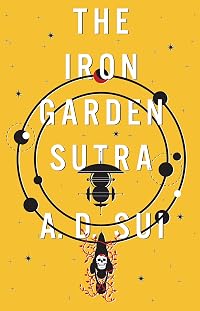
"Vessel Iris has devoted himself to the Starlit Order, performing funeral rites for the dead across the galaxy, guiding souls back into the Infinite Light. Despite the meaning he finds in his work and the comfort of AI companionship, his relationships with the living leave him longing for deeper connection. The spaceship Counsel of Nicaea has been lost for more than a thousand years, its passengers reduced to dust and bone. A relic of Earth's dying past, its sudden appearance has attracted a show more team of academics eager to investigate its archeological history. And Iris has been assigned to bring peace to the crew's long departed souls. Carpeted in moss and intertwined with vines, Nicaea is more forest than ship. Iris's religious rituals are met with bemusement by the scientists--and outright hostility by engineer Yan Fukui. But the plant life isn't the only sentience to have survived in the past millennia. Something on board is stalking the explorers one by one. And Iris with his AI enhancement may be their only hope for survival. . ." -- Dust jacket. show lessTags
Recommendations
































Member Reviews
Real Rating: 4.25* of five
The Publisher Says: Klara and the Sun meets S. A. Barnes’s Dead Silence with a touch of Becky Chambers’ A Psalm for the Wild-Built in Nebula Award-winning author A.D. Sui’s darkly philosophical murder mystery, as a death monk and a team of researchers trapped onboard a spaceship of the dead encounter something beyond human understanding.
Vessel Iris has devoted himself to the Starlit Order, performing funeral rites for the dead across the galaxy and guiding souls back into the Infinite Light. Despite the comfort he wants to believe he brings to the dead, his relationships with his fellow Vessels are distant at best, leaving him reliant on his AI construct for companionship.
The spaceship Counsel of Nicaea show more has been lost for more than a thousand years. A relic of Earth’s dying past, humanity took the ship to the stars on a multi-generation journey to find another habitable planet yet never reached its destination. Its sudden appearance has attracted a team of academics eager to investigate its archeological history. And Vessel Iris has been assigned to bring peace to the crew’s long departed souls.
Carpeted in moss and intertwined with vines, Nicaea is more forest than ship.
But the ship's plant life isn’t the only sentience to have survived in the past millennia. Something onboard is stalking the explorers one by one. And Vessel Iris with his AI construct may be their only hope for survival. . .
IN OUTER SPACE NO ONE CAN HEAR YOUR PRAYERS
I RECEIVED A DRC FROM THE PUBLISHER VIA NETGALLEY. THANK YOU.
My Review: What if Murderbot was a Buddhist monk, and arrives on a derelict generation ship to guide its long-dead colonists through samsara to the Light, but a bunch of irreligious bumbling academics need saving from...beings...while he's trying to do his work? Yes, this time he's male, and has a...situationship...with his AI. That's a major friction point with the normal humans he needs to save, because all life is sacred even when it's stupid and nasty.
It's a good story, it's got levels to think about that open like hatches hidden under green stuff then turn into wormholes, gates, passageways through reality into your busy monkey-brain. Whirling in my monkey-brain was a sneaky little thought: why do monks, who famously renounce the world, decide to help us worldly denizens of samsara (apparently Sanskrit for the same concept as "gefilte" or "mashed up and stuffed") only when we die?
But that's trespassing into religion, its uses and motivating ideas, its sacred territory....
What to enjoy about the monk with an AI sharing his brain, albeit in a subservient role, is the fertile territory for human nastiness to get directed at a "holy" person by the deeply secular people around him. I'm envious of Vessel Iris because he lives in a world of only a few tiny remnant religious nuts. Sounds like heaven to me. (See what I did there?) My missing parts of the fifth star came from my deep dislike of the Harry-Dresdenish self-recriminating litany of personal abuse Vessel Iris feeds himself. Since the book is all inside Vessel Iris' head, and since I want to shove him out an airlock about once every twenty pages, it made for a choppy, months-long reading experience. I made the deal with myself that I couldn't Pearl-Rule a book set on a failed generation ship with serious botanical Nostromo vibes and a monk who's treated like we'd treat a sex-trafficking politician for having an AI in his brain.
I don't think everyone will love this read. I'm not sure *I* loved this read. But I was completely unable to abandon ship. I lurked through the overgrown halls celebrating with nasty schadenfreude every time whatever it was picked off another creepy academic. I did not, in other words, root *for* anyone in the story, not even the dead colonists whose reasons for seeking a new world...well. I didn't like anyone. It wasn't an easy investment to make.
But it was one I absolutely did make.
This is a very philosophical horror-of-sorts story of how fear and safety are too deeply intertwined to be separable, no matter how much one tries to treat them as opposites or even antipodes on a spectrum. What happens when you're only safe when you're afraid is a subtle and fascinating frame to hang a space-locked-room mystery on.
It felt to me like the story smashed into a brick wall when Vessel Iris started in on his self-flagellation, but I stipulate that as a me problem. Leaving aside my annoyance I think the pace of the action is rising at a good storytelling clip; the ideas never got too top-heavy, causing weird bends in the plot (a major flaw in Becky Chambers' stories from my PoV); and the resolution was very nicely capping off the plot while not too obviously blaring the sequel-is-coming horn.
It might not be for you, but you will know within the first 10% if it isn't. Read a sample; there are genuine pleasures to be had in the story for people who don't have my oversensitivity to self-flagellation. show less
The Publisher Says: Klara and the Sun meets S. A. Barnes’s Dead Silence with a touch of Becky Chambers’ A Psalm for the Wild-Built in Nebula Award-winning author A.D. Sui’s darkly philosophical murder mystery, as a death monk and a team of researchers trapped onboard a spaceship of the dead encounter something beyond human understanding.
Vessel Iris has devoted himself to the Starlit Order, performing funeral rites for the dead across the galaxy and guiding souls back into the Infinite Light. Despite the comfort he wants to believe he brings to the dead, his relationships with his fellow Vessels are distant at best, leaving him reliant on his AI construct for companionship.
The spaceship Counsel of Nicaea show more has been lost for more than a thousand years. A relic of Earth’s dying past, humanity took the ship to the stars on a multi-generation journey to find another habitable planet yet never reached its destination. Its sudden appearance has attracted a team of academics eager to investigate its archeological history. And Vessel Iris has been assigned to bring peace to the crew’s long departed souls.
Carpeted in moss and intertwined with vines, Nicaea is more forest than ship.
But the ship's plant life isn’t the only sentience to have survived in the past millennia. Something onboard is stalking the explorers one by one. And Vessel Iris with his AI construct may be their only hope for survival. . .
IN OUTER SPACE NO ONE CAN HEAR YOUR PRAYERS
I RECEIVED A DRC FROM THE PUBLISHER VIA NETGALLEY. THANK YOU.
My Review: What if Murderbot was a Buddhist monk, and arrives on a derelict generation ship to guide its long-dead colonists through samsara to the Light, but a bunch of irreligious bumbling academics need saving from...beings...while he's trying to do his work? Yes, this time he's male, and has a...situationship...with his AI. That's a major friction point with the normal humans he needs to save, because all life is sacred even when it's stupid and nasty.
It's a good story, it's got levels to think about that open like hatches hidden under green stuff then turn into wormholes, gates, passageways through reality into your busy monkey-brain. Whirling in my monkey-brain was a sneaky little thought: why do monks, who famously renounce the world, decide to help us worldly denizens of samsara (apparently Sanskrit for the same concept as "gefilte" or "mashed up and stuffed") only when we die?
But that's trespassing into religion, its uses and motivating ideas, its sacred territory....
What to enjoy about the monk with an AI sharing his brain, albeit in a subservient role, is the fertile territory for human nastiness to get directed at a "holy" person by the deeply secular people around him. I'm envious of Vessel Iris because he lives in a world of only a few tiny remnant religious nuts. Sounds like heaven to me. (See what I did there?) My missing parts of the fifth star came from my deep dislike of the Harry-Dresdenish self-recriminating litany of personal abuse Vessel Iris feeds himself. Since the book is all inside Vessel Iris' head, and since I want to shove him out an airlock about once every twenty pages, it made for a choppy, months-long reading experience. I made the deal with myself that I couldn't Pearl-Rule a book set on a failed generation ship with serious botanical Nostromo vibes and a monk who's treated like we'd treat a sex-trafficking politician for having an AI in his brain.
I don't think everyone will love this read. I'm not sure *I* loved this read. But I was completely unable to abandon ship. I lurked through the overgrown halls celebrating with nasty schadenfreude every time whatever it was picked off another creepy academic. I did not, in other words, root *for* anyone in the story, not even the dead colonists whose reasons for seeking a new world...well. I didn't like anyone. It wasn't an easy investment to make.
But it was one I absolutely did make.
This is a very philosophical horror-of-sorts story of how fear and safety are too deeply intertwined to be separable, no matter how much one tries to treat them as opposites or even antipodes on a spectrum. What happens when you're only safe when you're afraid is a subtle and fascinating frame to hang a space-locked-room mystery on.
It felt to me like the story smashed into a brick wall when Vessel Iris started in on his self-flagellation, but I stipulate that as a me problem. Leaving aside my annoyance I think the pace of the action is rising at a good storytelling clip; the ideas never got too top-heavy, causing weird bends in the plot (a major flaw in Becky Chambers' stories from my PoV); and the resolution was very nicely capping off the plot while not too obviously blaring the sequel-is-coming horn.
It might not be for you, but you will know within the first 10% if it isn't. Read a sample; there are genuine pleasures to be had in the story for people who don't have my oversensitivity to self-flagellation. show less
I'm just going to start out and say that this book broke me in all the good ways because it then picked up the pieces and put them together again. One should read a book about a death monk with so much repressed grief, but as a religious studies student the idea of Vessel Iris and the Starlit Order was too big a temptation to resist. And I am so glad I didn't resist.
Part science fiction, part murder mystery, part ethical conversation about AI, technology, sentience, and our relationship to these things, this book contains a gripping narrative that kept me turning the pages long after I should have gone to bed. The characters are well drawn, fully realized, with just enough back story to make you understand their motivations and show more reasoning. The transformation over the course of the story is exquisite, and I worry about saying much more because I do not want to give a single thing away.
The Iron Garden Sutra is a book for those who want crunchy topics to think about with their science fiction, who are fans of lyrical writing that evokes all five senses, and for those who are thinking about the role religion and ritual play in our lives and in the case of funerary rites, for whom we perform these things and what responsibilities do we have to the dead.
One of the best books I've read in a very long time. show less
Part science fiction, part murder mystery, part ethical conversation about AI, technology, sentience, and our relationship to these things, this book contains a gripping narrative that kept me turning the pages long after I should have gone to bed. The characters are well drawn, fully realized, with just enough back story to make you understand their motivations and show more reasoning. The transformation over the course of the story is exquisite, and I worry about saying much more because I do not want to give a single thing away.
The Iron Garden Sutra is a book for those who want crunchy topics to think about with their science fiction, who are fans of lyrical writing that evokes all five senses, and for those who are thinking about the role religion and ritual play in our lives and in the case of funerary rites, for whom we perform these things and what responsibilities do we have to the dead.
One of the best books I've read in a very long time. show less
Iris is a monk tasked with ushering the souls of the dead back into the Light through funerary rites. He is a bundle of past trauma, sincere and earnest motivations, and wobbly faith. He’s good with straightforward obligations, but because his devotion is tangled up in the found family of his faith, nuanced situations throw him into anxiety and doubt. This makes him a compelling character, but I also found him (and the other characters) to often be self-contradicting and confusing in motivation.
An ancient, empty generation ship has been found, and Iris is given the assignment for the expected dead. He’s surprised to find teams of academics, engineers, and security on board, and struggles to do his work with them around. When there show more is a murder and a strange mysterious signal, the book divides between Iris’s internal struggles and the murder mystery. I wish this weren’t a thriller. I’m not sure why Iris was chosen as the viewpoint for this story, and it felt like a fight between two incompatible plots.
I ended up not finishing this book mostly due to a violent episode between characters that felt gratuitous and nonsensical. This book just wasn’t for me, but I did really love the theology chapters and epigraphs. I would have loved to read more of Iris and his conflicts, just in a different plot.
Thank you to NetGalley and Erewhon Books for an advance e-copy in exchange for an honest review. show less
An ancient, empty generation ship has been found, and Iris is given the assignment for the expected dead. He’s surprised to find teams of academics, engineers, and security on board, and struggles to do his work with them around. When there show more is a murder and a strange mysterious signal, the book divides between Iris’s internal struggles and the murder mystery. I wish this weren’t a thriller. I’m not sure why Iris was chosen as the viewpoint for this story, and it felt like a fight between two incompatible plots.
I ended up not finishing this book mostly due to a violent episode between characters that felt gratuitous and nonsensical. This book just wasn’t for me, but I did really love the theology chapters and epigraphs. I would have loved to read more of Iris and his conflicts, just in a different plot.
Thank you to NetGalley and Erewhon Books for an advance e-copy in exchange for an honest review. show less
(In which our reviewer writes a less-than-satisfying and less-than articulate review with enough abstractions to make the ideas contained difficult to get a solid hold on.)
A.D. Sui's The Iron Garden Sutra is a wonderful puzzle of a book—and I mean this in a good way. I don't want to try to summarize the plot because a) it's complex enough to make that task daunting and b) I don't want to inadvertently give anything away. What I do want to do is look at two of the "puzzle-y" bits of the narrative that kept me engaged, even when I didn't have the book in front og me.
Puzzle-y bit #1: The novel is set about 1,000 years in the future. What we learn as we make our way through it is that AI "constructs" have won the right to volition, show more meaning that not only are they capable of thinking their own thoughts, they have bodies and freedom of movement. Not that long ago, an AI construct could be planted in an individual's brain where it served as a combination reference librarian and companion. One of the novels characters has such an AI implant which is an issue of real significance in the novel. In a sense, that character "owns" the AI. And even if the AI has freedom of thought, it doesn't get to make many of the day-to-day choices that embodied life forms do. The AI makes the best it can for itself out of choices made by the brain it's planted in. AI implants are looked at with the same unease/rage that the idea of slavery brings in the present day. One can do a lot of thinking about this slice of the novel's culture.
Puzzle-y bit #2: Religion has become a curiosity of sorts. There is one faith still being practiced, but by a narrow slice of the population. This faith is modeled on Buddhism with "the light" as a central construct. People are born of the light, they die in the light, they will cease to exist as they do while they live and will be absorbed into the light once more. A sort of "ashes to ashes, dust to dust." When an individual is dying, a representative of the faith will be alongside them, listening and awaiting the moment when it will be their responsibility to pray over the departing life to let that life know it will no longer be existing as it once did as it once did, but that it remains a part of the eternal light. If a person dies alone or suddenly, there's an assumption within the faith that someone will find that individual's remains and say over it the prayers and promises usually shared with those in the process of departing. If the reader,as many of us do, finds themself regularly trying to understand the arc of existence-nonexistence. As a result the reader can regularly find herself pausing both inside and outside the book wondering about how to reconcile to the knowledge of inevitable death.
The arc of the novel is gripping. The characters are multi-faceted, both complicated and believable. Still, I keep returning to these two puzzle-y bits straddling my own world and the world of the novel.
I received a free electronic review copy of the novel from the publisher via Edelweiss+; the opinions are my own. show less
A.D. Sui's The Iron Garden Sutra is a wonderful puzzle of a book—and I mean this in a good way. I don't want to try to summarize the plot because a) it's complex enough to make that task daunting and b) I don't want to inadvertently give anything away. What I do want to do is look at two of the "puzzle-y" bits of the narrative that kept me engaged, even when I didn't have the book in front og me.
Puzzle-y bit #1: The novel is set about 1,000 years in the future. What we learn as we make our way through it is that AI "constructs" have won the right to volition, show more meaning that not only are they capable of thinking their own thoughts, they have bodies and freedom of movement. Not that long ago, an AI construct could be planted in an individual's brain where it served as a combination reference librarian and companion. One of the novels characters has such an AI implant which is an issue of real significance in the novel. In a sense, that character "owns" the AI. And even if the AI has freedom of thought, it doesn't get to make many of the day-to-day choices that embodied life forms do. The AI makes the best it can for itself out of choices made by the brain it's planted in. AI implants are looked at with the same unease/rage that the idea of slavery brings in the present day. One can do a lot of thinking about this slice of the novel's culture.
Puzzle-y bit #2: Religion has become a curiosity of sorts. There is one faith still being practiced, but by a narrow slice of the population. This faith is modeled on Buddhism with "the light" as a central construct. People are born of the light, they die in the light, they will cease to exist as they do while they live and will be absorbed into the light once more. A sort of "ashes to ashes, dust to dust." When an individual is dying, a representative of the faith will be alongside them, listening and awaiting the moment when it will be their responsibility to pray over the departing life to let that life know it will no longer be existing as it once did as it once did, but that it remains a part of the eternal light. If a person dies alone or suddenly, there's an assumption within the faith that someone will find that individual's remains and say over it the prayers and promises usually shared with those in the process of departing. If the reader,as many of us do, finds themself regularly trying to understand the arc of existence-nonexistence. As a result the reader can regularly find herself pausing both inside and outside the book wondering about how to reconcile to the knowledge of inevitable death.
The arc of the novel is gripping. The characters are multi-faceted, both complicated and believable. Still, I keep returning to these two puzzle-y bits straddling my own world and the world of the novel.
I received a free electronic review copy of the novel from the publisher via Edelweiss+; the opinions are my own. show less
A solid far future scifi, deeply meditative (haha), story about buddhism, ai, and our place in the universe.
Set in a galaxy spanning (maybe multi-galaxy spanning?) human future where AIs have firmly established themselves as individuals with rights, we follow a monk who's order is informed by Buddhism. There is a lot of reflection on how these beliefs guide or don't ones life. While get some world building information about the Starlit order, a few academic institutions, and how human civilization has incorporated AIs and given them rights as individuals, the story is ultimately quite a bit smaller. Focused on a limited cast of characters including our monk, several academics, and a couple of guards, we see them struggle with each show more other, their internal lives, and a mysterious antagonist aboard a recently discovered thousands year old generation ship. A slowly evolving and deeply touching love story forms one of the B plots, as does the protagonist's relationship with his own AI companion.
Lovely, contemplative, action-y, and an interesting world I'm eager to see fleshed out more. show less
Set in a galaxy spanning (maybe multi-galaxy spanning?) human future where AIs have firmly established themselves as individuals with rights, we follow a monk who's order is informed by Buddhism. There is a lot of reflection on how these beliefs guide or don't ones life. While get some world building information about the Starlit order, a few academic institutions, and how human civilization has incorporated AIs and given them rights as individuals, the story is ultimately quite a bit smaller. Focused on a limited cast of characters including our monk, several academics, and a couple of guards, we see them struggle with each show more other, their internal lives, and a mysterious antagonist aboard a recently discovered thousands year old generation ship. A slowly evolving and deeply touching love story forms one of the B plots, as does the protagonist's relationship with his own AI companion.
Lovely, contemplative, action-y, and an interesting world I'm eager to see fleshed out more. show less
Vessell Iris, a monk from the Starlight Order, arrives on an ancient first earth generation ship expecting to work alone as he helps the dead move on. On arrival he meets scientists there to study the ship. They all face a lot more than they planned! The perfect book if you are in the mood for something a little disturbing and filled with longing for life and connection.
Ratings
Members
- Recently Added By
Lists

Nonhuman Protagonists
243 works; 35 members

Books That Made Us Cry
278 works; 145 members

Books Read in 2025
4,189 works; 98 members

Academia in Fiction
158 works; 23 members

Poly Sci Fi
23 works; 2 members
Author Information

3+ Works 155 Members
Series

Common Knowledge
- Canonical title
- The Iron Garden Sutra
Classifications
Statistics
- Members
- 102
- Popularity
- 317,125
- Reviews
- 6
- Rating
- (4.17)
- Languages
- English
- Media
- Paper, Ebook
- ISBNs
- 3
- ASINs
- 1