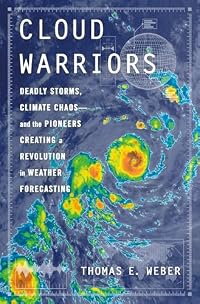
Cloud Warriors: Deadly Storms, Climate Chaos―and the Pioneers Creating a Revolution in Weather Forecasting
by Thomas E. Weber
On This Page
Description
"A deeply reported and wide-ranging look at the people, and the technology, predicting and tracking weather in order to raise public awareness to keep one step ahead of extreme weather. For millennia, humans have tried to understand and predict the weather. In the 1950s and 60s, the Space Age helped usher in satellites and radar, while computers made it possible to plug all that data into complex equations that predicted the atmosphere's future behavior. Now a new wave of forecasting show more advances is unfolding, driven by artificial intelligence, drones, and new types of satellites. The Internet of Things has turned everything from cellphones to cars into ubiquitous weather sensors. Equally significant are new efforts to understand how people respond to forecasts and warnings. Scientists and government officials are realizing that how people get their weather information, and how they use it, are crucial to the outcomes of weather events. Among other things, some inequities, such as economic and health issueas, as well as language barriers, can put vulnerable groups at increased risk due to weather. In CLOUD WARRIORS, veteran journalist Thomas E. Weber takes us on a fascinating tour of how meteorologists, scientists, and officials track and prepare for major weather events, such as hurricanes, tornados, floods, forest fires, extreme heat, and winter storms. As climate change is altering our planet and making weather events more extreme, readers will meet those on the front lines of weather preparation and prediction. We travel from coast-to-coast, to space and back, from National Weather Service to AccuWeather, meeting TV meteorologists and storm chasers, city planners and backyard weatherman. This is a book about the weather-and the power of being able to see it coming"-- Provided by publisher. show lessTags
Recommendations








































Member Reviews
Weber's powerful new book offers a combination of science, anecdote, and history, all of it clearly explained and expounded upon in a fashion that makes for compelling reading. And despite the cover and what the title might imply, the work is far-reaching in terms of climate, exploring all types of extreme weather, from tornadoes and wildfires on to extreme heat and hurricanes as well as drought and flood events, with other sections of the word dedicated to exploring the different types of forecasting and where they most excel, as well as the people pushing them forward.
For me, the most eye-opening sections were those on wildfire, extreme heat, and forecasting, but every chapter here is worth reading and reading again. It's a rare piece show more of nonfiction that demands not just to be read and passed on, but to be understood and acted upon. Unfortunately, what hangs over the reading experience like a deadly pall is the awareness of how much has changed in even the last six months, with Trump's Administration making deadly budget cuts to NOAA as well as other government agencies and scientific efforts in general. Part of me wishes that Weber could be called upon to add an addendum we could read to see where every person and agency described in the book--at least those in the U.S.--are now in August of 2025 after these cuts, and how the cuts have affected them, but I suspect it would be a terrifying and heart-wrenching read.
On the other hand, there is a great deal of hope in this work, both in the form of inspiring people and scientists as well as in the progress already made and where it seems to be heading. Perhaps even more hopeful, given the state of the national government right now, are the sections dedicated to looking at what individual cities and states in America are doing to forward climate concerns and help the most at-risk populations even before extreme weather comes calling.
In short, the book is fascinating, and Weber has put forward an incredible and timely work which I truly wish I could put into every person's hands.
Absolutely recommended--the sooner the better. show less
For me, the most eye-opening sections were those on wildfire, extreme heat, and forecasting, but every chapter here is worth reading and reading again. It's a rare piece show more of nonfiction that demands not just to be read and passed on, but to be understood and acted upon. Unfortunately, what hangs over the reading experience like a deadly pall is the awareness of how much has changed in even the last six months, with Trump's Administration making deadly budget cuts to NOAA as well as other government agencies and scientific efforts in general. Part of me wishes that Weber could be called upon to add an addendum we could read to see where every person and agency described in the book--at least those in the U.S.--are now in August of 2025 after these cuts, and how the cuts have affected them, but I suspect it would be a terrifying and heart-wrenching read.
On the other hand, there is a great deal of hope in this work, both in the form of inspiring people and scientists as well as in the progress already made and where it seems to be heading. Perhaps even more hopeful, given the state of the national government right now, are the sections dedicated to looking at what individual cities and states in America are doing to forward climate concerns and help the most at-risk populations even before extreme weather comes calling.
In short, the book is fascinating, and Weber has put forward an incredible and timely work which I truly wish I could put into every person's hands.
Absolutely recommended--the sooner the better. show less
Sometimes some books get written as witnesses of a moment. They will bear witness in the future to what was and what might have been.
One would not expect a book on weather forecasting to be such a book. Yet, in our current political climate, that’s what Cloud Warriors: Deadly Storms, Climate Chaos — and the Pioneers Creating a Revolution in Weather Forecasting (galley received as part of early review program), by Thomas Weber, proves to be.
The work is engagingly written and very well researched; the author is quite often “in the room where it happens” when it comes to weather tracking and forecasting. The major forms of weather disturbances and forecasts and players are considered, including tornadoes, hurricanes, heat, show more wildfire, short-, medium-, and long-term forecasting, both here in the States and in Europe.
The author well communicates the dedication and passion all the scientists maintain, and all with a view to preserve life and property in the face of whatever weather conditions may come at us.
All the technological developments are well explained and contextualized. The author presents reasons for optimism regarding how forecasts and predictions will get better with better and more granular data.
But, of course, all of this has now been thrown into chaos and doubt. The author did well in explaining how the government, university, and corporate alliances and cooperation have worked very well to advance and develop our current technological capabilities. That’s all been torn up by the present administration, ostensibly with a view to boost the corporate side at the detriment of the government and university departments. And, ultimately, to the harm of the rest of us, as forecasts get less accurate and communication less coherent.
We can only hope, and work, to make sure the recent disruptions to NOAA, the NWS, and university research funding are made very temporary, because the weather will still be volatile, and we are all better off when we allow the people the author interviews to do their jobs and do it well. show less
One would not expect a book on weather forecasting to be such a book. Yet, in our current political climate, that’s what Cloud Warriors: Deadly Storms, Climate Chaos — and the Pioneers Creating a Revolution in Weather Forecasting (galley received as part of early review program), by Thomas Weber, proves to be.
The work is engagingly written and very well researched; the author is quite often “in the room where it happens” when it comes to weather tracking and forecasting. The major forms of weather disturbances and forecasts and players are considered, including tornadoes, hurricanes, heat, show more wildfire, short-, medium-, and long-term forecasting, both here in the States and in Europe.
The author well communicates the dedication and passion all the scientists maintain, and all with a view to preserve life and property in the face of whatever weather conditions may come at us.
All the technological developments are well explained and contextualized. The author presents reasons for optimism regarding how forecasts and predictions will get better with better and more granular data.
But, of course, all of this has now been thrown into chaos and doubt. The author did well in explaining how the government, university, and corporate alliances and cooperation have worked very well to advance and develop our current technological capabilities. That’s all been torn up by the present administration, ostensibly with a view to boost the corporate side at the detriment of the government and university departments. And, ultimately, to the harm of the rest of us, as forecasts get less accurate and communication less coherent.
We can only hope, and work, to make sure the recent disruptions to NOAA, the NWS, and university research funding are made very temporary, because the weather will still be volatile, and we are all better off when we allow the people the author interviews to do their jobs and do it well. show less
A good book that could have used a little editing to be a bit more concise. However I do appreciate the effort by the author to make the technical data a bit more grounded in day-to-day realities. He does not shy away from the deleterious effects of climate change but neither does he preach about it.
Ratings
Members
- Recently Added By
Author Information
2 Works 40 Members
Awards and Honors
Classifications
- Genres
- Science & Nature, Technology, Nonfiction, General Nonfiction, Politics and Government
- DDC/MDS
- 511.63 — Natural sciences & mathematics Mathematics General principles of mathematics Combinatorics
- LCC
- QC995 .W2177 — Science Physics Physics Meteorology. Climatology Climatology and weather Weather forecasting
- BISAC
Statistics
- Members
- 39
- Popularity
- 743,675
- Reviews
- 3
- Rating
- (4.25)
- Languages
- English
- Media
- Paper, Ebook
- ISBNs
- 2
- ASINs
- 1