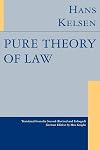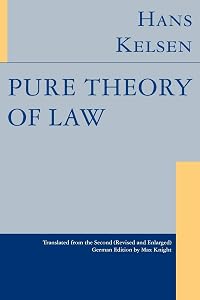
Pure Theory of Law
by Hans Kelsen
On This Page
Description
This title is part of UC Press's Voices Revived program, which commemorates University of California Press's mission to seek out and cultivate the brightest minds and give them voice, reach, and impact. Drawing on a backlist dating to 1893, Voices Revived makes high-quality, peer-reviewed scholarship accessible once again using print-on-demand technology. This title was originally published in 1967.Tags
Recommendations























Member Reviews
Hans Kelsen had an unusual theoretical aptitude. His theory of law is so general, in an Aristotelian way, that one can imagine someone reading it with keen interest even a thousand years from now. However, I didn’t quite enjoy this book as much as his General Theory of Law and State. At times his theoretical purity becomes a burden which restrains his thought too much. His arguments make sense, but the explanatory step from premise to conclusion is so short that every part of the argument is quite self-evident, and therefore not very interesting.
The author frequently emphasizes that his pure jurisprudence, which has quite misleadingly been translated as ”science” of law in this English translation, is independent of the show more ”political” aspects of law. This is somewhat disappointing from a philosophical point of view, because it means that the author disavows any considerations that have to do with legitimacy and illegitimacy. According to him, a ”valid” constitution can be put in force by any revolutionary victor, no matter how absurd and unfair its content may be. Dictators across the world could quote the Pure Theory of Law to prove that their coercion is based on ”valid” grounds.
The English translation of this book also seems a bit wobbly at times. The real meaning of some sentences has clearly been lost in translation, others are just overly complicated. I liked the chapters on the state and international law most, but the book mentioned above is a much broader analysis of these subjects. The concluding chapter on legal interpretation was also nice, but very short. Overall this is a book for the ages, but only for a very narrow community of legal scholars. Let's hope they won't serve dictatorial governments. The audience of this book could have expanded significantly if the theory had been a little bit less ”pure”. show less
The author frequently emphasizes that his pure jurisprudence, which has quite misleadingly been translated as ”science” of law in this English translation, is independent of the show more ”political” aspects of law. This is somewhat disappointing from a philosophical point of view, because it means that the author disavows any considerations that have to do with legitimacy and illegitimacy. According to him, a ”valid” constitution can be put in force by any revolutionary victor, no matter how absurd and unfair its content may be. Dictators across the world could quote the Pure Theory of Law to prove that their coercion is based on ”valid” grounds.
The English translation of this book also seems a bit wobbly at times. The real meaning of some sentences has clearly been lost in translation, others are just overly complicated. I liked the chapters on the state and international law most, but the book mentioned above is a much broader analysis of these subjects. The concluding chapter on legal interpretation was also nice, but very short. Overall this is a book for the ages, but only for a very narrow community of legal scholars. Let's hope they won't serve dictatorial governments. The audience of this book could have expanded significantly if the theory had been a little bit less ”pure”. show less
Arménio Amado - Editor
O-3
Oct 9, 2020Catalan
Ratings
Members
- Recently Added By
Author Information

Awards and Honors
Notable Lists
Work Relationships
Common Knowledge
- Canonical title
- Pure Theory of Law
- Original title
- Reine Rechtslehre
- Original publication date
- 1934
- Original language
- German
- Disambiguation notice
- This work is for the book first published in English as Pure Theory of Law, which is a later revision with substantial updates published in the 1960s. It should not be combined with the work first published as Rein... (show all)e Rechtslehre in 1934 and its translations.
Classifications
Statistics
- Members
- 219
- Popularity
- 149,597
- Reviews
- 3
- Rating
- (3.77)
- Languages
- 12 — Catalan, English, Estonian, French, German, Hungarian, Italian, Japanese, Portuguese, Russian, Spanish, Swedish
- Media
- Paper, Ebook
- ISBNs
- 48
- ASINs
- 1