On This Page
Description
A Ship of the Law travels the infinite enormity of space, carrying eighty-two young people: fighters, strategists, scientists, the children. They work with sophisticated non-human technologies that need new thinking to comprehend them. They are cut off forever from the people they left behind. Denied information, they live within a complex system that is both obedient and beyond their control. They are frightened. And they are making war against entities whose technologies are so advanced, show more so vast, as to dwarf them, against something whose psychology is ultimately, unknowably alien. show lessTags
Recommendations






















Member Reviews
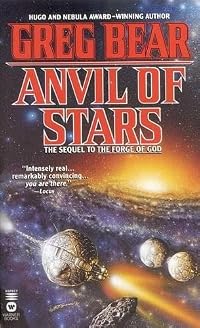
An intelligent and idea-rich follow-up to The Forge of God. After the events of that earlier novel, in which Earth was destroyed by an alien civilisation, we now follow some of the descendants of the survivors of humankind. Patronised by another benevolent alien civilisation, they travel through star systems on a 'Ship of the Law', seeking revenge on 'the Killers'.
One of the main strengths of the previous book was that it felt real and immediate, as our Earth was believably and terrifyingly unmade by the Killers' machines. This is, of course, lost in Anvil of Stars as it is more speculative: set in the distant future with advanced technologies and scientific developments and alien civilisations, it requires greater leaps of imagination show more and toleration. Author Greg Bear does well to keep it anchored but, unlike its predecessor, a lot of the pathos and emotion and anger has been lost. Bear remains as eloquent as ever in describing the mind-bending scientific concepts, but even more thrilling – for me – were the emotional gut-punches and twists. These remained as fascinating and well-told as in The Forge of God, but they were in much smaller quantities. Forge was as much a thriller as it was sci-fi; Anvil is most certainly sci-fi, and the deceptions were less frequent and less prominent.
This unmooring from earthier concepts – whilst necessary, given how the plot develops – does lead Anvil into some strange areas. Often, this is a good thing, as in the case of the aliens that the humans encounter. The 'Brothers' , as they are dubbed, are very believable, despite their strangeness and we begin to empathise and root for them almost as much as we do the humans. Similarly, the sheer epic scale of interstellar war and of supernovas and of planets being unmade is as rich as it was in Forge.
Elsewhere, Bear's strangeness is jarring. The humans' starship community is almost like a hippy commune. Most of the crew have weird names like Mountain Lily and Ginny Chocolate, and characters squat in the lotus position and speak earnestly of others' "personal treasure of spiritual solace" (pg. 192). Free love abounds, and the creepily-detailed sex scenes are both odd and often: an inadvisable position for a novel to find itself in. It creates a sort of tonal dissonance in the book: whilst we have characters speaking, dripping with raw vengeance, of turning the Killers' worlds to slag (pg. 147), we also have lines like "he had spoken with a staircase god, and drunk water from the fountain of Sleep." (pg. 420). For all its positive mind-bending ideas and excitements, there's also plenty that no staircase god or bishop vulture, no babar would understand.
This occasional flavour of oddness is prominent enough to be remarked upon, but it is by no means the main tone of the novel. Anvil of Stars is, primarily, a cathartic revenge quest for those terrorised by the obliteration of Earth and Bear fulfils this remit admirably. A lot of doubts are raised throughout this quest and many of the insecurities, deceptions and questions posed in The Forge of God are present again here, with many more raised. I particularly enjoyed this, as it allows the reader to truly interact with the book, even if my own speculations after reading the first book proved to be quite wide of the mark. Some questions still remain unanswered ([spoiler] not least that of the ghosts/shadows which start to be seen on the starship around the 100-page mark, or of the real role and benevolence of the 'moms' [end spoiler]) but the main threads are resolved and the ending is entirely representative of the tone of Anvil and its predecessor: epic and emotional. Just as the protagonist remarks amid the destruction on page 459, there is a melancholy thrill and grandeur in reading this novel, "watching worlds writhe and die across hours and days." show less
One of the main strengths of the previous book was that it felt real and immediate, as our Earth was believably and terrifyingly unmade by the Killers' machines. This is, of course, lost in Anvil of Stars as it is more speculative: set in the distant future with advanced technologies and scientific developments and alien civilisations, it requires greater leaps of imagination show more and toleration. Author Greg Bear does well to keep it anchored but, unlike its predecessor, a lot of the pathos and emotion and anger has been lost. Bear remains as eloquent as ever in describing the mind-bending scientific concepts, but even more thrilling – for me – were the emotional gut-punches and twists. These remained as fascinating and well-told as in The Forge of God, but they were in much smaller quantities. Forge was as much a thriller as it was sci-fi; Anvil is most certainly sci-fi, and the deceptions were less frequent and less prominent.
This unmooring from earthier concepts – whilst necessary, given how the plot develops – does lead Anvil into some strange areas. Often, this is a good thing, as in the case of the aliens that the humans encounter. The 'Brothers' , as they are dubbed, are very believable, despite their strangeness and we begin to empathise and root for them almost as much as we do the humans. Similarly, the sheer epic scale of interstellar war and of supernovas and of planets being unmade is as rich as it was in Forge.
Elsewhere, Bear's strangeness is jarring. The humans' starship community is almost like a hippy commune. Most of the crew have weird names like Mountain Lily and Ginny Chocolate, and characters squat in the lotus position and speak earnestly of others' "personal treasure of spiritual solace" (pg. 192). Free love abounds, and the creepily-detailed sex scenes are both odd and often: an inadvisable position for a novel to find itself in. It creates a sort of tonal dissonance in the book: whilst we have characters speaking, dripping with raw vengeance, of turning the Killers' worlds to slag (pg. 147), we also have lines like "he had spoken with a staircase god, and drunk water from the fountain of Sleep." (pg. 420). For all its positive mind-bending ideas and excitements, there's also plenty that no staircase god or bishop vulture, no babar would understand.
This occasional flavour of oddness is prominent enough to be remarked upon, but it is by no means the main tone of the novel. Anvil of Stars is, primarily, a cathartic revenge quest for those terrorised by the obliteration of Earth and Bear fulfils this remit admirably. A lot of doubts are raised throughout this quest and many of the insecurities, deceptions and questions posed in The Forge of God are present again here, with many more raised. I particularly enjoyed this, as it allows the reader to truly interact with the book, even if my own speculations after reading the first book proved to be quite wide of the mark. Some questions still remain unanswered ([spoiler] not least that of the ghosts/shadows which start to be seen on the starship around the 100-page mark, or of the real role and benevolence of the 'moms' [end spoiler]) but the main threads are resolved and the ending is entirely representative of the tone of Anvil and its predecessor: epic and emotional. Just as the protagonist remarks amid the destruction on page 459, there is a melancholy thrill and grandeur in reading this novel, "watching worlds writhe and die across hours and days." show less
For a time Greg Bear was THE name for hard sf that challenged readers with big ideas. This sequel to what was an absorbing 'end of the world' novel, 'Forge of God' is a perfect example of the author's strengths. Tasked with avenging Earth's destruction, a group of surviving Earth children set forth on a warship provided and run by the robot intelligences that saved humanity in the first place. But Earth itself was destroyed by automated weapons launched thousands of years ago. Where did they come from? And is visiting vengeance on the descendants of the civilization that built them so long ago truly justice? And by committing themselves to the task of vengeance, the humans are forever cutting themselves off from the humanity they knew. show more What then is their mission worth? The ambiguities in what seems like a straight-forward quest for revenge are endless and its these ambiguities that make this an outstanding novel of speculative fiction. show less
A very different book to The Forge of God, Anvil of Stars continues the story of the survivors of the destruction of Earth. A handful of survivors were rescued by an alien group called the Benefactors, and the youngest generation of survivors are sent forth to track down the originators of the von Neumann probes that destroyed the Earth. Their task is to carry out The Law – races that build destructive von Neumann probes must themselves be destroyed in a sort of interstellar lex talonis (‘an eye for an eye, a tooth for a tooth’). The Benefactors provide the nominated survivors with the tools for The Job – a ship and super weapons.
We join the protagonists on board the Ship of the Law Dawn Treader, searching for the rogue show more civilisation. The society these humans, barely out of their teens, has created is modelled heavily on Earth children’s tales and mythology; the ship’s name is, of course, drawn from C.S. Lewis’ Narnia books, and they refer to themselves as Lost Boys and Wendys, in reference to Peter Pan. The first section of the book is highly claustrophobic, and the combination of endless military training and a closed society of young people gives the whole story an air of being a combination of Ender’s Game and Lord of the Flies.
A target system is identified, and the crew set out to enforce the Law. But the system is a decoy, and the attack barely succeeds, and only at considerable cost in loss of life. The pov character, the leader, Martin (son of the main protagonist of The Forge of God"), relinquishes his position and a new leader takes the ship to the next target.
In the meantime, the ship is first of all directed to another Ship of the Law, a derelict, from which the crew retrieve records of a dead race who had the same Job, and failed. And then they rendezvous with a third Ship, whose alien crew are potential allies. These aliens are well-drawn, and certainly have little in common with the humans in form, biology and thought; their mathematics does not rely on integers, and they live as composite lifeforms, communicating by audible and olfactory senses.
Although they are quite likeable, some of the human crew cannot adjust to living and working in proximity – yet they have to press home their attack on the system now identified as the home of the builders of the original weapons. But are the inhabitants of this system all they seem? Are they the people who built the weapons that destroyed Earth? Or have those original builders died out, or moved on? And even if their descendants are the beings the crew encounter, to what extent is it right to impose a punishment on what might be an entire innocent civilisation?
There are no definitive answers, of course; so how valid is The Law? And what is the real obligation on the Lost Boys and Wendys to see it through? Whereas The Forge of God is pretty much a straightforward disaster story, Anvil of Stars asks a range of difficult questions, and also shows what happens when laws that were created a long time ago have to be enacted in the here and now. show less
We join the protagonists on board the Ship of the Law Dawn Treader, searching for the rogue show more civilisation. The society these humans, barely out of their teens, has created is modelled heavily on Earth children’s tales and mythology; the ship’s name is, of course, drawn from C.S. Lewis’ Narnia books, and they refer to themselves as Lost Boys and Wendys, in reference to Peter Pan. The first section of the book is highly claustrophobic, and the combination of endless military training and a closed society of young people gives the whole story an air of being a combination of Ender’s Game and Lord of the Flies.
A target system is identified, and the crew set out to enforce the Law. But the system is a decoy, and the attack barely succeeds, and only at considerable cost in loss of life. The pov character, the leader, Martin (son of the main protagonist of The Forge of God"), relinquishes his position and a new leader takes the ship to the next target.
In the meantime, the ship is first of all directed to another Ship of the Law, a derelict, from which the crew retrieve records of a dead race who had the same Job, and failed. And then they rendezvous with a third Ship, whose alien crew are potential allies. These aliens are well-drawn, and certainly have little in common with the humans in form, biology and thought; their mathematics does not rely on integers, and they live as composite lifeforms, communicating by audible and olfactory senses.
Although they are quite likeable, some of the human crew cannot adjust to living and working in proximity – yet they have to press home their attack on the system now identified as the home of the builders of the original weapons. But are the inhabitants of this system all they seem? Are they the people who built the weapons that destroyed Earth? Or have those original builders died out, or moved on? And even if their descendants are the beings the crew encounter, to what extent is it right to impose a punishment on what might be an entire innocent civilisation?
There are no definitive answers, of course; so how valid is The Law? And what is the real obligation on the Lost Boys and Wendys to see it through? Whereas The Forge of God is pretty much a straightforward disaster story, Anvil of Stars asks a range of difficult questions, and also shows what happens when laws that were created a long time ago have to be enacted in the here and now. show less
Earth is dead, reduced to rocks and dust by a horde of marauding alien machine intelligences. A few thousand Earthlings have been saved by the Benefactors, themselves machine intelligences who have helped the survivors re-establish themselves on Mars. That story was told in Greg Bear’s 1987 novel, The Forge of God.
Now, in Anvil of Stars, the sequel to Forge, three hundred years have gone by, and the Benefactors have outfitted 80 or so Earth children with a Ship of the Law capable of exacting revenge on the killer machines that destroyed their home. Three hundred years have gone by in a literal blink of the eye, as the children have been asleep, traveling at 99 percent of the speed of light. They begin training for what lies ahead of show more them: the willful destruction of an entire solar system full of intelligent beings.
This tightly plotted novel stands alone as a highly imaginative consideration of genocide. Enacting the Law of revenge is one thing; making sure you’ve got the true perpetrators of Earth’s destruction is another. Hundreds of years have passed—what if the killer machines and their makers have changed their ways?
The pleasures of this novel lie in Bear’s ability to weave together the action and pacing of a thriller with the philosophical puzzle of blame and the sociological complexities of a group of kids tutored by aliens so technologically advanced humans are simple animals by comparison. Simple animals, perhaps, but Bear always celebrates the ability of the human mind to learn and adapt. The alien Benefactors teach the human children a method of mathematical analysis called momerath, a kinetic visualization technique that enables them to calculate orbits in complex systems and develop weapons of unimaginable power.
A master of science fiction on an epic scale, Anvil of Stars has Bear operating on full imaginative power. Add to that the cultural relevance of the novel’s central themes – justice and genocide – and you’ve got a thriller as exciting and worthwhile today as when it was originally published in 1992.
Originally published on Curled Up with a Good Book. show less
Now, in Anvil of Stars, the sequel to Forge, three hundred years have gone by, and the Benefactors have outfitted 80 or so Earth children with a Ship of the Law capable of exacting revenge on the killer machines that destroyed their home. Three hundred years have gone by in a literal blink of the eye, as the children have been asleep, traveling at 99 percent of the speed of light. They begin training for what lies ahead of show more them: the willful destruction of an entire solar system full of intelligent beings.
This tightly plotted novel stands alone as a highly imaginative consideration of genocide. Enacting the Law of revenge is one thing; making sure you’ve got the true perpetrators of Earth’s destruction is another. Hundreds of years have passed—what if the killer machines and their makers have changed their ways?
The pleasures of this novel lie in Bear’s ability to weave together the action and pacing of a thriller with the philosophical puzzle of blame and the sociological complexities of a group of kids tutored by aliens so technologically advanced humans are simple animals by comparison. Simple animals, perhaps, but Bear always celebrates the ability of the human mind to learn and adapt. The alien Benefactors teach the human children a method of mathematical analysis called momerath, a kinetic visualization technique that enables them to calculate orbits in complex systems and develop weapons of unimaginable power.
A master of science fiction on an epic scale, Anvil of Stars has Bear operating on full imaginative power. Add to that the cultural relevance of the novel’s central themes – justice and genocide – and you’ve got a thriller as exciting and worthwhile today as when it was originally published in 1992.
Originally published on Curled Up with a Good Book. show less
"Anvil of Stars" sequel to "The Forge of God".. - just the titles alone are enuf to make me wary.. BUT, that sort of thing is par for the golf course of black holes in SF - so no biggie.. In other words, the title is so rotten-cheese-ball that many a sensitive literary type might avoid it.. BUT, I liked this bk. Bear's plots are GRANDIOSE. I vaguely recall reading that he & Greg Egan are 2 of the main 'hard science' SF writers (or maybe that's just what I thought at some point or another) - meaning that all their plots have to be backed up by significant scientific projection of the day.. BUT, this is basically pure SPACE OPERA. The plot? A group of young people, survivors from a destroyed Earth, are traveling in a "Ship of the Law" show more seeking out those responsible for Earth's destruction to avenge it. They form an alliance w/ another Ship of the Law populated by a dramatically different species from another planet that's been similarly ill-served. Regardless of how much this story pulls out all the melodramatic stops, its scale is impressive: How many people can imagine conflicts that loom this large? Not many.. & reading such tales stretches one's own sense of possible proportion. W/o getting into spoilers, though, the ethical problems in all this, while addressed, aren't delved into as satisfactorily as a sentient being truly concerned w/ such things might like. show less
I found this to be a disappointing sequel. It's combinations of Peter Pan (overtly)/Lord of the Flies/...Wrath of Khan??? ultimately didn't pay off. There are perhaps too many loose ends (who are the mom's creators, what did become of the solar system's humans, what happens with the Brothers, who/what/why the Killers, etc.)
Worse, the great moral dilemmas/plots that the entire last third of the book hinges around are not satisfactorily addressed. I.e., "Collateral damage on the scale of multiple-genocide just happened... anyway, moving on." I.e., "We've got a religious movement developing... oh, its leader is murdered... oh, its vice-leader is now vice-president. Ok, no worries, now its over." I.e., the entire pacifism versus... not so show more much violence, as revenge. (There is even a passage that comes tantalizingly close to, in my ears, an "obvious" debate about the efficacy -not even the morals- of the death penalty.) Which is subsumed in the larger WTF of committing genocide on a planetary-system-wide scale...
Uggh, frustrating. I feel like this is a case of over-ambitious storytelling. If this was a 900-1000 page book maybe... or treated in two separate books... or re-editted to... ugh. show less
Worse, the great moral dilemmas/plots that the entire last third of the book hinges around are not satisfactorily addressed. I.e., "Collateral damage on the scale of multiple-genocide just happened... anyway, moving on." I.e., "We've got a religious movement developing... oh, its leader is murdered... oh, its vice-leader is now vice-president. Ok, no worries, now its over." I.e., the entire pacifism versus... not so show more much violence, as revenge. (There is even a passage that comes tantalizingly close to, in my ears, an "obvious" debate about the efficacy -not even the morals- of the death penalty.) Which is subsumed in the larger WTF of committing genocide on a planetary-system-wide scale...
Uggh, frustrating. I feel like this is a case of over-ambitious storytelling. If this was a 900-1000 page book maybe... or treated in two separate books... or re-editted to... ugh. show less
Greg Bear and i have a teensy bit of a troubled relationship. i read him for ideas, so it's unfair to fault him on the entertainment end, but sometimes i just do. his ideas aren't always translated into engaging characters and/or story. but this one held my interest all the way through. bit stiff, but worth the read. a study of vengeance as a measure of humanity. i liked my ending better, though.*g*
Members
- Recently Added By
Author Information

140+ Works 47,105 Members
Greg Bear was born in San Diego, California, on August 20, 1951. He received a Bachelor of Arts degree from San Diego State University in 1973. At age 14, he began submitting pieces to magazines and at 15 he sold his first story to Robert Lowndes' Famous Science Fiction. It would be five years before he sold another piece, but by 23 he was selling show more stories regularly. He has written more than 30 science fiction and fantasy books and has won numerous awards for his work. In 1984, Hardfought and Blood Music won the Nebula Awards for best novella and novelette; Blood Music went on to win the Hugo Award. The novel version of that story, also called Blood Music, won the Prix Apollo in France. In 1987, Tangents won the Hugo and Nebula awards for best short story. He also won a Nebula in 1994 for Moving Mars and in 2001 for Darwin's Radio. Both Dinosaur Summer and Darwin's Radio have been awarded the Endeavour for best novel published by a Northwest science fiction author. He is also an illustrator and his work has appeared in Galaxy, Fantasy and Science Fiction, and Vertex, and in both hardcover and paperback books. He was a founding member of ASFA, the Association of Science Fiction Artists. His works include City at the End of Time, Hull Zero Three, The Mongoliad, Mariposa, Halo: Cryptum, Halo: Primordium and Halo: Silentium. (Bowker Author Biography) show less
Some Editions
Awards and Honors
Awards
Series

Belongs to Publisher Series
Work Relationships
Is a (non-series) sequel to
Common Knowledge
- Canonical title
- Anvil of Stars
- Original title
- Anvil of Stars
- Original publication date
- 1992-02
- People/Characters
- Martin Gordon
- Dedication
- For Dan Garrett, cousin and friend
- First words
- Marty sits in the front seat of his father's Buick, riding along a freeway in Oregon at midsummer twilight.
- Last words
- (Click to show. Warning: May contain spoilers.)There is shame in victory, and much to think about, and that is enough until we arrive and are young and fertile again.
- Original language
- English
Classifications
Statistics
- Members
- 1,853
- Popularity
- 11,592
- Reviews
- 20
- Rating
- (3.53)
- Languages
- Dutch, English, German, Italian
- Media
- Paper, Audiobook, Ebook
- ISBNs
- 21
- ASINs
- 15