Bird Brains: The Intelligence of Crows, Ravens, Magpies, and Jays
by Candace Savage
On This Page
Description
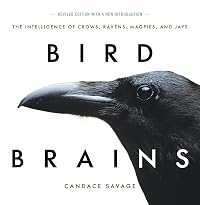
"Birds have long been viewed as the archetypal featherbrains--beautiful but dumb. But according to naturalist Candace Savage, "bird brain," as a pejorative expression, should be rendered obsolete by new research on the family of corvids: crows and their close relations. The ancients who regarded these remarkable birds as oracles, bringers of wisdom, or agents of vengeance were on the right track, for corvids appear to have powers of abstraction, memory, and creativity that put them on a par show more with many mammals, even higher primates. Bird Brains presents these bright, brassy, and surprisingly colorful birds in a remarkable collection of full-color, close-up photographs by some two dozen of the world's best wildlife photographers. Savage's lively, authoritative text describes the life and behavior of sixteen representative corvid species that inhabit North America and Europe. Drawing on recent research, she describes birds that recognize each other as individuals, call one another by "name," remember and relocate thousands of hidden food caches, engage in true teamwork and purposeful play, and generally exhibit an extraordinary degree of sophistication."--Provided by publisher. show lessTags
Recommendations




Member Recommendations
Member Reviews
An absolutely beautiful book! The photographs alone make it worth picking this one up.
Candace Savage takes the reader through the latest research on corvids -- crows, ravens, magpies and jays. She takes us through what is known and not known about how these birds think. These birds are so fascinating -- they use tools, they form complex social relationships and seem to have memory and the ability to reason. As the author says, calling someone a bird brain may be a compliment.
Candace Savage takes the reader through the latest research on corvids -- crows, ravens, magpies and jays. She takes us through what is known and not known about how these birds think. These birds are so fascinating -- they use tools, they form complex social relationships and seem to have memory and the ability to reason. As the author says, calling someone a bird brain may be a compliment.
I love it when even an older book can teach me something! Even though I've read other, newer books on bird intelligence and behavior, I didn't know that some types of jays and crows have nest helpers. These are usually offspring from previous years who come back to their parents. They are there primarily to learn how to select nest sites, build nests, raise chicks, find food and other parental duties. Eventually they help feed the nestlings. Some birds do this for 3-4 years before setting up their own households. Studies have shown that birds who do this are better and more successful parents than birds who don't.
A note about the photography - it's great to see film again. It has a particular quality of contrast, grain and color show more separation that digital, for all it's precision and high-resolution just doesn't have. A lot of the shots were taken in low light and have slower shutter speeds and so have some motion-blur. Just lovely. show less
A note about the photography - it's great to see film again. It has a particular quality of contrast, grain and color show more separation that digital, for all it's precision and high-resolution just doesn't have. A lot of the shots were taken in low light and have slower shutter speeds and so have some motion-blur. Just lovely. show less
This over-sized, beautiful and bold book on birds is entertaining on a multitude of levels. You don't have to be an avid birder to appreciate Bird Brains for its witty, informative text and drop dead gorgeous photography. The premise for Bird Brains is the intelligence of the crow family. The argument for how smart they are is illustrated in the bird's ability to adapt to changing conditions, ingenious nesting techniques, strategic enticing of a mate, uncanny voice recognition of their young, social nature such as showing off and much, much more. I was intrigued to learn of corvid "societies." These birds congregate in avian clans. For example, the Jackdaws live in society regardless of the season and participate in communal activities show more such as feeding and roosting. show less
A beautiful photographic essay text that tells of the intelligence of birds in the corvid or crow family. Stunning close-up photographs of various corvids fill the pages and the author tells the story of corvids with supporting research. The text has a conversational tone and at times is humorous. The author titles one of the chapters "Bread and Butter Issues" and proceeds to discuss the many ways corvids obtain food. This was a great book to have in the classroom for a study of bird identification and animal intelligence. I personally will never look at a crow the same as I used to just knowing how intelligent they really are after reading this book.
About the shape of a coffee table book, with lots of gorgeous photos. But unlike the heavy hardbacks we grew up with, this is actually meant to be read. Good science, engagingly told. Corvids are even more amazing than I imagined. And some, for example the Siberian jay, are quite pretty. If you've ever read about Raven the Trickster, or clever jackdaws, or wondered if parrots were the only intelligent birds, you want to read this book. It's relatively short, but worth spending time with. Includes an extensive chapter-by-chapter bibliography, and an index.
A thoroughly engaging look at members of the crow/jay families of birds. There are enough references to scientific studies to give credence to the author's suppositions, but not so much to bog it down with scientific jargon. Oh, and the photographs are gorgeous. Though I've been birding for half a century, I came across some information with which I was unfamiliar. Nice read.
Bird-brain is by no means an insult. When I happened upon this book at the library, I was delighted by the potential mix of one of my passions, animal intelligence, and positive PR for a widely maligned species. Alas, then, when I discovered this book was heavy on the pictures, light on the intelligence studies--none of the three studies most widely publicized studies I knew of concerning crow intelligence were mentioned.
Despite pretensions at erudition, this is clearly a coffee-table book. Bird Brains contains beautiful pictures, lovely quotes, bits of folklore and mythology. Oh yes, and alliterative cleverness in the form of the title and table of contents ('Brainy Birds,' 'Beginnings,' 'Belonging,' 'Bread and Butter Issues'). Oy. show more Organization is jumbled, with full-page pictures and sidebar quotes breaking up the writing almost every other page. Photos clearly show the Sierra Club publishing heritage--the photos are gorgeous and detailed, and without doubt calendar-worthy. Overall, however, it is heavier on the gloss than information. Much of the material is general biology related, educating the reader about nesting, growth, and foraging. Studies mentioned are usually in context of 'natural' behavior, or birds reacting and adapting to environmental changes such as selection of nesting sites by experienced birds.
Ideally, it would have contained more science about 'intelligence' and less description and analysis of 'natural' behaviors. Want to know just how smart crows and corvids are? Check out these studies:
The first comes from a fortunate accident in the midst of studying crow selection of tools. Tool-use was originally considered one of the distinguishing characteristics of human intelligence, but when we discovered other species use objects/tools, we added the caveat of tool creation. A pair of crows were given access to two tools, one wire with a hook at the end and the other a straight wire. Their favorite treat was then hidden beneath a bell-like container with a loop at the top. The male used the hooked wire, obtained his treat, and being male, flew off with his tool. The female, left frustrated without a useable tool, took the straight wire and made a hook at the end. Here was an example of a crow fashioning a tool out of a material she had never used-–she had only used pipecleaners over a year before this study.
Video of the crow using a hooked wire to access treats: http://www.youtube.com/watch?v=efcIsve5wu8
Crows seem to have a knack for thwarting researchers’ aims. Once again, study innovation resulted from accidental findings. As part of a 5 year study, scientists trapped and banded baby crows in the area. Every year the researchers came back, they found themselves dive-bombed and attacked by a flock of angry crows, even ones that had nothing to do with the banding. Wondering at how unfamiliar crows learned that the researchers were 'dangerous' turned into another study examining facial recognition. This time researchers did the banding wearing masks--a caveman and a Dick Cheney mask (the primary researcher is not without humor). Crows reacted more strongly when re-exposed to the caveman mask, the one used for the banding/crownapping behavior. Then, when new people wore the masks while walking in the area, not even attempting threatening behavior, the crows responded with warning cries and mobbing behavior. The author theorizes the crows are teaching other crows in their flocks, and long-term studies seem to bear it out–Marzluff reports 47 of 53 crows seen reacted to him on a recent walk when he wore one of the banding masks.
The final interesting study has been surrounded by some controversy, and research clouded by anecdotal reports. Crows are one of at least three avian species that know how to break open food sources by dropping them from heights. Urban stories exist of them using cars as part of the process, even garnering a mention in an Attenborough production: http://www.youtube.com/watch?v=BGPGknpq3e0 However, a study analyzing reports of such behavior in California do not prove reliance on cars, only use of the 'dropping' method. It is worth noting, however, that apparently they vary heights based on food type, a highly complex and learned behavior.
Upshot? Looking for a sophisticated discussion of corvid intelligence, this likely would not be your best bet. However, it is a decent introduction to crow behavior that would appeal to the highly visual reader.
***************************************
For my science-geek readers, the original article on crows and tool use is at http://www.sciencemag.org/content/297/5583/981.full.pdf?sid=d5fb42ee-1d98-41ef-a...
The free NYT article on facial recognition: http://www.nytimes.com/2008/08/26/science/26crow.html?_r=0
The scholarly article on facial recognition: http://www.sciencedirect.com/science/article/pii/S0003347209005806
The article on nut-dropping: http://beheco.oxfordjournals.org/content/10/3/220.full show less
Despite pretensions at erudition, this is clearly a coffee-table book. Bird Brains contains beautiful pictures, lovely quotes, bits of folklore and mythology. Oh yes, and alliterative cleverness in the form of the title and table of contents ('Brainy Birds,' 'Beginnings,' 'Belonging,' 'Bread and Butter Issues'). Oy. show more Organization is jumbled, with full-page pictures and sidebar quotes breaking up the writing almost every other page. Photos clearly show the Sierra Club publishing heritage--the photos are gorgeous and detailed, and without doubt calendar-worthy. Overall, however, it is heavier on the gloss than information. Much of the material is general biology related, educating the reader about nesting, growth, and foraging. Studies mentioned are usually in context of 'natural' behavior, or birds reacting and adapting to environmental changes such as selection of nesting sites by experienced birds.
Ideally, it would have contained more science about 'intelligence' and less description and analysis of 'natural' behaviors. Want to know just how smart crows and corvids are? Check out these studies:
The first comes from a fortunate accident in the midst of studying crow selection of tools. Tool-use was originally considered one of the distinguishing characteristics of human intelligence, but when we discovered other species use objects/tools, we added the caveat of tool creation. A pair of crows were given access to two tools, one wire with a hook at the end and the other a straight wire. Their favorite treat was then hidden beneath a bell-like container with a loop at the top. The male used the hooked wire, obtained his treat, and being male, flew off with his tool. The female, left frustrated without a useable tool, took the straight wire and made a hook at the end. Here was an example of a crow fashioning a tool out of a material she had never used-–she had only used pipecleaners over a year before this study.
Video of the crow using a hooked wire to access treats: http://www.youtube.com/watch?v=efcIsve5wu8
Crows seem to have a knack for thwarting researchers’ aims. Once again, study innovation resulted from accidental findings. As part of a 5 year study, scientists trapped and banded baby crows in the area. Every year the researchers came back, they found themselves dive-bombed and attacked by a flock of angry crows, even ones that had nothing to do with the banding. Wondering at how unfamiliar crows learned that the researchers were 'dangerous' turned into another study examining facial recognition. This time researchers did the banding wearing masks--a caveman and a Dick Cheney mask (the primary researcher is not without humor). Crows reacted more strongly when re-exposed to the caveman mask, the one used for the banding/crownapping behavior. Then, when new people wore the masks while walking in the area, not even attempting threatening behavior, the crows responded with warning cries and mobbing behavior. The author theorizes the crows are teaching other crows in their flocks, and long-term studies seem to bear it out–Marzluff reports 47 of 53 crows seen reacted to him on a recent walk when he wore one of the banding masks.
The final interesting study has been surrounded by some controversy, and research clouded by anecdotal reports. Crows are one of at least three avian species that know how to break open food sources by dropping them from heights. Urban stories exist of them using cars as part of the process, even garnering a mention in an Attenborough production: http://www.youtube.com/watch?v=BGPGknpq3e0 However, a study analyzing reports of such behavior in California do not prove reliance on cars, only use of the 'dropping' method. It is worth noting, however, that apparently they vary heights based on food type, a highly complex and learned behavior.
Upshot? Looking for a sophisticated discussion of corvid intelligence, this likely would not be your best bet. However, it is a decent introduction to crow behavior that would appeal to the highly visual reader.
***************************************
For my science-geek readers, the original article on crows and tool use is at http://www.sciencemag.org/content/297/5583/981.full.pdf?sid=d5fb42ee-1d98-41ef-a...
The free NYT article on facial recognition: http://www.nytimes.com/2008/08/26/science/26crow.html?_r=0
The scholarly article on facial recognition: http://www.sciencedirect.com/science/article/pii/S0003347209005806
The article on nut-dropping: http://beheco.oxfordjournals.org/content/10/3/220.full show less
Members
- Recently Added By
Lists

Books Read in 2019
4,052 works; 110 members

Favorite Animal Non-Fiction
293 works; 144 members
Author Information

43 Works 1,966 Members
Candace Savage is the author of more than two dozen books, including Strangers in the House and A Geography of Blood, which won the Hilary Weston Writers' Trust Prize for Nonfiction. She divides her time between homes in Eastend and Saskatoon, Saskatchewan. Visit her at candacesavage.ca.
Awards and Honors
Common Knowledge
- Canonical title
- Bird Brains: The Intelligence of Crows, Ravens, Magpies, and Jays
- Original publication date
- 1995
- First words
- It was just an ordinary crow, its shiny black feathers sleek against the pale spring morning.
- Last words
- (Click to show. Warning: May contain spoilers.)By their example, crows, ravens, magpies and jays call us to open our minds to the full possibilities of intelligence - our own as well as theirs.
Classifications
Statistics
- Members
- 404
- Popularity
- 76,757
- Reviews
- 11
- Rating
- (4.19)
- Languages
- English
- Media
- Paper
- ISBNs
- 5
- ASINs
- 2