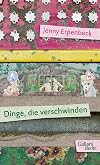
Things That Disappear: Reflections and Memories
by Jenny Erpenbeck
On This Page
Description
An exciting new collection of autobiographical essays by Jenny Erpenbeck, winner of the 2024 Booker International Prize: "She is among the most sophisticated and powerful novelists we have-it's no surprise that she is already bruited as a future Nobelist." -Dwight Garner, The New York TimesTags
Recommendations


































Member Reviews
This book is not quite what I anticipated when I reserved it from the library. Jenny Erpenbeck was born in East Germany in 1967 (just a little earlier than me), and she grew up in an intellectual, literary family, who have apparently been described as part of the GDR's cultural elite. Her most recent novel, Kairos, was about a woman of about the same age as the author and seemed to be, possibly, somewhat autobiographical.
Things That Disappear, published in book form in 2011 in Germany, and in English translation in the UK and US last year, is a collection of very short pieces (mostly just two pages), first written as a series of newspaper columns for the Frankfurter Allgemeine Zeitung. They contain glimpses of political and social show more changes in Germany since the end of the GDR, other communist regimes in central and eastern Europe and reunification of the country.
The first article is about the Palace of the Republic, a cultural centre in East Berlin built in the 1970s, where the young Jenny Erpenbeck went to concerts and cafes, sports activities and first dates, now demolished and replaced by a new arts centre. Several of the other pieces are about demolition and redevelopment, including one about the method of destruction. A slightly longer article is about a visit to the Warsaw Ghetto in Poland, where a Jewish community resisted the German Nazis who had taken over the city. Most of the houses that were not destroyed at that time have since been demolished and replaced by new buildings whose occupants have little interest in remembering this history.
When I first read it a few weeks ago, I was disappointed that the pieces were so short, with frustrating glimpses into interesting stories but no space for development, but looking through it, I can see how these pieces do have unifying themes, and I would like to reread it more carefully. show less
Things That Disappear, published in book form in 2011 in Germany, and in English translation in the UK and US last year, is a collection of very short pieces (mostly just two pages), first written as a series of newspaper columns for the Frankfurter Allgemeine Zeitung. They contain glimpses of political and social show more changes in Germany since the end of the GDR, other communist regimes in central and eastern Europe and reunification of the country.
The first article is about the Palace of the Republic, a cultural centre in East Berlin built in the 1970s, where the young Jenny Erpenbeck went to concerts and cafes, sports activities and first dates, now demolished and replaced by a new arts centre. Several of the other pieces are about demolition and redevelopment, including one about the method of destruction. A slightly longer article is about a visit to the Warsaw Ghetto in Poland, where a Jewish community resisted the German Nazis who had taken over the city. Most of the houses that were not destroyed at that time have since been demolished and replaced by new buildings whose occupants have little interest in remembering this history.
When I first read it a few weeks ago, I was disappointed that the pieces were so short, with frustrating glimpses into interesting stories but no space for development, but looking through it, I can see how these pieces do have unifying themes, and I would like to reread it more carefully. show less
Ratings
Members
- Recently Added By
Published Reviews
ThingScore 75
Jenny Erpenbeck wrote the pieces collected in this compact yet kaleidoscopic book for a column in the newspaper Frankfurter Allgemeine Zeitung; published in German in 2009, they now appear in an English translation by Kurt Beals, following the immense success of Erpenbeck’s novel Kairos, which won the 2024 International Booker prize.
It’s interesting and instructive to reflect on what show more German newspaper readers made of the column in the early years of the new millennium, nearly two decades on from the fall of the Berlin Wall. For while Erpenbeck adopted some of the features of the form – apparently throwaway observations on daily life, such as minor irritation at the difficulty of sourcing proper splitterbrötchen, an unpretentious pastry now pimped for a more elaborate and wealthy clientele – she consistently enlarged and complicated it. Into that recognisable tone of ennui and mild querulousness with which journalists hope to woo a time-pressed but disenchanted or nostalgic readership, Erpenbeck smuggled metaphysics, politics and history.
As in her fiction, her attention is drawn to the irrefutable power of contingency. As a child and adolescent, she was an East German; entering adulthood, she finds that her country no longer exists and that personal, family, social and political histories have been compressed into the suddenly appearing moment. If the collapse of the Berlin Wall was an easily grasped symbol, dramatic in its intensity and immediacy, what happened to the places and the people in the hours, days and years that followed? Put in more abstract philosophical terms, what is the status of an object after it has disappeared, a person after they have died, a renamed and reconfigured state, an altered identity?
Contingency tells us that it depends. That splitterbrötchen, for example: a sweet, plain item “rather jumbled up, as if the baker had stuck all the leftover scraps of dough together” is now a far more refined affair, involving layers of puff pastry, techniques and processes, a thumb pressed into the dough “to let air in”. “Air!?!” exclaims Erpenbeck. “For the first time, it strikes me that the word disappear has something active at its core, that there is a perpetrator in the word.”
The pieces are necessarily short, and Erpenbeck leaves the reader to flesh out what she implies and only occasionally makes more explicit, as in the question of the disappearing drip-catcher – a once ubiquitous and low-tech gadget deployed to save East German tablecloths from coffee spills, now made obsolete as coffee pots have been replaced by Italian espresso-makers.
These domestic concerns are inflected with irony and humour, but several of the pieces address larger and more significant absences. When Erpenbeck visits the site of the Warsaw Ghetto, describing the modern hotel where “glass elevators go up and down inside a glass tube” and chestnut trees flourish only in areas beyond the rebuilt zone, she reveals a memorable detail: that “there’s often a small slope to the right and left of the sidewalk, overgrown with grass and bushes, and the buildings themselves sit a bit higher”, because they have been constructed on the rubble and the foundations of old houses burnt to the ground by the Germans.
Writing in miniature demands the exemplary and the material: something concrete to conjure a picture, to anchor a thought. But Erpenbeck is just as concerned with how such profound alterations affect intellect and emotion, how they redraw mental landscapes and interior life. Recalling people that she has lost – “R.”, whose fully charged shaver she collected from the hospital the day after his death, or her grandmother’s gnarled hands – she considers how her instinct to preserve is taking shape. She is forming a habit, she tells us, of trying to capture aspects of the “perfectly alive” people around her and imagining them as pieces of film, “as if I could select my memories in advance and learn them by heart, so that I could be sure to recall them later”. show less
It’s interesting and instructive to reflect on what show more German newspaper readers made of the column in the early years of the new millennium, nearly two decades on from the fall of the Berlin Wall. For while Erpenbeck adopted some of the features of the form – apparently throwaway observations on daily life, such as minor irritation at the difficulty of sourcing proper splitterbrötchen, an unpretentious pastry now pimped for a more elaborate and wealthy clientele – she consistently enlarged and complicated it. Into that recognisable tone of ennui and mild querulousness with which journalists hope to woo a time-pressed but disenchanted or nostalgic readership, Erpenbeck smuggled metaphysics, politics and history.
As in her fiction, her attention is drawn to the irrefutable power of contingency. As a child and adolescent, she was an East German; entering adulthood, she finds that her country no longer exists and that personal, family, social and political histories have been compressed into the suddenly appearing moment. If the collapse of the Berlin Wall was an easily grasped symbol, dramatic in its intensity and immediacy, what happened to the places and the people in the hours, days and years that followed? Put in more abstract philosophical terms, what is the status of an object after it has disappeared, a person after they have died, a renamed and reconfigured state, an altered identity?
Contingency tells us that it depends. That splitterbrötchen, for example: a sweet, plain item “rather jumbled up, as if the baker had stuck all the leftover scraps of dough together” is now a far more refined affair, involving layers of puff pastry, techniques and processes, a thumb pressed into the dough “to let air in”. “Air!?!” exclaims Erpenbeck. “For the first time, it strikes me that the word disappear has something active at its core, that there is a perpetrator in the word.”
The pieces are necessarily short, and Erpenbeck leaves the reader to flesh out what she implies and only occasionally makes more explicit, as in the question of the disappearing drip-catcher – a once ubiquitous and low-tech gadget deployed to save East German tablecloths from coffee spills, now made obsolete as coffee pots have been replaced by Italian espresso-makers.
These domestic concerns are inflected with irony and humour, but several of the pieces address larger and more significant absences. When Erpenbeck visits the site of the Warsaw Ghetto, describing the modern hotel where “glass elevators go up and down inside a glass tube” and chestnut trees flourish only in areas beyond the rebuilt zone, she reveals a memorable detail: that “there’s often a small slope to the right and left of the sidewalk, overgrown with grass and bushes, and the buildings themselves sit a bit higher”, because they have been constructed on the rubble and the foundations of old houses burnt to the ground by the Germans.
Writing in miniature demands the exemplary and the material: something concrete to conjure a picture, to anchor a thought. But Erpenbeck is just as concerned with how such profound alterations affect intellect and emotion, how they redraw mental landscapes and interior life. Recalling people that she has lost – “R.”, whose fully charged shaver she collected from the hospital the day after his death, or her grandmother’s gnarled hands – she considers how her instinct to preserve is taking shape. She is forming a habit, she tells us, of trying to capture aspects of the “perfectly alive” people around her and imagining them as pieces of film, “as if I could select my memories in advance and learn them by heart, so that I could be sure to recall them later”. show less
added by kleh
Lists

Books Read in 2025
4,128 works; 98 members

Books Read in 2026
2,063 works; 69 members
Author Information

23+ Works 4,118 Members
Jenny Erpenbeck was born on March 12, 1967 in East Berlin. She is a German director and writer. In Berlin she attended an Advanced High School, where she graduated in 1985. She then completed a two-year apprenticeship as a bookbinder before working at several theaters as props and wardrobe supervisor. From 1988 to 1990 Erpenbeck studied theatre at show more the Humboldt University of Berlin. In 1990 she changed her studies to Music Theater Director studying with Ruth Berghaus. After the completion of her studies in 1994 she spent some time as an assistant director at the opera house in Graz, where in 1997 she did her own productions of Schoenberg's Erwartung, Bartók's Duke Bluebeard's Castle and a world premiere of her own piece Cats Have Seven Lives. As a freelance director, she directed in 1998 different opera houses in Germany and Austria, including Monteverdi's L'Orfeo in Aachen, Acis and Galatea at the Berlin State Opera and Wolfgang Amadeus Mozart's Zaide in Nuremberg/Erlangen. In the 1990s Erpenbeck started a writing career in addition to her directing. She is author of narrative prose and plays: in 1999, History of the Old Child, her debut; in 2001, her collection of stories Trinkets; in 2004, the novella Dictionary; and in February 2008, the novel Visitation. In March 2007, Erpenbeck took over a column by Nicole Krauss in the Frankfurter Allgemeine Zeitung. In 2015 won the Independent Foreign Fiction Prize with her title The End of Days. (Bowker Author Biography) show less
Some Editions
Awards and Honors
Awards
Distinctions
The Guardian Book of the Day (2025-11-21)
Common Knowledge
- Canonical title
- Things That Disappear: Reflections and Memories
- Important places
- Berlin, Germany
- Original language
- German
Classifications
- Genres
- Fiction and Literature, General Fiction, Biography & Memoir
- DDC/MDS
- 834.914 — Literature & rhetoric German & related literatures German essays 1900- 1900-1990 1945-1990
- LCC
- PT2665 .R59 .D5613 — Language and Literature German, Dutch and Scandinavian literatures German literature Individual authors or works 1961-2000
- BISAC
Statistics
- Members
- 70
- Popularity
- 448,964
- Reviews
- 1
- Rating
- (3.64)
- Languages
- Dutch, English, German
- Media
- Paper, Ebook
- ISBNs
- 6
- ASINs
- 2