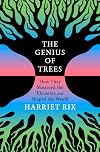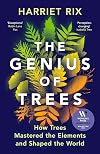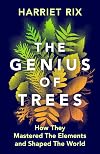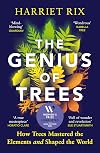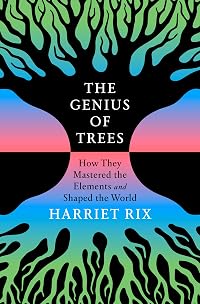
The Genius of Trees: How They Mastered the Elements and Shaped the World
by Harriet Rix
On This Page
Description
"For a supposedly stationary life-form, trees have demonstrated an astonishing mastery over the environment around them. In The Genius of Trees, tree scientist Harriet Rix reveals the inventive ways trees sculpt their environment and explains the science of how they achieve these incredible feats. Taking us on an awe-inspiring journey through deep history and unseen biochemistry across the globe, Rix restores trees to their rightful station, not as victims of our negligence but as ingenious, show more stunningly inventive agents in a grand ecological narrative. Trees manipulate fundamental elements, plants, animals, bacteria, fungi, and even humankind to achieve their ends, as seen with oaks in Devon, England, shaping ecosystems through root networks and fungi, and in Amedi, Iraq, changing sexes as they age; laurel rainforests in the Canary Islands regulating water cycles; and metasequoias in California influencing microclimates. Some tree species have gone to extraordinary lengths to make sure their fruits reach large primates, who can spread their seeds over vast distances, while poisoning smaller and less useful mammals. Others can split solid rock and create fertile ground in barren landscapes, effectively building entire ecosystems from scratch. And new discoveries are constantly coming to light: research has shown that trees have an even greater role in preventing global warming than we thought--trees, at one time thought to produce methane actually consume it. We share one world with trees and one need for survival. This eye-opening journey into the inner lives of nature's most powerful plant is a profoundly new and original way of understanding both the miracles trees perform and the glories of our natural world." -- Amazon. show lessTags
Recommendations























Member Reviews
This is a great book for broadening the mind of the average reader. For many, me included, popular science-fact, and explanations of evolution tend to focus almost exclusively on animals. So to have the evolution of plants and trees as the focus of a book is an excellent addition.
I'm almost embarrassed by how much I didn't know! But the author is such a passionate lover of trees that the reader gets swept up with her.
One serious gripe. The author continually presents evolutionary change as directed, planned, as delivering a needed outcome. This is, of course, tosh. Evolutionary change is totally random and undirected. Changes that aren't helpful don't get noticed - the plant dies, or any change is insignificant. The ones that do work show more seem amazing, and lead to gushing prose. But trees don't develop a particular chemical to lure insects, for example. The change happens, and the insects get lured, and looking back afterwards it seems like a wonderfully planned system. It's not. It's chance. show less
I'm almost embarrassed by how much I didn't know! But the author is such a passionate lover of trees that the reader gets swept up with her.
One serious gripe. The author continually presents evolutionary change as directed, planned, as delivering a needed outcome. This is, of course, tosh. Evolutionary change is totally random and undirected. Changes that aren't helpful don't get noticed - the plant dies, or any change is insignificant. The ones that do work show more seem amazing, and lead to gushing prose. But trees don't develop a particular chemical to lure insects, for example. The change happens, and the insects get lured, and looking back afterwards it seems like a wonderfully planned system. It's not. It's chance. show less
The Genius of Trees by Harriet Rix tells the scientific story of how trees came to be, developed, evolved and influenced the spaces and creatures around them.
In this fascinating look, Rix covers how trees-- through interactions at the atomic level, tree structure and engineering, to growth patterns—are able to draw water to themselves and support optimal moisture levels. Roots crunch through rocks developing soil for themselves, purify air through chemicals that are released, and get animals to spread their seeds so that they can develop a wider growing area. There is quite a bit beyond average science description and content. For example: “Let’s follow a phenylpropanoid molecule as it seeds a cloud. A sacrifice of Apollonius, a show more tree related to avocado, 2-(3-mehtoxy-4 hydroxyphenyl)-1-3-porpanediol’s structure was defined in 1995 and...it looks simple: a hexagonal ring of carbon, with one carbon arm sticking out, and various prickles of hydrogen and oxygen attached.”
This is also a travel log that takes the author to multiple amazing places around the globe as they research various aspects of trees. This is particularly enjoyable and does help to put some of the science in context.
This ultimately leads to a main issue with the book. It is more involved in describing scientific processes than a more casual reader, or even one with a great interest in trees, is likely to want to wade through. On the other hand, it isn’t a textbook or similar, so will it appeal to the scientific community? It may, but I’m not sure that they would appreciate the travel parts. It just is not clear who the audience is for this book.
Overall, this appears to be very well researched and makes some interesting points to reframe how trees work in their environment.
Thank you to NetGalley and Crown Publishing for the free eARC. show less
In this fascinating look, Rix covers how trees-- through interactions at the atomic level, tree structure and engineering, to growth patterns—are able to draw water to themselves and support optimal moisture levels. Roots crunch through rocks developing soil for themselves, purify air through chemicals that are released, and get animals to spread their seeds so that they can develop a wider growing area. There is quite a bit beyond average science description and content. For example: “Let’s follow a phenylpropanoid molecule as it seeds a cloud. A sacrifice of Apollonius, a show more tree related to avocado, 2-(3-mehtoxy-4 hydroxyphenyl)-1-3-porpanediol’s structure was defined in 1995 and...it looks simple: a hexagonal ring of carbon, with one carbon arm sticking out, and various prickles of hydrogen and oxygen attached.”
This is also a travel log that takes the author to multiple amazing places around the globe as they research various aspects of trees. This is particularly enjoyable and does help to put some of the science in context.
This ultimately leads to a main issue with the book. It is more involved in describing scientific processes than a more casual reader, or even one with a great interest in trees, is likely to want to wade through. On the other hand, it isn’t a textbook or similar, so will it appeal to the scientific community? It may, but I’m not sure that they would appreciate the travel parts. It just is not clear who the audience is for this book.
Overall, this appears to be very well researched and makes some interesting points to reframe how trees work in their environment.
Thank you to NetGalley and Crown Publishing for the free eARC. show less
Ratings
Members
- Recently Added By
Published Reviews
ThingScore 100
What, then, is the genius of trees? Rix locates it in the elegant solutions they have devised to the constantly changing riddle of life. It’s a genius you can smell in the rich terpenes given off by trees to seed clouds, generating rain and expanding their own habitats. It’s a genius you can taste in the sweet fruit that makes animals do trees’ bidding, and arguably gave our simian show more ancestors their brains. It’s a vast, generative genius that has nurtured our own. Our clever fingers – and fingerprints – evolved to grip their branches. Our dreams were born in the safe, fragrant nests we built in their canopies. This is why, Rix argues, we find the smell of wood so comforting, and why we like to press our noses between the pages of books. Genius is too small a word for all of this. show less
added by SandraArdnas
Lists

Sandra's Wishlist
57 works; 1 member

The Wainwright Prizes 2026
24 works; 1 member
Author Information

2+ Works 84 Members
Awards and Honors
Awards
Distinctions
Notable Lists
Common Knowledge
- Original title
- The Genius of Trees: How They Mastered the Elements and Shaped the World
- Original publication date
- 2025
- Original language
- English
Classifications
- Genres
- Science & Nature, Nonfiction, General Nonfiction
- DDC/MDS
- 582.16 — Natural sciences & mathematics Plants (Botany) Plants noted for specific vegetative characteristics and flowers Herbaceous and woody plants, plants noted for their flowers Trees
- LCC
- QK477 .R59 — Science Botany Botany Spermatophyta. Phanerogams
- BISAC
Statistics
- Members
- 82
- Popularity
- 388,914
- Reviews
- 2
- Rating
- (4.33)
- Languages
- English
- Media
- Paper, Ebook
- ISBNs
- 8
- ASINs
- 2