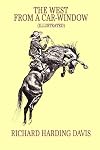
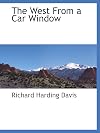
The West from a car-window
by Richard Harding Davis
37 Members (4.00)
On This Page
Description
Excerpt: "It is somewhat disturbing to one who visits the West for the first time with the purpose of writing of it, to read on the back of a railroad map, before he reaches Harrisburg, that Texas "is one hundred thousand square miles larger than all the Eastern and Middle States, including Maryland and Delaware." It gives him a sharp sensation of loneliness, a wish to apologize to some one, and he is moved with a sudden desire to get out at the first station and take the next train back, show more before his presumption is discovered. He might possibly feel equal to the fact that Texas is "larger than all of the Eastern and Middle States," but this easy addition of one hundred thousand square miles, and the casual throwing in of Maryland and Delaware like potatoes on a basket for good measure, and just as though one or two States more or less did not matter, make him wish he had sensibly confined his observations to that part of the world bounded by Harlem and the Battery. If I could travel over the West for three years, I might write of it with authority; but when my time is limited to three months, I can only give impressions from a car-window point of view, and cannot dare to draw conclusions. I know that this is an evident and cowardly attempt to "hedge" at the very setting forth. But it is well to understand what is to follow. All that I may hope to do is to tell what impressed an Eastern man in a hurried trip through the Western States. I will try to describe what I saw in such a way that those who read may see as much as I saw with the eyes of one who had lived in the cities of the Eastern States, but the moral they draw must be their own, and can differ from mine as widely as they please." show lessTags
Recommendations




















Member Reviews
Members
- Recently Added By
Lists

Geography and Travel from The Book-Lover
291 works; 1 member
Author Information

98+ Works 1,256 Members
Author and journalist Richard Harding Davis was born in Philadelphia on April 18, 1864. After studying at Lehigh and Johns Hopkins universities, he became a reporter and in 1890, he was the managing editor of Harper's Weekly. On assignments, he toured many areas of the world and recorded his impressions of the American West, Europe, and South show more America in a series of books. As a foreign correspondent, he covered every war from the Greco-Turkish to World War I and published several books recording his experiences. In 1896, he became part of William Randolph Hearst's unproven plot to start the Spanish-American War in order to boost newspaper sales when Hearst sent him and illustrator Frederick Remington to cover the Cuban rebellion against Spanish rule. In Cuba, Davis wrote several articles that sparked U.S. interest in the struggles of the Cuban people, but he resigned when Hearst changed the facts in one of his stories. Davis was aboard the New York during the bombing of Mantanzas, which gave the New York Herald a scoop on the war. As a result, the U.S. Navy prohibited reporters from being aboard any U.S. ships for the rest of the Cuban conflict. Davis was captured by the German Army in 1914 and was threatened with execution as a spy. He eventually convinced them he was a reporter and was released. He is considered one of the most influential reporters of the yellow journalist era. He died in Mount Kisco, New York on April 11, 1916. (Bowker Author Biography) show less
Classifications
- Genres
- Nonfiction, Travel, Biography & Memoir
- DDC/MDS
- 917.804 — History & geography Geography & travel Geography of and travel in North America Western U.S. Travel
- LCC
- F595 .D26 — Local History of the United States, Canada and Latin America United States local history The West. Trans-Mississippi Region. Great Plains
Statistics
- Members
- 37
- Popularity
- 781,054
- Rating
- (4.00)
- Languages
- English
- Media
- Paper, Ebook
- ISBNs
- 8
- ASINs
- 4