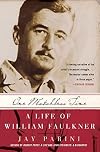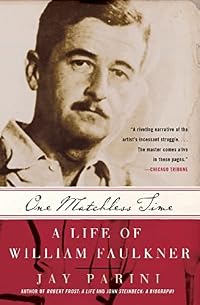
One Matchless Time: A Life of William Faulkner
by Jay Parini
On This Page
Description
"One Matchless time is an evocation of William Faulkner's life and work. From his birth in 1897 in Mississippi to his death sixty-five years later, Faulkner spent almost his entire life on this one small patch of land, the "significant soil" from which all his fiction grew. Jay Parini paints an intimate picture of Faulkner's Mississippi world and shows how the artist transformed this raw material into Yoknapatawpha County, a place of pure imagination." "Between 1928 and 1942, during what show more Faulkner called his "one matchless time," a period of wild inspiration when characters and stories came to him mysteriously and in abundance, he published more than half a dozen masterpieces, including the novels The Sound and the Fury; As I Lay Dying; Sanctuary; Light in August; Absalom, Absalom!; The Wild Palms; Go Down, Moses; and The Hamlet. This is an astonishing achievement without equal in American literature." "Parini, who has taught Faulkner's work to students for nearly thirty years, brings to life this writer's complex fictional world in the context of his life, using the one to illuminate the other. He uses letters and memoirs unavailable to earlier biographers as well as interviews he had with Faulkner's daughter and several of his lovers. His William Faulkner is an immensely gifted, obsessive artist plagued by alcoholism and a bad marriage, but someone who rose above his limitations to become a figure of major importance on the stage of world literature."--BOOK JACKET. show lessTags
Recommendations
















Member Reviews
“I discovered that my own little postage stamp of native soil was worth writing about and that I would never live long enough to exhaust it, and that by sublimating the actual into the apocryphal I would have the complete liberty to use whatever talent I might have to its absolute top.”
“It is my ambition to be, as a private individual, abolished and voided from history, leaving it markless, no refuse save the printed books.”
“In Faulkner, the grotesque typically emerges in terms of the horrific. He presents a wide array of twisted old spinsters, compulsive sadists, eccentric lovers of beasts, incestuous brothers and fathers, unfeeling mothers, and toothless wonders who revel in the base forms of human behavior.”
In this show more outstanding biography, the author mentions that one does not read Faulkner, but rereads him. I think that is an excellent observation and it is one that highlights my failing, in regards to this difficult southern author. Yes, I have read and enjoyed several of his classic novels, but I have only taken a peek, a mere glimpse at what, this writer is trying to convey, so my appreciation is limited. I better get busy, catching up with his "must-read" books, plus the inevitable "rereading".
I knew very little about Faulkner's life, which was the reason I wanted to read this bio and I can't imagine another biographer doing a better job, casting an intense spotlight on this man's history, which is endlessly fascinating. Parini is also an excellent writer, in his own right, so the narrative hums along like a song:
“In the end, however, William Faulkner stands alone, a master of tragic farce, a wild-eyed comedian, a raconteur of the highest order, still sitting around the campfire in the Big Woods, still talking in the thousands of pages that remain his legacy.” show less
“It is my ambition to be, as a private individual, abolished and voided from history, leaving it markless, no refuse save the printed books.”
“In Faulkner, the grotesque typically emerges in terms of the horrific. He presents a wide array of twisted old spinsters, compulsive sadists, eccentric lovers of beasts, incestuous brothers and fathers, unfeeling mothers, and toothless wonders who revel in the base forms of human behavior.”
In this show more outstanding biography, the author mentions that one does not read Faulkner, but rereads him. I think that is an excellent observation and it is one that highlights my failing, in regards to this difficult southern author. Yes, I have read and enjoyed several of his classic novels, but I have only taken a peek, a mere glimpse at what, this writer is trying to convey, so my appreciation is limited. I better get busy, catching up with his "must-read" books, plus the inevitable "rereading".
I knew very little about Faulkner's life, which was the reason I wanted to read this bio and I can't imagine another biographer doing a better job, casting an intense spotlight on this man's history, which is endlessly fascinating. Parini is also an excellent writer, in his own right, so the narrative hums along like a song:
“In the end, however, William Faulkner stands alone, a master of tragic farce, a wild-eyed comedian, a raconteur of the highest order, still sitting around the campfire in the Big Woods, still talking in the thousands of pages that remain his legacy.” show less
The name William Faulkner evokes a great deal of respect (and perhaps fear) from readers. He is known for long sentences that span more than one page. He is inescapably deep – an abyss. He sees into the Southern American male experience as no other and draws out truths that apply to all of humanity. His allure extends from the South into New England, across the Atlantic to France and down the isthmus to Latin America.
To be successful, a biographer of Faulkner has to be utterly in-touch with himself/herself. Parini seems up to the task, though even he self-consciously doubts his portrait in the conclusion. He tries to tie together Faulkner’s life and writings into one coherent unit. He succeeds in my measure even though I still get show more lost in the depthlessness of the characters in Yoknapatawpha County, Mississippi.
Parini delineates with relative objectivity “Bill” Faulkner’s failed marriage, his affairs, the adoration of his daughter Jill, and Bill’s ever-expanding mastery of his financial and economic situation. Parini tackles Faulkner’s brilliant speech in Stockholm to accept the Nobel Prize with an equanimity worth of the moment. As with any good biography, I leave with the feeling that I have known Faulkner and that I have known the author. show less
To be successful, a biographer of Faulkner has to be utterly in-touch with himself/herself. Parini seems up to the task, though even he self-consciously doubts his portrait in the conclusion. He tries to tie together Faulkner’s life and writings into one coherent unit. He succeeds in my measure even though I still get show more lost in the depthlessness of the characters in Yoknapatawpha County, Mississippi.
Parini delineates with relative objectivity “Bill” Faulkner’s failed marriage, his affairs, the adoration of his daughter Jill, and Bill’s ever-expanding mastery of his financial and economic situation. Parini tackles Faulkner’s brilliant speech in Stockholm to accept the Nobel Prize with an equanimity worth of the moment. As with any good biography, I leave with the feeling that I have known Faulkner and that I have known the author. show less
A fine telling of the life of writer William Faulkner, intercut with 'essays' on the writers work. Faulkner's renown, I feel, rests on two key aspects: his focus on, and passion for, a singular place, and his experimental writing, which could both awe and enrage his readers. This 'telling' of his life is both accessible and has narrative drive (Parini is also a novelist).
I've read maybe four of Faulkner's novels (one twice), and wondered whether reading summaries of his books might spoil the reading of the other books, but soon realised that I'd forgotten much of the detail of the books I'd read, so likely would have forgotten the summaries. What I hadn't forgotten was the tone and the feeling of reading the books, and some of the show more imagery.
Of his personal life, although far from uncommon, I found his drinking painful to hear about. His repeated visits to hospital after heavy intakes of alcohol consumption were painful examples of self-harm, that no-one seemed able to guide him away from.
A gentleman of the South, with manners, kindness and loyalty, yet still able to craft such scurrilous behaviours in many of his characters.
As Parini says, one doesn't read Faulkner, one rereads Faulkner. One might add, Faulkner didn't write, he rewrote.
I decided to go online and see if I could find a recording of Faulkner's voice, there are many. Interestingly, when I read his books, I heard a slow, Southern drawl, but in reality, he reads his work at quite a clip. I wonder if that will change how I hear his work going forward.
From [As I Lay Dying] : https://m.youtube.com/watch?v=upVi3BX5mUw show less
I've read maybe four of Faulkner's novels (one twice), and wondered whether reading summaries of his books might spoil the reading of the other books, but soon realised that I'd forgotten much of the detail of the books I'd read, so likely would have forgotten the summaries. What I hadn't forgotten was the tone and the feeling of reading the books, and some of the show more imagery.
Of his personal life, although far from uncommon, I found his drinking painful to hear about. His repeated visits to hospital after heavy intakes of alcohol consumption were painful examples of self-harm, that no-one seemed able to guide him away from.
A gentleman of the South, with manners, kindness and loyalty, yet still able to craft such scurrilous behaviours in many of his characters.
As Parini says, one doesn't read Faulkner, one rereads Faulkner. One might add, Faulkner didn't write, he rewrote.
I decided to go online and see if I could find a recording of Faulkner's voice, there are many. Interestingly, when I read his books, I heard a slow, Southern drawl, but in reality, he reads his work at quite a clip. I wonder if that will change how I hear his work going forward.
From [As I Lay Dying] : https://m.youtube.com/watch?v=upVi3BX5mUw show less
Having read Blottner's biography of Faulkner many years ago I was curious to get an update by reading Parini's One Matchless Time: A Life of William Faulkner. It offered a thorough discussion and analyses of all Faulkner's works as well as a good look at his life. He was sadly a womanizer and a drunk even if he was one of America's greatest writers though he wasn't always well received by the critics. I thoroughly enjoyed this biography and it incited me to tackle some of Faulkner's novels even though I find them daunting. If you are interested in writers' lives as I am I encourage you to pick up this book.
Here is a terrific, accessible biography about Faulkner. His faults are drawn out here, I guess because they make for interesting writing. It's still impressive how he overcame them in order to put together the insanely good novels and stories that make him maybe the greatest American writer.
Not as detailed as the Blotner but more accessible. Not as good as Parini's bio of Frost, though. Made me want to reread The Sound and the Fury.
Not as detailed as the Blotner but more accessible. Not as good as Parini's bio of Frost, though. Made me want to reread The Sound and the Fury.
Members
- Recently Added By
Published Reviews
ThingScore 50
His scheme is to follow Faulkner's life chronologically, interrupting the narrative with short critical essays of an introductory nature on individual works. In the right hands such a scheme could result in exemplary specimens of the critic's art. But Parini's essays are not up to exemplary standard.
added by jburlinson
Author Information

73+ Works 3,143 Members
Jay Parini was born in Pittston, Pennsylvania in 1948. In 1970 he graduated from Lafayette College and he received a doctorate from the University of St. Andrews in 1975. Before becoming a professor of Engliah and Creative Writing at Vermont's Middlebury College in 1982, Parini taught at Dartmouth College. Parini writes poetry, novels, show more biographies, and criticism, and he has published numerous reviews and essays in major journals and newspapers. He co-founded the New England Review in 1976. In 1995, he was appointed literary executor for author Gore Vidal. A film version of The Last Station, his 1990 novel, was released in 2009. Parini's novel, One Matchless Time: A Life of William Faulkner, made the New York Times bestseller list in 2015. (Bowker Author Biography) show less
Awards and Honors
Distinctions
Common Knowledge
- People/Characters
- William Faulkner
- Important places
- Oxford, Mississippi, USA; Hollywood, Los Angeles, California, USA; Stockholm, Sweden
- Dedication
- For Devon, these and all other words
- First words
- A sense of place was everything to William Faulkner...
- Last words
- (Click to show. Warning: May contain spoilers.)At last, he was home for good.
- Blurbers
- Blotner, Joseph; Coetzee, J.M.; Leonard, John
Classifications
Statistics
- Members
- 193
- Popularity
- 169,049
- Reviews
- 8
- Rating
- (4.27)
- Languages
- English
- Media
- Paper, Ebook
- ISBNs
- 4
- ASINs
- 3