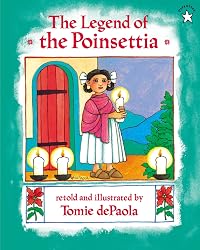
The Legend of the Poinsettia
by Tomie dePaola
On This Page
Description
When Lucida is unable to finish her gift for the Baby Jesus in time for the Christmas procession, a miracle enables her to offer the beautiful flower we now call the poinsettia.Tags
Recommendations







Member Recommendations
AbigailAdams26 Another enjoyable picture book retelling of this Mexican folktale explaining how poinsettias first came to be.
Member Reviews
Lucida lived with her mama, papa and younger brother and sister in a small mountain village in Mexico. She worked hard to help both of her parents, and when Padre Alvarez asked her mother to weave a new blanket for the Baby Jesus, to be used in that year's Christmas procession, she helped with that too. But when her mother became ill and had to go away, and Lucida tangled the weaving, it seemed that her family would be the only one to have no gift to give to the Baby Jesus. Hanging back from entering the church on Christmas Eve, she encountered a strange woman, who encouraged her to give what she could, and heartened by this advice, she gathered some green weeds to lay before the manger. In doing this, she set in motion a miracle, for show more the weeds were transformed into gorgeous red flowers—poinsettias, or the flor of Nochebuana...
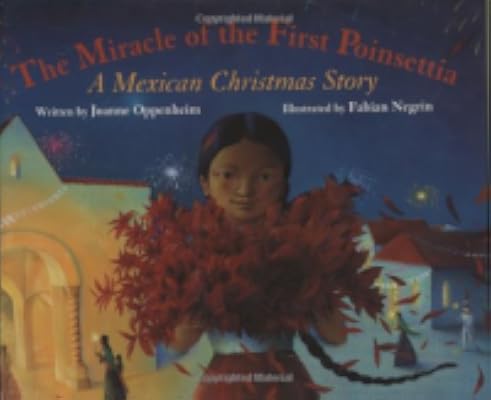
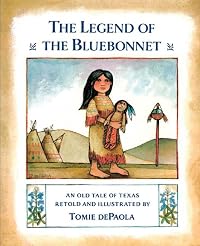
Published in 1994, The Legend of the Poinsettia is the third folktale retelling I have read from author/illustrator Tomie dePaola, following upon his The Legend of the Bluebonnet (1983) and The Legend of the Indian Paintbrush (1988), that explains how a flower came to be. It is also the second picture book retelling of this specific folktale I have encountered, after Joanne Oppenheim and Fabian Negrin's The Miracle of the First Poinsettia: A Mexican Christmas Story. On the whole I think I prefer that other telling just a bit, because of Negrin's fabulous illustrations, but this one is still very appealing, with a lovely story of a Christmas miracle, and dePaola's appealing artwork (which I would recognize anywhere, having grown up with it!). Recommended to anyone looking for Christmas stories with a Mexican cultural background, as well as to young folklore enthusiasts, particularly those who enjoy pourquoi stories explaining how things came to be. show less
Published in 1994, The Legend of the Poinsettia is the third folktale retelling I have read from author/illustrator Tomie dePaola, following upon his The Legend of the Bluebonnet (1983) and The Legend of the Indian Paintbrush (1988), that explains how a flower came to be. It is also the second picture book retelling of this specific folktale I have encountered, after Joanne Oppenheim and Fabian Negrin's The Miracle of the First Poinsettia: A Mexican Christmas Story. On the whole I think I prefer that other telling just a bit, because of Negrin's fabulous illustrations, but this one is still very appealing, with a lovely story of a Christmas miracle, and dePaola's appealing artwork (which I would recognize anywhere, having grown up with it!). Recommended to anyone looking for Christmas stories with a Mexican cultural background, as well as to young folklore enthusiasts, particularly those who enjoy pourquoi stories explaining how things came to be. show less
I've always loved poinsettias at Christmas, but it wasn't until my brother married into a Mexican family a few years ago that I learned that poinsettias are native to Mexico. Tomie dePaola's colorfully illustrated book tells the story of how the poinsettia became associated with Christmas in Mexico. It's a beautiful legend that reminds me of the Little Drummer Boy. Families might want to read this one together during the Christmas season. Elementary teachers could use this book in a unit on holiday traditions in other countries. I think I'll add it to my Christmas decorations in a coffee table display of seasonal reading.
This beautiful Mexican story of the la Flor de Nochebuena, the Flower of the Holy Night - the poinsettia is one I had not read before. I love poinsettias and do now even more because of this story. This would be a great story to read on one of the last days before Christmas vacation. Poinsettias are plentiful at that time and if affordable the students could take a small one home as a gift for their parents and share the story with them.
This book tells the story of the poinsetta and how it came to be a major symbol of Christmas. Lucida is a young girl who is excited to help her mother weave a beautiful blanket to give as a gift during Christmas mass to the baby Jesus in the nativity scene. Unfortunately, before the blanket is finished Lucida's mother falls ill. Lucida is upset and decides to try to finish the blanket herself so that she can give it as a gift still, but she ends up tangling the blanket so badly it cannot be fixed in time. Lucida is ashamed that she has no gift and feels that she ruined Christmas until an elderly woman appears near her while she is hiding outside the church. The woman tells her that she has a message: that he mom will be fine and will show more return so she should join everyone for the Christmas procession. Lucida worries about what to give as an offering, so the woman explains that any gift is beautiful because it is given. I loved the sentiment of gift-giving in her advice, making it about the thought rather than the value. Lucida collects a bundle of tall green weeds to give, which makes people whisper. While she is giving her offering and praying, something magical happens. The green weeds bloom into beautiful red flowers and so do all of the weeds outside the church. They bloom into what we now call poinsettias. Lucida's gift did indeed become beautiful when she gave it as an offering, just like the old woman told her. This retelling of a Mexican legend is very touching and captures the spirit of Christmas. I loved the legend, but the way the book itself was written was not my favorite. This book is very text heavy for a picture book, making it more suited for older children. I think that younger kids could enjoy the story if it's read aloud. show less
This is the story of the poinsettia and how it became a symbol of Christmas. This book follows Lucinda, a young girl living in Mexico, who is looking forward to Christmas. Her mother and her are given he honor to make the blanket for the baby Jesus in the Nativity scene. Before they are able to finish the blanket, Lucinda's mother becomes ill and is unable to complete it. Lucinda tries to finish it on her own and the blanket becomes a tangled mess. Lucinda feels as though she has disappointed everyone and ruined Christmas. On Christmas Eve the city gathers for a procession, Lucinda hides in the shadows. An elderly woman appears and explains to Lucinda that her mother will be fine and she should return to the procession. Lucinda feels show more worried that she does not have anything to offer. The woman tells her the beauty of a gift is that it is given. Lucinda gathers green weeds and brings them in to lay at the Nativity scene. When she looks up all of the weeds have blossomed into red flowers, poinsettias. This is a wonderful retelling of a Mexican legend that carries the spirit of Christmas. This would be a great book for a read aloud and in sharing the meaning of a gift. show less
Summary: This Mexican legend tells how the poinsettia came to be, through a little girl's unselfish gift to the Christ Child.
Personal Reaction: Beautiful illustrations. A wonderful story about the gift of giving and that homemade gift as the best!
Classroom Extension: Introduce at Christmas time, as a folktale and an example of Mexican folklore(combine with other examples), talk about the value of giving not just receiving, and talk about different cultures Christmas traditions.
Personal Reaction: Beautiful illustrations. A wonderful story about the gift of giving and that homemade gift as the best!
Classroom Extension: Introduce at Christmas time, as a folktale and an example of Mexican folklore(combine with other examples), talk about the value of giving not just receiving, and talk about different cultures Christmas traditions.
I liked this book for several main reasons. First, it had a bilingual component to it. Although it wasn’t a fully bilingual book, there were spanish references in the story. For example, one page read “At home Lucida helped mama clean their casita- their little house- and pat out the tortillas for their meals.” Although there was no full translation, there was a lot of spanish vocabulary mixed into the book. This can act as a good introduction to the spanish language. Another thing I liked about this book was the topic. Everyone loves the holidays, no matter which one they celebrate. There’s something heartwarming about reading how others celebrate the holidays that you enjoy so much. The main idea of this book was spelled out show more directly on one of the last pages: “Ah, Lucida, any gift is beautiful because it is given...whatever you give, they will love, because it comes from you.” show less
Members
- Recently Added By
Lists

Christmas Books
370 works; 40 members

A Child's Book Tour of Mexico
56 works; 2 members

Read Aloud Revival
108 works; 4 members
Author Information

243+ Works 98,385 Members
Tomie dePaola was born in Meriden, Connecticut on September 15, 1934. He received a B.F.A. from Pratt Institute in 1956, a M.F.A. from California College of Arts and Crafts in 1969, and a doctoral equivalency from Lone Mountain College in 1970. He has written and/or illustrated more than 270 books including 26 Fairmount Avenue, Strega Nona, Meet show more the Barkers, Nana Upstairs and Nana Downstairs, and Oliver Button Is a Sissy. He has received numerous awards for his work including the Caldecott Honor Award, the Newbery Honor Award and the New Hampshire Governor's Arts Award of Living Treasure. His murals and paintings can be seen in many churches and monasteries throughout New England. He has designed greeting cards, magazine and record album covers, and theater sets. His work is shown in galleries and museums. Tomie dePaola died on March 30, 2020 because of complications he had from surgery after a fall. (Bowker Author Biography) show less
Awards and Honors
Common Knowledge
- Original publication date
- 1994
- People/Characters
- Lucida Martinez; Mama; Papa; Paco Martinez; Lupe Martinez; Pepito ~ burro (show all 10); Padre Alvarez; Señora Gomez; Tía Carmen; old woman
- Important places
- village in Mexico
- Important events
- Christmas
- Dedication
- To Chris O’Brien, who knows that the beauty of the gift is in the giving.
- First words
- Lucida lived in a small village high up in the mountains of Mexico with her mama, her papa, and her younger brother and sister, Paco and Lupe.
- Last words
- (Click to show. Warning: May contain spoilers.)The people call the plants la Flor de Nochebuena—the Flower of the Holy Night—the poinsettia.
Classifications
- Genres
- Children's Books, Picture Books
- DDC/MDS
- 398.242 — Society, government, & culture Customs, etiquette & folklore Folklore & Folktales Folk literature Fables, Magical Creatures Plantlore
- LCC
- PZ8.1 .D43 .L — Language and Literature Fiction and juvenile belles lettres Fiction and juvenile belles lettres Juvenile belles lettres
- BISAC
Statistics
- Members
- 2,290
- Popularity
- 8,711
- Reviews
- 35
- Rating
- (3.97)
- Languages
- English, Spanish
- Media
- Paper, Audiobook, Ebook
- ISBNs
- 22
- ASINs
- 6