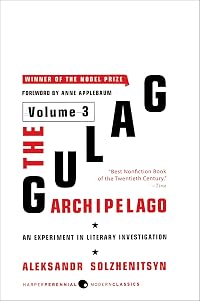
The Gulag Archipelago, 1918-1956: Parts V-VII
by Aleksandr Solzhenitsyn
The Gulag Archipelago (Volume 3, Parts V-VII)
On This Page
Description
Volume 3 of the Nobel Prize winner's towering masterpiece: Solzhenitsyn's moving account of resistance within the Soviet labor camps and his own release after eight years. Features a new foreword by Anne Applebaum. "The greatest and most powerful single indictment of a political regime ever leveled in modern times." -George F. Kennan "It is impossible to name a book that had a greater effect on the political and moral consciousness of the late twentieth century." -David Remnick, New Yorker show more "Solzhenitsyn's masterpiece. ... The Gulag Archipelago helped create the world we live in today." -Anne Applebaum, Pulitzer Prize-winning author of Gulag: A History, from the foreword. show lessTags
Recommendations



































Member Reviews
This book is the concluding part of Aleksandr Solzhenitsyn’s monumental work chronicling the forced labor camps in the Soviet Union, collectively called ‘The Gulag.’ I confess to being exhausted at the end of this volume because reading over 2,000 pages of these chronicles will tire the reader. When you finish reading the books, and if you complain of exhaustion as I did, think of the lives of the people incarcerated in the Gulag.
Aleksandr Solzhenitsyn devoted considerable space to those who continually tried to escape, focusing on their planning, their escape, their inevitable recapture, and their punishment.
The book focuses on various ways in which the prisoners resisted, from passive resistance to extreme forms such as show more escape.
The volumes also explore the brutality of the regime, the underlying fear in society, the brutality and corruption of the state, and the arbitrary arrests.
By blending the personal narratives (Aleksandr’s and those of the prisoners) with an exposé of the system, the author has created a searing and unforgettable picture of the Gulag.
The book also demonstrates how such a regime causes moral decay, inevitably weakening society.
As I mentioned in my review of the previous volumes, the sparse writing style serves to accentuate more than any florid style could.
A testament to an era that seems to have passed and is warning: such horrors can return very easily. show less
Aleksandr Solzhenitsyn devoted considerable space to those who continually tried to escape, focusing on their planning, their escape, their inevitable recapture, and their punishment.
The book focuses on various ways in which the prisoners resisted, from passive resistance to extreme forms such as show more escape.
The volumes also explore the brutality of the regime, the underlying fear in society, the brutality and corruption of the state, and the arbitrary arrests.
By blending the personal narratives (Aleksandr’s and those of the prisoners) with an exposé of the system, the author has created a searing and unforgettable picture of the Gulag.
The book also demonstrates how such a regime causes moral decay, inevitably weakening society.
As I mentioned in my review of the previous volumes, the sparse writing style serves to accentuate more than any florid style could.
A testament to an era that seems to have passed and is warning: such horrors can return very easily. show less
Conclusion of the author's harrowing account of the history and operation of the prison camps of the USSR, something he experienced first hand. This book in particular focuses on rebellions in the camps and the use of exile by the Communist government. Some parts of this book are not as strong as others (the "white kitten" chapter in particular), but other parts are intriguing. At one point, the author discusses Ukraine vis-a-vis Russia in a fashion that's compelling reading in 2024. Certainly, the whole series is must reading for anyone who wants to understand 20th century Russian history.
Truly worthwhile. A historical record and analysis and a personal story all running in parallel. Provides surprising insights into workings of governments, psychology, human motivations and of course the mind harrowing horrors of Russian 20th century history, showing how a whole society can collapse in on itself.
If you have gotten through the other two versions, you HAVE to read this one. He does not exactly pull all the strings together, but lays out the pieces in their various places, so that you know how complicated the whole situation really was.
Solzhenitsyn clearly has great anger directed at Stalin and Lenin, and who could blame him. But he backs his anger up, not with ideology (athough he does go there) but with enough horror stories to shock even the most insensitive soul.
One problem with Solzhenitsyn--he tends to just throw words and ideas on the page, without really editing his thoughts. There is a lot there, and most of it is worth digging for, but you may have to get through five or six examples or stories before you find the ones show more that really hit home for you.
He calls this work "an experiment in literary investigation" and to be honest, I am not so sure it worked as well as he hoped. Sometimes it is too "literary" at least for Western ears, and sounds almost maudlin.
Personally I preferred The First Circle to the latter volumes of the Gulag, but I want to be quick to say that in spite of my minor picking at it, this whole set is well worth the read. Any one with political leanings should at least read the first volume. show less
Solzhenitsyn clearly has great anger directed at Stalin and Lenin, and who could blame him. But he backs his anger up, not with ideology (athough he does go there) but with enough horror stories to shock even the most insensitive soul.
One problem with Solzhenitsyn--he tends to just throw words and ideas on the page, without really editing his thoughts. There is a lot there, and most of it is worth digging for, but you may have to get through five or six examples or stories before you find the ones show more that really hit home for you.
He calls this work "an experiment in literary investigation" and to be honest, I am not so sure it worked as well as he hoped. Sometimes it is too "literary" at least for Western ears, and sounds almost maudlin.
Personally I preferred The First Circle to the latter volumes of the Gulag, but I want to be quick to say that in spite of my minor picking at it, this whole set is well worth the read. Any one with political leanings should at least read the first volume. show less
Eye-witness reporting of real people, with real names, involving real events.
While Soviet crimes are the subject, the democracies of the West are not left untouched. In the story of General Vlasov we hear of how his Divisions ended up fighting both the Nazis and the Communists, and then were captured by the Americans and turned over to Stalin.
While Soviet crimes are the subject, the democracies of the West are not left untouched. In the story of General Vlasov we hear of how his Divisions ended up fighting both the Nazis and the Communists, and then were captured by the Americans and turned over to Stalin.
The whole triology is unbelieveable. I highly recommend it.
Questo volume considera l'arco conclusivo dell'epoca di Stalin e gli anni succesivi fino a Chruscev:il ristabilimento della galera, poi soppiantata dai lager speciali per detenuti politici, la storia delle evasioni, scioperi e rivolte che accelerarono lo sfaldamento del sistema dei lager staliniani nel dopoguerra.
Sep 12, 2012 (Edited)Italian
Members
- Recently Added By
Lists

Books Read in 2024
4,623 works; 126 members

imperialism, war & genocide
11 works; 1 member

The Well-Educated Mind, Susan Wise Bauer, 2016
179 works; 3 members

Personal 2025 reads
18 works; 1 member
Author Information

360+ Works 44,717 Members
Aleksandr Solzhenitsyn was born on December 11, 1918 in Kislovodsk in the northern Caucusus Mountains. He received a degree in physics and math from Rostov University in 1941. He served in the Russian army during World War II but was arrested in 1945 for writing a letter criticizing Stalin. He spent the next decade in prisons and labor camps and, show more later, exile, before being allowed to return to central Russia, where he worked as a high school science teacher. His first novel, One Day in the Life of Ivan Denisovich, was published in 1962. In 1970, he was awarded the Nobel Prize for Literature. In 1974, he was arrested for treason and exiled following the publication of The Gulag Archipelago. He moved to Switzerland and later the U. S. where he continued to write fiction and history. When the Soviet Union collapsed, he returned to his homeland. His other works include The First Circle and The Cancer Ward. He died due to a heart ailment on August 3, 2008 at the age of 89. (Bowker Author Biography) show less
Some Editions
Series

Belongs to Publisher Series
W&Wserien (422)
Work Relationships
Common Knowledge
- Canonical title
- The Gulag Archipelago, 1918-1956: An Experiment in Literary Investigation (Volume Three, Parts V-VII) (Volume Three, Parts V-VII); The Gulag Archipelago, 1918-1956: Parts V-VII
- Original title
- Arkhipelag GULag, 1918-1956
- Alternate titles*
- De Goelag Archipel 1918-1956 : proeve van een artistieke studie. Boek 3/3
- Original publication date
- 1976 (Russian) (Russian); 1978 (English: Harry Willetts) (English: Harry Willetts)
- Original language
- Russian
- Disambiguation notice
- Aleksandr Solzhenistyn's The Gulag Archipelago has been published in a number of formats, and is catalogued in a variety of ways. The complete work consists of seven parts, often divided into three volumes as follow: V... (show all)olume One, consisting of Part I ("The Prison Industry") and Part II ("Perpetual Motion"); Volume Two, consisting of Part III ("The Destructive-Labor Camps") and Part IV ("The Soul and Barbed Wire"); and Volume III, consisting of Part V ("Katorga"), Part VI ("Exile") and Part VII ("Stalin Is No More").
THIS LT WORK IS INTENDED ONLY FOR VOLUME THREE, PARTS V-VII (including Volume III of the Blackstone Audiobook edition).
Please do not combine other copies having materially different content (e.g., Parts I-II, Parts III-IV, the complete work, an omnibus [such as Parts I-VI], any individual Part, or the abridged version). Thank you.
*Some information comes from Common Knowledge in other languages. Click "Edit" for more information.
Classifications
- Genres
- Nonfiction, History, Biography & Memoir, General Nonfiction
- DDC/MDS
- 365.450947 — Society, government, & culture Social problems and social services Punishment Institutions for specific classes of inmates Institutions for political prisoners and related groups of people
- LCC
- HV9713 .S6413 — Social sciences Social pathology. Social and public welfare. Criminology Social pathology. Social and public welfare. Criminal justice administration Penology. Prisons. Corrections By region or country
- BISAC
Statistics
- Members
- 1,176
- Popularity
- 21,302
- Reviews
- 9
- Rating
- (4.40)
- Languages
- 15 — Czech, Danish, Dutch, English, Estonian, Finnish, French, German, Italian, Norwegian (Bokmål), Polish, Russian, Serbian, Spanish, Swedish
- Media
- Paper, Audiobook, Ebook
- ISBNs
- 49
- UPCs
- 1
- ASINs
- 18