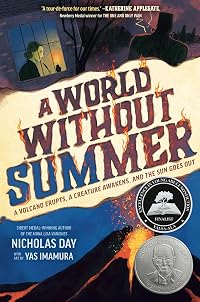
A World Without Summer: A Volcano Erupts, A Creature Awakens, and the Sun Goes Out
by Nicholas Day
On This Page
Description
"A narrative nonfiction account that explores how Mount Tambora's eruption in 1815 affected the global climate and inspired Mary Shelley's work"-- Provided by publisher.Tags
Recommendations


Member Reviews
A blazing fast read that connects the 1815 eruption of Mount Tambora, Mary Shelley's writing of Frankenstein, and our current climate crisis, with brief sections that address the reader directly and ask them to consider big questions. In the wake of Tambora's eruption and the global climate shock it caused, societies everywhere were forced to consider the concepts of help (were governments responsible for their citizens?) and expertise (which explanations were most likely?). In fact, the weather data we have now is partly a result of people realizing they needed to study the weather after Tambora.
Quotes
The only way to understand is to have been there.
But if you had been there, you would be-- well, you would be dead.
So we will do the show more best we can. (page 1)
Some of the sky is above the weather, and that part is the stratosphere... (36-37)
The event is local, but the effects are global. (46)
This is called an ice core, but it could be called a time machine....Inside each ice core is a detailed record of the climate. (56)
Most of the time, we humans put ourselves at the center of our stories....We make ourselves the main characters...But there's a danger to telling stories that way. Because if the story of Tambora tells us anything, it is this: we're not the main character. (71)
The problem was that they didn't know how to make sense of it. They didn't know how to interpret it.
The idea that some people were better than others at interpreting things - that was a new concept. It's the idea of expertise, and the whole notion of expertise was still being worked out. (107)
This is the fate of a world without the idea of expertise, a world without any sense of whom to trust. In that world, any story was a relief....Any story was better than nothing at all. (108)
The seasons had been jarred loose. Nothing arrived on schedule and nothing arrived in the right amounts. (114)
The seasons were no longer normal, and so cholera was no longer seasonal. (115)
How much would be enough?....When do we have enough information? When do we believe something is really happening? When do we agree to move to the next question - the question of what to do about it? (151)
[Rumford soup] was part of this wholly new system of welfare - help the people who needed help. It was a revolutionary idea. (200)
It's a classic story: a crisis reshapes the world and suddenly someone can see clearly what should be done. That's how new inventions emerge out of disaster: because the old way of doing things no longer works. (214)
Tambora was a climate shock, and because it was shocking....People noticed. The world is changing now, too, but in a very different way..."Because we barely notice changes that happen gradually...we accept gradual changes that we would reject if they happened abruptly." (Daniel Gilbert, 259) show less
Quotes
The only way to understand is to have been there.
But if you had been there, you would be-- well, you would be dead.
So we will do the show more best we can. (page 1)
Some of the sky is above the weather, and that part is the stratosphere... (36-37)
The event is local, but the effects are global. (46)
This is called an ice core, but it could be called a time machine....Inside each ice core is a detailed record of the climate. (56)
Most of the time, we humans put ourselves at the center of our stories....We make ourselves the main characters...But there's a danger to telling stories that way. Because if the story of Tambora tells us anything, it is this: we're not the main character. (71)
The problem was that they didn't know how to make sense of it. They didn't know how to interpret it.
The idea that some people were better than others at interpreting things - that was a new concept. It's the idea of expertise, and the whole notion of expertise was still being worked out. (107)
This is the fate of a world without the idea of expertise, a world without any sense of whom to trust. In that world, any story was a relief....Any story was better than nothing at all. (108)
The seasons had been jarred loose. Nothing arrived on schedule and nothing arrived in the right amounts. (114)
The seasons were no longer normal, and so cholera was no longer seasonal. (115)
How much would be enough?....When do we have enough information? When do we believe something is really happening? When do we agree to move to the next question - the question of what to do about it? (151)
[Rumford soup] was part of this wholly new system of welfare - help the people who needed help. It was a revolutionary idea. (200)
It's a classic story: a crisis reshapes the world and suddenly someone can see clearly what should be done. That's how new inventions emerge out of disaster: because the old way of doing things no longer works. (214)
Tambora was a climate shock, and because it was shocking....People noticed. The world is changing now, too, but in a very different way..."Because we barely notice changes that happen gradually...we accept gradual changes that we would reject if they happened abruptly." (Daniel Gilbert, 259) show less
A volcano erupts in Indonesia; the weather fails in Europe and America; crops rot or freeze; people riot, migrate, starve, cope, create. The central point of this book is that we live, have always lived, in a deeply interconnected world, whether or not our technologies and psychology allow us to grasp it, and that point does land pretty cleanly.
Beyond that, though, I really enjoyed Day’s exploration of how people reacted to the impact of this catastrophe—especially those on the other side of the world, who couldn’t see the connection between that distant event and their own disrupted lives. The grasping for understanding, the scrambling to adapt and respond. People across the world faced a mystifying series of dreadful show more repercussions, and struggled mightily to comprehend their source—sunspots? divine retribution? war? the cessation of war? lightning rods? And it’s not just that they didn’t discover the truth; what was so intriguing was the desperate places they looked for it. It’s not simply that they were lacking information—they just had no idea what they had no idea about, and in the intellectual hubris which is so common among us, they mistook the limits of their own knowledge for the limits of what was knowable. It’s a fascinating lens on human understanding.
I have to admit, I also appreciated Day’s deep focus on Mary Shelley and the writing of Frankenstein (one of my favorite books). He may be overstating the effect of the climate on her mood and her creative output, and he may be stretching to apply her allegory to the larger narrative. But he draws some intriguing insights, and paints a vivid picture of the process she went through to generate that pivotal work. Plus he rightfully rakes her husband over the coals, and I’m here for that as well.
Beyond that, though, I really enjoyed Day’s exploration of how people reacted to the impact of this catastrophe—especially those on the other side of the world, who couldn’t see the connection between that distant event and their own disrupted lives. The grasping for understanding, the scrambling to adapt and respond. People across the world faced a mystifying series of dreadful show more repercussions, and struggled mightily to comprehend their source—sunspots? divine retribution? war? the cessation of war? lightning rods? And it’s not just that they didn’t discover the truth; what was so intriguing was the desperate places they looked for it. It’s not simply that they were lacking information—they just had no idea what they had no idea about, and in the intellectual hubris which is so common among us, they mistook the limits of their own knowledge for the limits of what was knowable. It’s a fascinating lens on human understanding.
I have to admit, I also appreciated Day’s deep focus on Mary Shelley and the writing of Frankenstein (one of my favorite books). He may be overstating the effect of the climate on her mood and her creative output, and he may be stretching to apply her allegory to the larger narrative. But he draws some intriguing insights, and paints a vivid picture of the process she went through to generate that pivotal work. Plus he rightfully rakes her husband over the coals, and I’m here for that as well.
Percy was a genius, and Mary made the allowances for him that people have always made for genius. But she was also a genius, and no one made allowances for her.I can’t say what that has to do with the eruption at Tambora, but I’ll take it. show less
First sentence: The only way to understand is to have been there. The world loud isn't loud enough. The word hot isn't hot enough. The word-- None of the words are enough. The only way to understand is to have been there. But if you had been there, you would be--well, you would be dead. So we will do the best we can.
Premise/plot: Nonfiction. History. Nature. Science. This is the story of the eruption of a the volcano Tambora in April 1815 and how it impacted the world for several years. YES, years. The book's title might mislead you into thinking it was a short span of time the world's global climate was changed by this volcanic eruption--and all its aftermath. But it was in fact several years before things began to stabilize and show more 'return' to 'normal.' Of course, that's not quite the whole truth. For that generation there would always be some effect. (For example, the malnutrition--starving or nearly so--of those growing up would leave a forever impact on their bodies whose growth and development would remain stunted.)
The book is equally fascinating and bleak. It is impactful. For sure.
My thoughts: I loved, loved, loved much about this one. What I didn't love--well--I hated. The book doesn't allow much for subtly messaging the reader, allowing the reader to connect dots between the past and present. (IF in fact there are any dots to be connected between the past and the future.) The author is all about hitting readers over the head with a hammer. Perhaps with both hands holding a hammer. While I would say most of the book can be read and enjoyed, the agenda is so heavy-handed and extremely not subtle that it becomes obnoxious. There's a right way and a wrong way to get your message across. Sometimes less is more. Sometimes being subtle is more effective. Let readers reach their own conclusion and trust them a bit more. show less
Premise/plot: Nonfiction. History. Nature. Science. This is the story of the eruption of a the volcano Tambora in April 1815 and how it impacted the world for several years. YES, years. The book's title might mislead you into thinking it was a short span of time the world's global climate was changed by this volcanic eruption--and all its aftermath. But it was in fact several years before things began to stabilize and show more 'return' to 'normal.' Of course, that's not quite the whole truth. For that generation there would always be some effect. (For example, the malnutrition--starving or nearly so--of those growing up would leave a forever impact on their bodies whose growth and development would remain stunted.)
The book is equally fascinating and bleak. It is impactful. For sure.
My thoughts: I loved, loved, loved much about this one. What I didn't love--well--I hated. The book doesn't allow much for subtly messaging the reader, allowing the reader to connect dots between the past and present. (IF in fact there are any dots to be connected between the past and the future.) The author is all about hitting readers over the head with a hammer. Perhaps with both hands holding a hammer. While I would say most of the book can be read and enjoyed, the agenda is so heavy-handed and extremely not subtle that it becomes obnoxious. There's a right way and a wrong way to get your message across. Sometimes less is more. Sometimes being subtle is more effective. Let readers reach their own conclusion and trust them a bit more. show less
Ratings
Members
- Recently Added By
Lists

Youth: Science, Miscellaneous
34 works; 1 member

North Star Short List TBR
25 works; 1 member
Author Information

9+ Works 404 Members
Awards and Honors
Awards
Distinctions
Common Knowledge
- Important events
- Summer of 1816 (1816)
Classifications
Statistics
- Members
- 61
- Popularity
- 508,188
- Reviews
- 3
- Rating
- (4.63)
- Languages
- English
- Media
- Paper, Ebook
- ISBNs
- 5
- ASINs
- 1