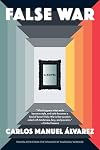
False War: A Novel
by Carlos Manuel Álvarez
On This Page
Description
"The characters in False War are ambivalent castaways living lives of deep estrangement from their home country, stranded in an existential no-man's land. Some of them want to leave and can't, others do leave but never quite get anywhere. In this multivoiced novel, employing a dazzling range of narrative styles from noir to autofiction, Carlos Manuel Alvarez brings together the stories of many people from all walks of life through a series of interconnected daisy chains. From Havana to show more Mexico City to Miami, from New York to Paris to Berlin, whether toiling in a barber shop, roaring in Yankee Stadium, lost in the Louvre, intensely competing in a chess hall in Cuba, plotting a theft, or on a junket for emigre dissidents in Berlin, these characters learn that while they may seem to be on the move, in reality they are paralyzed, immersed in a fake war waged with little real passion. The fractured narrative, filled with extraordinary portraits of ordinary people, reflects the disintegration that comes from being uprooted. At the same time it is full of tenderness, moments of joy and profound release. False War confirms Carlos Manuel Alvarez as one of the indispensable voices of his generation in Latin American letters"-- Provided by publisher. show lessTags
Recommendations






































Member Reviews
Rating: 4* of five
The Publisher Says: An ambitious, panoptic novel about exile as both condition and state of being by a major young Cuban writer
The characters in False War are ambivalent castaways living lives of deep estrangement from their home country, stranded in an existential no-man’s land. Some of them want to leave and can’t, others do leave but never quite get anywhere.
In this multivoiced novel, employing a dazzling range of narrative styles from noir to autofiction, Carlos Manuel Álvarez brings together the stories of many people from all walks of life through a series of interconnected daisy chains. From Havana to Mexico City to Miami, from New York to Paris to Berlin, whether toiling in a barber shop, roaring in Yankee show more Stadium, lost in the Louvre, intensely competing in a chess hall in Cuba, plotting a theft, or on a junket for émigré dissidents in Berlin, these characters learn that while they may seem to be on the move, in reality they are paralyzed, immersed in a fake war waged with little real passion.
The fractured narrative, filled with extraordinary portraits of ordinary people, reflects the disintegration that comes from being uprooted. At the same time it is full of tenderness, moments of joy and profound release. False War confirms Carlos Manuel Álvarez as one of the indispensable voices of his generation in Latin American letters.
I RECEIVED A DRC FROM THE PUBLISHER VIA EDELWEISS+. THANK YOU.
My Review: Complex narrative told in multiple styles...it requires paying attention...but like the most exciting stories, it repays you with an interlocking puzzle of identities giving a full-color image of exile.
Few times do you get a challenge set you in a long reading life that feels both longer, for its richness, and shorter, for its fascinating concise storytelling across styles, than its page count. Yes, there are a lot of people talking to you; yes, they act as though you're in medias res with them. You will be.
What a bunch these people are! Petty crime, grand theft (there are tech workers everywhere), music makers...all united by the fact of leaving Cuba, their home, for all sorts of reasons. All twine around the central narrative of the writer creating the novel from the stories he's been, is being, told, then telling us: "And right now, reader, neither you nor I can know what it is I’m thinking about this book you’re holding (your right now is not the same as my right now; the right now is always tragically different from the right now of writing)."
Shades of the time slices so beloved of physicists explaining why there is no now due to relativity! Part of that disorienting purpose is also served by the polyphony's voices being labeled, like the time slices needing labels (Observer A, Observer B), and others being job titles, others still (most disorientingly, are they real or invented?) receiving normal names.
The Cuban diasporas having left over the course of sixty years, they are often strangers to each other as much as the places they're staying. A man who learned his dance moves in the 1970s has little chance of making a good showing in a crowd who learned theirs thirty years later;but they're all united by the one main identity: Cuban Exile.
In braiding the many voices telling the different stories of why, of how, of that moment when, exile was the solution, Author Álvarez via Translator Wimmer has handed us the kaleidoscope with no instructions on how to use it. Twisting it a bit to that side, into shade, away from blinding searchlights, Author Álvarez takes your eyeline with him, letting you hold the device but showing you *his* pretty colors.
Made of the numerous rays in the story, he's found beauty in hard and endless toil...to fit in? to stand out? to find, lose, escape, respond? to the endlessness of crafting an identity. show less
The Publisher Says: An ambitious, panoptic novel about exile as both condition and state of being by a major young Cuban writer
The characters in False War are ambivalent castaways living lives of deep estrangement from their home country, stranded in an existential no-man’s land. Some of them want to leave and can’t, others do leave but never quite get anywhere.
In this multivoiced novel, employing a dazzling range of narrative styles from noir to autofiction, Carlos Manuel Álvarez brings together the stories of many people from all walks of life through a series of interconnected daisy chains. From Havana to Mexico City to Miami, from New York to Paris to Berlin, whether toiling in a barber shop, roaring in Yankee show more Stadium, lost in the Louvre, intensely competing in a chess hall in Cuba, plotting a theft, or on a junket for émigré dissidents in Berlin, these characters learn that while they may seem to be on the move, in reality they are paralyzed, immersed in a fake war waged with little real passion.
The fractured narrative, filled with extraordinary portraits of ordinary people, reflects the disintegration that comes from being uprooted. At the same time it is full of tenderness, moments of joy and profound release. False War confirms Carlos Manuel Álvarez as one of the indispensable voices of his generation in Latin American letters.
I RECEIVED A DRC FROM THE PUBLISHER VIA EDELWEISS+. THANK YOU.
My Review: Complex narrative told in multiple styles...it requires paying attention...but like the most exciting stories, it repays you with an interlocking puzzle of identities giving a full-color image of exile.
Few times do you get a challenge set you in a long reading life that feels both longer, for its richness, and shorter, for its fascinating concise storytelling across styles, than its page count. Yes, there are a lot of people talking to you; yes, they act as though you're in medias res with them. You will be.
What a bunch these people are! Petty crime, grand theft (there are tech workers everywhere), music makers...all united by the fact of leaving Cuba, their home, for all sorts of reasons. All twine around the central narrative of the writer creating the novel from the stories he's been, is being, told, then telling us: "And right now, reader, neither you nor I can know what it is I’m thinking about this book you’re holding (your right now is not the same as my right now; the right now is always tragically different from the right now of writing)."
Shades of the time slices so beloved of physicists explaining why there is no now due to relativity! Part of that disorienting purpose is also served by the polyphony's voices being labeled, like the time slices needing labels (Observer A, Observer B), and others being job titles, others still (most disorientingly, are they real or invented?) receiving normal names.
The Cuban diasporas having left over the course of sixty years, they are often strangers to each other as much as the places they're staying. A man who learned his dance moves in the 1970s has little chance of making a good showing in a crowd who learned theirs thirty years later;but they're all united by the one main identity: Cuban Exile.
In braiding the many voices telling the different stories of why, of how, of that moment when, exile was the solution, Author Álvarez via Translator Wimmer has handed us the kaleidoscope with no instructions on how to use it. Twisting it a bit to that side, into shade, away from blinding searchlights, Author Álvarez takes your eyeline with him, letting you hold the device but showing you *his* pretty colors.
Made of the numerous rays in the story, he's found beauty in hard and endless toil...to fit in? to stand out? to find, lose, escape, respond? to the endlessness of crafting an identity. show less
Members
- Recently Added By
Author Information
4+ Works 130 Members
Some Editions
Awards and Honors
Classifications
- Genres
- General Fiction, Fiction and Literature
- DDC/MDS
- 863.7 — Literature & rhetoric Spanish, Portuguese, Galician literatures Spanish fiction 21st Century
- LCC
- PQ7392 .A478 .F3613 — Language and Literature French, Italian, Spanish and Portuguese literatures Spanish literature Provincial, local, colonial, etc. Spanish America
- BISAC
Statistics
- Members
- 33
- Popularity
- 854,828
- Reviews
- 1
- Rating
- (4.00)
- Languages
- English, Spanish
- Media
- Paper
- ISBNs
- 3