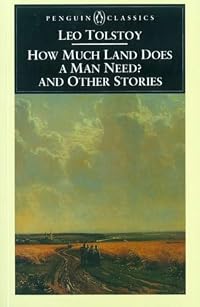
How Much Land Does a Man Need? and Other Stories
by Leo Tolstoy
On This Page
Description
The protagonist of the story is a peasant named Pahom, who overhears his wife and sister-in-law argue over the merits of town and peasant farm life. He thinks to himself "if I had plenty of land, I shouldn't fear the Devil himself!". Unbeknownst to him, Satan is present sitting behind the stove and listening. Satan abruptly accepts his challEnglishe and also tells that he would give Pahom more land and then snatch everything from him. A short amount of time later, a landlady in the village show more decides to sell her estate, and the peasants of the village buy as much of that land as they can. He himself purchases some land, and by working off the extra land is able to repay his debts and live a more comfortable life. show lessTags
Recommendations
















Member Reviews
In these two stories, translated by Ronald Wilks, Russian peasants find themselves caught up in unwitting encounters with the supernatural. In the first, the titular How Much Land Does a Man Need?, the humble peasant Pakhom and his wife live a modest but contented existence in the country. Yet Pakhom has one desire: 'I don't have enough land. Give me enough of that and I'd fear no one - not even the Devil himself!' But, unluckily for Pakhom, the Devil is lurking in his cottage than night and sees an excellent opportunity to put this ambitious peasant to the test. And so Pakhom finds himself in a position where he starts being able to acquire more land; but, with each gain, he becomes hungry for more. The more he acquires, the more he show more wants, while the Devil watches with glee from the sidelines. It makes for a pointed fable about the damaging effects of avarice and the importance of being content with your god-given lot in life.
The religious theme continues in the second story, What Men Live By, which in one sense is a retelling of the Good Samaritan. The impoverished shoemaker Semyon is returning from town one day, in low spirits, when he finds a naked man sitting in the cold outside a chapel. Semyon's instinct is to walk on and mind his own business, but compassion leads him to return to the man, give him his own worn coat, and take him home to share a dinner they can ill afford. Semyon's goodness is repaid by loyalty: the foundling, Mikhail, turns out to have a gift for shoemaking and the business prospers. But Semyon and his wife know so little about their new assistant, and the enigma deepens as the years pass, until Mikhail is finally ready to reveal the truth of his identity: one that emphasises the importance of sharing, looking out for one another and acting with kindness.
Like the first story, this has the air of a fable or fairy story, charmingly devout. As such, neither tale has the impressive power of some of the stories covered here, but they were some of the most enjoyable to read (except, of course, for the gleefully nonsensical Nose). I won't be reading War and Peace again any time soon, but I should seek out some more of Tolstoy's short stories, as they confirm him as a gifted and graceful storyteller. show less
The religious theme continues in the second story, What Men Live By, which in one sense is a retelling of the Good Samaritan. The impoverished shoemaker Semyon is returning from town one day, in low spirits, when he finds a naked man sitting in the cold outside a chapel. Semyon's instinct is to walk on and mind his own business, but compassion leads him to return to the man, give him his own worn coat, and take him home to share a dinner they can ill afford. Semyon's goodness is repaid by loyalty: the foundling, Mikhail, turns out to have a gift for shoemaking and the business prospers. But Semyon and his wife know so little about their new assistant, and the enigma deepens as the years pass, until Mikhail is finally ready to reveal the truth of his identity: one that emphasises the importance of sharing, looking out for one another and acting with kindness.
Like the first story, this has the air of a fable or fairy story, charmingly devout. As such, neither tale has the impressive power of some of the stories covered here, but they were some of the most enjoyable to read (except, of course, for the gleefully nonsensical Nose). I won't be reading War and Peace again any time soon, but I should seek out some more of Tolstoy's short stories, as they confirm him as a gifted and graceful storyteller. show less
A classic tale of greed where one forgets one's needs and strives after material goods. Had read this once long ago, and read it once again tonight. Still as delightful. Tolstoy's short stories always leave a big impact.
Available for free online on many sites as this story is in the public domain. I read it on https://www.marxists.org/archive/tolstoy/1886/how-much-land-does-a-man-need.html.
Available for free online on many sites as this story is in the public domain. I read it on https://www.marxists.org/archive/tolstoy/1886/how-much-land-does-a-man-need.html.
Brilliant ending. Worthy of Tolstoy. I still like others of his better, but he has a point and makes it well.
A classic tale of greed where one forgets one's needs and strives after material goods. Had read this once long ago, and read it once again tonight. Still as delightful. Tolstoy's short stories always leave a big impact.
Available for free online on many sites as this story is in the public domain. I read it on https://www.marxists.org/archive/tolstoy/1886/how-much-land-does-a-man-need.html.
Available for free online on many sites as this story is in the public domain. I read it on https://www.marxists.org/archive/tolstoy/1886/how-much-land-does-a-man-need.html.
The story of a greedy peasant named Pakhom. Although Pakhom enjoys health and family happiness, he feels dissatisfied when he learns of the grand fortunes of his relatives. He decides to go on a quest for more land, only to find that with each new acquisition new problems develop that is desire and greed.
Then suddenly he came to know of a village that sells land according to your strength and the stamina of walking for a very small amount. He went there and started his journey but his greed made him delusional and he went on walking but when it's time to return to the starting point his heartbeat was fast and his body gaving up on him and when he reached the point he fall on floor even though he got the land , he will not be able to show more plough , his children but at what cost of life. show less
Then suddenly he came to know of a village that sells land according to your strength and the stamina of walking for a very small amount. He went there and started his journey but his greed made him delusional and he went on walking but when it's time to return to the starting point his heartbeat was fast and his body gaving up on him and when he reached the point he fall on floor even though he got the land , he will not be able to show more plough , his children but at what cost of life. show less
The story of a greedy peasant named Pakhom. Although Pakhom enjoys health and family happiness, he feels dissatisfied when he learns of the grand fortunes of his relatives. He decides to go on a quest for more land, only to find that with each new acquisition new problems develop that is desire and greed.
Then suddenly he came to know of a village that sells land according to your strength and the stamina of walking for a very small amount. He went there and started his journey but his greed made him delusional and he went on walking but when it's time to return to the starting point his heartbeat was fast and his body gaving up on him and when he reached the point he fall on floor even though he got the land , he will not be able to show more plough , his children but at what cost of life. show less
Then suddenly he came to know of a village that sells land according to your strength and the stamina of walking for a very small amount. He went there and started his journey but his greed made him delusional and he went on walking but when it's time to return to the starting point his heartbeat was fast and his body gaving up on him and when he reached the point he fall on floor even though he got the land , he will not be able to show more plough , his children but at what cost of life. show less
Серия небольших рассказов с глубокий смыслом. Притчи, я бы сказал.
Коротко, глубоко, сильно.
Коротко, глубоко, сильно.
Members
- Recently Added By
Author Information

2,483+ Works 129,187 Members
Count Lev Nikolayevich Tolstoy was born on September 9, 1828 in Russia. He is usually referred to as Leo Tolstoy. He was a Russian author who is regarded as one of the greatest authors of all time. Leo Tolstoy is best known for his novels War and Peace (1869) and Anna Karenina (1877). Tolstoy's fiction includes dozens of short stories and several show more novellas such as The Death of Ivan Ilyich, Family Happiness, and Hadji Murad. He also wrote plays and numerous philosophical essays. Tolstoy had a profound moral crisis and spiritual awakening in the 1870's which he outlined in his work, A Confession. His literal interpretation of the ethical teachings of Jesus, centering on the Sermon on the Mount, caused him to become a fervent Christian anarchist and pacifist. His ideas of nonviolent resistance which he shared in his works The Kingdom of God is Within You, had a profund impact on figures such as Mohandas Gandhi and Martin Luther King, Jr. On September 23, 1862 Tolstoy married Sophia Andreevna Behrs. She was the daughter of a court physician. They had 13 children, eight of whom survived childhood. Their early married life allowed Tolstoy much freedom to compose War and Peace and Anna Karenina with his wife acting as his secretary and proofreader. The Tolstoy family left Russia in the aftermath of the Russian Revolution and the subsequent establishment of the Soviet Union. Leo Tolstoy's relatives and descendants moved to Sweden, Germany, the United Kingdom, France and the United States. Tolstoy died of pneumonia at Astapovo train station, after a day's rail journey south on November 20, 1910 at the age of 82. (Bowker Author Biography) Count Leo Tolstoy was born in 1828 on the family estate of Yasnaya Polyana in the Tula province. He married in 1862 & was the father of 13 children. Tolstoy managed the estate of Yasnaya Polyana & ran its peasant schools, while writing his great novels, "War & Peace" (1869) & "Anna Karenina" (1877). He died in 1910. (Publisher Provided) show less
Some Editions
Awards and Honors
Awards
Series
Belongs to Publisher Series
Work Relationships
Is contained in
Common Knowledge
- Canonical title
- How Much Land Does a Man Need? and Other Stories
- Original title
- Много ли человеку земли нужно?; Много ли человеку земли нужно? [short story]
- Original publication date
- 1886
- People/Characters*
- Pahom
- First words
- An elder sister came to visit her younger sister in the country.
- Last words
- (Click to show. Warning: May contain spoilers.)Six feet from his head to his heels was all he needed.
- Original language
- Russian
*Some information comes from Common Knowledge in other languages. Click "Edit" for more information.
Classifications
- Genres
- Fiction and Literature, General Fiction
- DDC/MDS
- 891.733 — Literature & rhetoric Asian Literature East Indo-European and Celtic literatures Russian and East Slavic languages Russian fiction 1800–1917
- LCC
- PG3366 .A15 .W55 — Language and Literature Slavic languages and literatures. Baltic languages. Albanian language Slavic. Baltic. Albanian Russian literature Individual authors and works 1800-1870 Tolstoi
- BISAC
Statistics
- Members
- 459
- Popularity
- 66,190
- Reviews
- 15
- Rating
- (4.09)
- Languages
- 6 — Dutch, English, German, Hebrew, Portuguese (Portugal), Spanish
- Media
- Paper, Audiobook, Ebook
- ISBNs
- 42
- ASINs
- 14