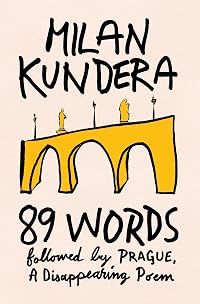
89 Words followed by Prague, A Disappearing Poem
by Milan Kundera
On This Page
Description
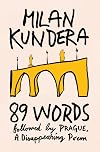
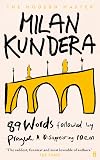
Translating a work from its original language can be complicated; it's a complex art that can easily mar and twist the intent and meaning of a writer's words. Precise translations were of particular importance to Milan Kundera, who did not live to see all his books published in his native Czech language. Words, for Kundera, were the object of constant scrutiny. This fascinating volume includes two Kundera works from the 1980s, originally written for the now defunct French magazine Le Debat, show more which have never been available in in English. In "89 Words," Kundera wryly recounts the many pitfalls in reading his own poorly translated works. When a friend of Kundera's asked him about the words he considered the most--the ones he fretted over and loved--Kundera created a personal dictionary--his "89 Words." This discerning essay, steeped in his signature barbed cheekiness, showcases his casually gutting philosophical reflections on what it means to be a writer in translation--the exile of life and art in another language. In the second work, "Prague: A Disappearing Poem," Kundera writes with a wistfulness and despair for his ever-more-distant home, offering an intimate look at the specificity of his native culture: the richness of a heritage born in a "small nation" but whose significance is universal. Here, like in A Kidnapped West, we find the double condemnation of "Soviet civilization," which had suffocated and persecuted Czech culture, and of Western Europe, which refused to neither acknowledge Kundera's culture or understand it. Prefaced by lauded French historian Pierre Nora and translated from the French by award-winning Matt Reeck, these two texts return us to Kundera's much-missed living presence. Subtle, alive, and full of wit and irony, 89 Words followed by Prague, A Disappearing Poem is an homage to a literary legend and a reminder of just how prescient his words and insights are today. -- from publisher show lessTags
Recommendations










Member Reviews
Even though Milan Kundera died in 2023, works of his are still being translated. This one, called 89 Words, is remarkable for what it reveals about his intellect and his creative process. He has selected 89 words and described why they are important, how they are employed and misused, and what power they pack.
Why stop at 89? Well, “eighty-nine” is one of the words he selected, so let me just quote Kundera directly with this entry:
“Prime numbers. They’re solid, like a fortress: indivisible, indestructible. The ideal mathematical base for a work’s architecture. As for the number itself, the numbers 8 and 9 give it the charm of a couple of Swedish athletes, tall and lean. To be beautiful like 89. The magical number of the show more alchemists in Rudolf II’s court.”
(Rudolf II was the most famous and by far the wildest Czech king, ruling from the royal compound Hradcany atop the hill overlooking Prague. It was famous, among other things, for people being thrown out the windows. But also great patronage for the arts.)
So the reader can already see how Kundera was wired differently than the rest of humanity. A close reading of the 89 words results in all kinds of revelations and connections, few, if any, expected. Love is not there, but coatrack is. He claims obscenity is “the deepest root of national pride.” How a nation swears defines it. A European is someone nostalgic for Europe. People who thrill to advertising and mass media are collabos of modernity, like the Vichy government was to Hitler. But my favorite is his summation of the word beauty: “the last possible victory of a person who has lost hope.”
The introduction is all about mistranslations. Writing in Czech as he did, everything had to be translated to be sold anywhere else, because essentially no one spoke Czech as a second language. And translators, it seems, like to leave their own marks, choosing different words than Kundera did, changing the direction and meaning of what he had written so precisely, and basically making it their own work. Suddenly, ten different translations appeared that would result in ten different understandings of his newest book.
It drove him crazy, as readers will better appreciate after reading about the 89 words. He describes the endless battles he had over the book (and then film) title The Unbearable Lightness of Being. Not only did translators all over the world murder the word Being, replacing it with things that made more sense to them (alone), but even in Prague, they wanted a different word in the original Czech. Translators were the bane of Kundera’s existence, another reason his life was very different.
As an aside, there are precious articles by Barry Hoberman in The Atlantic from 1985 as well as one by Leo Rosten called “All Hail Translators”, a chapter in a book of his, in which they show how translators have botched the Bible itself, among other works. This has resulted in age-old misinterpretations that have screwed up Christianity to this day. One example: the ancient Greek word for rays of light –cornu – is very similar to the word for horns, which is why Michelangelo’s statue of Moses in a church in Rome will forever have two short horns coming out of his hair. It said so in the Bible. So Kundera is in good company.
Growing up I was mightily impressed with a long TV interview by Dick Cavett of SJ Perelman, a humor writer I collected. Perelman admitted his production was lower than it could be because he could and did spend all day on a single word, or an entire week on a single sentence. Now here is Kundera, demonstrating the same kind of respect for language and words. Despite its short length of just 70 pages, I very much appreciate this book.
To round it out, there is a paean to Prague, called Prague: A Disappearing Poem. Prague my favorite city in the world, and Kundera’s universe until he moved to Paris. He shines a bright light on all the world-class talent that bloomed there, despite Nazi occupation followed by Russian occupation. For centuries it had been a Western capital, and then was suddenly thrust into being an Eastern one, making life contorted for all, but especially the culturally focused.
Kundera also praises fellow Czech and Polish writers, including Witold Gombrowicz, who wrote a book called Ferdydurke that Kundera praises as hilarious – the only time he uses that word. It is a satirical send-up of European society. After reading 89 Words, I immediately found one and bought it. Watch this space.
David Wineberg show less
Why stop at 89? Well, “eighty-nine” is one of the words he selected, so let me just quote Kundera directly with this entry:
“Prime numbers. They’re solid, like a fortress: indivisible, indestructible. The ideal mathematical base for a work’s architecture. As for the number itself, the numbers 8 and 9 give it the charm of a couple of Swedish athletes, tall and lean. To be beautiful like 89. The magical number of the show more alchemists in Rudolf II’s court.”
(Rudolf II was the most famous and by far the wildest Czech king, ruling from the royal compound Hradcany atop the hill overlooking Prague. It was famous, among other things, for people being thrown out the windows. But also great patronage for the arts.)
So the reader can already see how Kundera was wired differently than the rest of humanity. A close reading of the 89 words results in all kinds of revelations and connections, few, if any, expected. Love is not there, but coatrack is. He claims obscenity is “the deepest root of national pride.” How a nation swears defines it. A European is someone nostalgic for Europe. People who thrill to advertising and mass media are collabos of modernity, like the Vichy government was to Hitler. But my favorite is his summation of the word beauty: “the last possible victory of a person who has lost hope.”
The introduction is all about mistranslations. Writing in Czech as he did, everything had to be translated to be sold anywhere else, because essentially no one spoke Czech as a second language. And translators, it seems, like to leave their own marks, choosing different words than Kundera did, changing the direction and meaning of what he had written so precisely, and basically making it their own work. Suddenly, ten different translations appeared that would result in ten different understandings of his newest book.
It drove him crazy, as readers will better appreciate after reading about the 89 words. He describes the endless battles he had over the book (and then film) title The Unbearable Lightness of Being. Not only did translators all over the world murder the word Being, replacing it with things that made more sense to them (alone), but even in Prague, they wanted a different word in the original Czech. Translators were the bane of Kundera’s existence, another reason his life was very different.
As an aside, there are precious articles by Barry Hoberman in The Atlantic from 1985 as well as one by Leo Rosten called “All Hail Translators”, a chapter in a book of his, in which they show how translators have botched the Bible itself, among other works. This has resulted in age-old misinterpretations that have screwed up Christianity to this day. One example: the ancient Greek word for rays of light –cornu – is very similar to the word for horns, which is why Michelangelo’s statue of Moses in a church in Rome will forever have two short horns coming out of his hair. It said so in the Bible. So Kundera is in good company.
Growing up I was mightily impressed with a long TV interview by Dick Cavett of SJ Perelman, a humor writer I collected. Perelman admitted his production was lower than it could be because he could and did spend all day on a single word, or an entire week on a single sentence. Now here is Kundera, demonstrating the same kind of respect for language and words. Despite its short length of just 70 pages, I very much appreciate this book.
To round it out, there is a paean to Prague, called Prague: A Disappearing Poem. Prague my favorite city in the world, and Kundera’s universe until he moved to Paris. He shines a bright light on all the world-class talent that bloomed there, despite Nazi occupation followed by Russian occupation. For centuries it had been a Western capital, and then was suddenly thrust into being an Eastern one, making life contorted for all, but especially the culturally focused.
Kundera also praises fellow Czech and Polish writers, including Witold Gombrowicz, who wrote a book called Ferdydurke that Kundera praises as hilarious – the only time he uses that word. It is a satirical send-up of European society. After reading 89 Words, I immediately found one and bought it. Watch this space.
David Wineberg show less
3.5
89 words is an expanded section that originally I read in a Kundera book I like much more called Art Of The Novel...but that said, I realize how much I miss him now that he is gone. His Prague has disappeared much like he has. This is not major MK but for those who enjoy his writing, there is much to delight in here. Once you pierce the slightly arrogant veneer, there is a smart and funny man at the core. To be honest, a lot of this is just bitching about translation, but he has some amusing anecdotes.
89 words is an expanded section that originally I read in a Kundera book I like much more called Art Of The Novel...but that said, I realize how much I miss him now that he is gone. His Prague has disappeared much like he has. This is not major MK but for those who enjoy his writing, there is much to delight in here. Once you pierce the slightly arrogant veneer, there is a smart and funny man at the core. To be honest, a lot of this is just bitching about translation, but he has some amusing anecdotes.
Ratings
Members
- Recently Added By
Author Information

49+ Works 61,240 Members
One of the foremost contemporary Czech writers, Kundera is a novelist, poet, and playwright. His play The Keeper of the Keys, produced in Czechoslovakia in 1962, has long been performed in a dozen countries. His first novel, The Joke (1967), is a biting satire on the political atmosphere in Czechoslovakia in the 1950s. It tells the story of a show more young Communist whose life is ruined because of a minor indiscretion: writing a postcard to his girlfriend in which he mocks her political fervor.The Joke has been translated into a dozen languages and was made into a film, which Kundera wrote and directed. His novel Life Is Elsewhere won the 1973 Prix de Medicis for the best foreign novel. Kundera has been living in France since 1975. His books, for a long time suppressed in his native country, are once again published.The Unbearable Lightness of Being (1984), won him international fame and was a successful English-language film. In this work Kundera moves toward more universal and philosophically tinged themes, thus transforming himself from a political dissident into a writer of international significance. (Bowker Author Biography) show less
Classifications
- Genres
- Literature Studies and Criticism, Fiction and Literature
- DDC/MDS
- 891.86354 — Literature & rhetoric Asian Literature East Indo-European and Celtic literatures West and South Slavic languages (Bulgarian, Slovene, Polish, Czech, Slovak, Serbo-Croatian, and Macedonian) Czech Czech fiction 1900–1989 Late 20th century 1945–1989
- LCC
- PQ2671 .U47 .Q3813 — Language and Literature French, Italian, Spanish and Portuguese literatures French literature Modern literature 1961-2000
- BISAC
Statistics
- Members
- 29
- Popularity
- 950,675
- Reviews
- 2
- Rating
- (3.38)
- Languages
- English, French, Italian
- Media
- Paper
- ISBNs
- 8