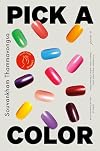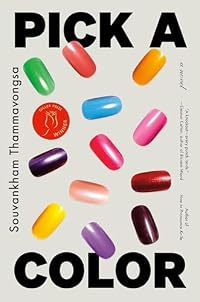
Pick a Color
by Souvankham Thammavongsa
On This Page
Description
From Giller Prize and O. Henry Award winner Souvankham Thammavongsa comes a revelatory novel about loneliness, love, labor, and class, an intimate and sharply written book following a nail salon owner as she toils away for the privileged clients who don't even know her true name. "I live in a world of Susans. I got name tags for everyone who works at this nail salon, and on every one is printed the name 'Susan.'" Ning is a retired boxer, but to the customers who visit her nail salon, she is show more just another worker named Susan. On this summer's day, much like any other, the Susans buff and clip and polish and tweeze. They listen and smile and nod. But beneath this superficial veneer, Ning is a woman of rigorous intellect and profound complexity. A woman enthralled by the intricacy and rhythms of her work, but also haunted by memories of paths not taken and opportunities lost. A woman navigating the complex power dynamics among her fellow Susans, whose greatest fears and desires lie just behind the gossip they exchange. As the day's work grinds on, the friction between Ning's two identities—as anonymous manicurist and brilliant observer of her own circumstances—will gather electric and crackling force, and at last demand a reckoning with the way the world of privilege looks at a woman like Ning. Told over a single day with razor-sharp precision and wit, Pick a Color confirms Souvankham Thammavongsa's place as literature's premier chronicler of the immigrant experience, in its myriad, complex, and slyly subversive forms. show lessTags
Recommendations




























Member Reviews
I really enjoyed this novel full of contrasts. A boxer opens a nail salon. With her team she mocks her clients, insists on efficiency and up-selling. She keeps a solid distance with everyone and shoulders all responsibilities. At the same time, she cares, tremendously. She loves her shop, the life she has made for herself, her staff. She cares about the people in the street and even the pigeons on her stoop. We sense a complicated past, one of hurt and disappointment, perhaps of betrayals and failures - certainly racism - but through all that hope shines through in the very intimate, soft spots of the story.
This book is full of details but explains very little: it is up to the reader to make sense of the gestures, dynamics, unsaid show more words, right down to the last encounter which is both a truce and a closure.
Thammavongsa is a poet and in this book she shows her art in the form of a novel. show less
This book is full of details but explains very little: it is up to the reader to make sense of the gestures, dynamics, unsaid show more words, right down to the last encounter which is both a truce and a closure.
Thammavongsa is a poet and in this book she shows her art in the form of a novel. show less
A little novella with a lot to say. This book was a Giller prize finalist in 2025. The action takes place within a single day at a nail salon owned by Ning. In order to make things simple, the shop is called Susan’s and Ning and her staff are all Susans while in the shop. This little book is full of biting wit, double entendres and complex personalities. So few words and so much said! It shines a light on a small slice of humanity and in its own way lays humanity bare for us to see. This author is brilliant with her insight, and not afraid to bring the most private emotions out into the open.
Really enjoyed this. Accessible, deceptively simple with lots going on under the surface. A mysterious Southeast Asian is the main character. She’s a former boxer in her early 40s who somehow lost a finger, is mistrustful of others, and is estranged from her family. She now runs a nail salon in which all the female employees are dressed in black and are called Susan (ostensibly for the convenience of the clients). An observant, interesting novel. I’m very interested in reading the author’s prizewinning How to Pronounce Knife: Stories.
For Ning, whose nail salon is the setting of Souvankham Thammavongsa’s debut novel, Pick a Colour, every word spoken carries hidden meaning, every action is a power play, every encounter a contest. A retired boxer, Ning brings a fighter’s mindset with her into the salon: she is constantly on the alert, seeking an advantage, studying her opponent for signs of weakness. Ning is an immigrant (her home country is never specified) and proficient in English. But experience has taught her that not being native to the country in which she lives is a disadvantage. So she does what she can to level the playing field. For a start, she knows that in the eyes of her customers, she and people like her—females of South Asian origin—are largely show more interchangeable. Therefore, she only hires other youngish South Asian women of similar build (short, wiry), and gives each the same pageboy haircut, the same black uniform, and a nametag that says “Susan.” In this way, the invisibility that immigrants experience in their adopted society becomes an advantage: by erasing their identities (they are all “Susan”), they are free to do and say what they want. Ning is also sensitive to the power of language. She knows the solidarity that a private vernacular provides to those who speak it, and the power it gives them over those who don’t: much of the conversation that occurs in the salon during work hours takes place among Ning and her colleagues as they joke around in their native language, trash-talking their oblivious clients, all while smiling and nodding in a pretence of subservience. Pick a Colour is a short novel, set over a single day, and its depiction of clashing cultures is potent. But to some extent the action lacks the kind of tension that pulls a reader in. Ning narrates with the urgency of someone who never lets down her guard, but her defensive posturing and jaded perspective can leave the reader feeling somewhat on the outside looking in. Maybe Ning has survived by her wits, by knowing when to strike and when to back away. But at the end of the day her pugilist’s approach to human interaction leaves her battle weary and physically and emotionally drained, a feeling that readers might share. There’s no doubt Thammavongsa’s award-winning pedigree ensures Pick a Colour a significant audience. And it does tell a fast-paced, quirky, occasional humorous story, one of endurance under challenging circumstances, that readers are likely to enjoy. But Pick a Colour is also frustrating: Ning’s habit of holding back ensures that she never comes clearly into focus and, at the novel’s end, remains a person whose mysteries are still mysterious. show less
Poet Souvankham Thammavongsa’s debut novel depicts a typical working day at a cut-rate nail salon. The four female staff members, all immigrants from the same unspecified Asian country, look alike, dress alike, and wear name tags emblazoned with the same name—Susan. As the narrative progresses, the shop’s emotionally stunted owner, Ning, explains the logic behind every rule she imposes upon her domain. Ning’s rigid management style is the direct result of her previous experiences as a boxer and as an employee at a rival salon.
I loved this book at the beginning. Ning’s narrative voice is compelling, and Thammavongsa clearly knows her way around both a nail salon and a boxing ring. I was, however, expecting a bigger payoff at show more the end. show less
I loved this book at the beginning. Ning’s narrative voice is compelling, and Thammavongsa clearly knows her way around both a nail salon and a boxing ring. I was, however, expecting a bigger payoff at show more the end. show less
Mani Pedi Salon Tales
A review of the Knopf Canada eBook (September 30, 2025).
It is an unfair comparison but I couldn't help feeling a bit disappointed in Pick a Colour due to having read a somewhat similar book Katja Oskamp's [book:Marzahn, mon amour: Geschichten einer Fußpflegerin|49947323] (2019) which I read in English translation as [book:Marzahn, mon amour|59737256] (2022) and reviewed as A Podiatrist's Tales. Both books deal with the workers and customers at a salon.
There was a joy and exuberance in Oskamp that contrasts with show more the bitterness and secretiveness in Thammavongsa. I would likely have had a more positive impression of the later book if I hadn't read the earlier one. Nothing to be done about that. I had thoroughly enjoyed Thammavongsa's earlier short story collection [book:How to Pronounce Knife: Stories|51196859] (2020) which even had somewhat of a cross-over story which was also set in a mani-pedi salon. That collection had quite a lot of humour to it which I found mostly lacking in the novella.
It was interesting to learn some background to the book in the Giller Book Club interview (see link below). Thammavongsa even admitted that in order to get her next book of short stories published she had to agree to do a novel, presumably due to the publisher's requirements. Also some of the reader's speculations about how the salon operator lost the tip of her finger (which is never revealed in the book itself) were quite entertaining to hear about.
Trivia and Link
Pick a Colour was the winner of the 2025 Giller Prize in Canada. You can read the Jury's decision and link to videos of the ceremony at the Giller Prize website here.
Author Souvankham Thammavongsa is interviewed for the Giller Book Club and you can watch the interview at the Book Club's YouTube channel here. show less
A review of the Knopf Canada eBook (September 30, 2025).
You look at something long enough and you begin to see everything in its details. And you’d be surprised what people tell you when they think you are a stranger and they are never going to see you again.
It is an unfair comparison but I couldn't help feeling a bit disappointed in Pick a Colour due to having read a somewhat similar book Katja Oskamp's [book:Marzahn, mon amour: Geschichten einer Fußpflegerin|49947323] (2019) which I read in English translation as [book:Marzahn, mon amour|59737256] (2022) and reviewed as A Podiatrist's Tales. Both books deal with the workers and customers at a salon.
There was a joy and exuberance in Oskamp that contrasts with show more the bitterness and secretiveness in Thammavongsa. I would likely have had a more positive impression of the later book if I hadn't read the earlier one. Nothing to be done about that. I had thoroughly enjoyed Thammavongsa's earlier short story collection [book:How to Pronounce Knife: Stories|51196859] (2020) which even had somewhat of a cross-over story which was also set in a mani-pedi salon. That collection had quite a lot of humour to it which I found mostly lacking in the novella.
It was interesting to learn some background to the book in the Giller Book Club interview (see link below). Thammavongsa even admitted that in order to get her next book of short stories published she had to agree to do a novel, presumably due to the publisher's requirements. Also some of the reader's speculations about how the salon operator lost the tip of her finger (which is never revealed in the book itself) were quite entertaining to hear about.
Trivia and Link
Pick a Colour was the winner of the 2025 Giller Prize in Canada. You can read the Jury's decision and link to videos of the ceremony at the Giller Prize website here.
Author Souvankham Thammavongsa is interviewed for the Giller Book Club and you can watch the interview at the Book Club's YouTube channel here. show less
Delightful character-driven slice-of-life novel that leaves you wondering (in a good way).
Members
- Recently Added By
Published Reviews
The business, called Susan’s, is Ning’s kingdom. There are five chairs, four workers, serving clients three at a time; “any more than that and I lose track of who is doing what and when”. Ning lives in a “tiny apartment … right above the shop” and “can’t remember the last time I spent any time away from it”. And so the book’s impressive constraints are set: one room, one show more day, one business.One of the challenges of the circadian novel, especially when it’s also a closed-room novel, is to channel enough backstory through the present moment to establish the significance of what might be dismissed as too routine or trivial for literary attention. The premise of this kind of writing, paying close attention to humdrum daily life, is that the real stories lie in the opening and closing of doors, the making of tea and sweeping of floors. The writer has to make the reader see such acts anew, to recognise that life arcs, shaped by war and colonialism and migration, play out in thoughtless transactions and small impulses.But kindness, also, seeps through in the end. There’s no disgust at tired feet or oily skin. Proudly child-free, scornful of clients’ desire to talk about their babies, Ning nonetheless keeps drawings made by the children of an employee whom she allowed to exploit her. There are developing moments of sympathy and even affection for her longest-serving worker, and beautifully understated sadness at the end.The constrained setting, deep investment in a feminised and minoritised experience and disengagement from plot will alienate some readers. They will miss a highly crafted, layered and clever novel. show less
added by VivienneR
Lists

Giller Prize Winners
32 works; 6 members

Globe and Mail | Canadian Fiction: October 11, 2025
10 works; 1 member

Globe and Mail | Canadian Fiction: October 25, 2025
10 works; 1 member

Globe and Mail | Canadian Fiction: November 8, 2025
10 works; 1 member

Books Read in 2025
4,090 works; 97 members
Globe and Mail | Canadian Fiction: November 29, 2025
10 works; 1 member
Globe and Mail | Canadian Fiction: December 6, 2025
10 works; 1 member
Globe and Mail | Canadian Fiction: December 13, 2025
10 works; 1 member
Globe and Mail | Canadian Fiction: December 20, 2025
10 works; 1 member
Globe and Mail | Canadian Fiction: December 27, 2025
10 works; 1 member

Globe and Mail | Canadian Fiction: January 10, 2026
10 works; 1 member

Globe and Mail | Canadian Fiction: January 17, 2026
10 works; 1 member
Globe and Mail | Canadian Fiction: January 24, 2026
10 works; 1 member
Author Information

13+ Works 795 Members
Awards and Honors
Awards
Distinctions
Common Knowledge
- Canonical title
- Pick a Color
- People/Characters
- Ning
Classifications
Statistics
- Members
- 151
- Popularity
- 215,832
- Reviews
- 12
- Rating
- (3.42)
- Languages
- English
- Media
- Paper, Audiobook, Ebook
- ISBNs
- 9
- ASINs
- 3