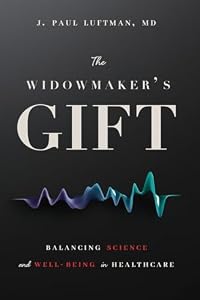
The Widowmaker's Gift: Balancing Science and Well-Being in Healthcare
by J Paul Luftman
On This Page
Tags
Member Reviews
J. Paul Luftman says the personal journey he recounts in this book began around three decades ago. Although the timeline is rather fuzzy, at some point this accomplished and driven family and (non-surgical) sports medicine doctor had a psychological breakdown. To all outward appearances, he was a competent and successful professional, holding a number of leadership and administrative roles. However, almost from the start of his career in medicine, he’d felt like an imposter. Over time, that feeling had only grown. A workaholic through and through, he was a human doing, rather than a human being. Luftman pushed himself to the point of exhaustion, his anxiety became debilitating, and he began to have panic attacks. As I said, the show more chronology is unclear, but it appears that his marriage failed around this time, and he was buried in a mountain of debt.
Roughly six years ago, Luftman had a massive heart attack, what is known as a widowmaker because it is more common in men than women and often fatal. With this condition, the left anterior descending artery—the major artery supplying the heart muscle— is entirely blocked. Luftman came very close to losing his life. In denial, he initially attributed his difficulty breathing, the burning in his chest, and his searing arm pain to intense esophageal spasm. When every second counted, he delayed calling for an ambulance. Finally, the inner voice that had repeatedly told him to get help prevailed. He received just-in-time cardiac catheterization.
Only 48, he had no personal or family history of heart disease, had never smoked, his cholesterol wasn’t elevated, nor was he diabetic. He was active, apparently fit, and ate a healthy diet. The attending cardiologist could offer no explanation for the event; neither could the other heart specialists he consulted for second and third opinions. Reflecting that he was no longer in “the Realm of the Known” but “tossed into the Sea of Unknowing,” he decided to travel on uncharted waters to look for answers. “If we’re lucky,” he writes, “there comes a time in our lives when we are given the chance to claim ourselves.” He seized the opportunity to understand the mystery of his longstanding unease, distress, and anxiety. It appears that he suspected that psychological factors contributed to his massive heart attack.
The Widowmaker’s Gift is a mixture of memoir, guidance to other healthcare workers who may be experiencing symptoms similar to his, and a record of the extensive research he undertook. Recovery literature figures fairly prominently in the book, but there are chapters on the intersection of Buddhism and psychology, meditation, and alternative medical therapies as well. I found the sections on music and sound particularly fascinating. While he acknowledges the gains that evidence-based medicine has brought us, Luftman strongly advocates for a mind-body approach in which patients’ psychological and spiritual needs are also considered. He points to interesting research on consciousness and the ways in which several notable physicists were inspired by the Vedanta, ancient Hindu philosophy.
Early on, well before his heart attack, Luftman saw a Freudian psychoanalyst. He found this a helpful stopgap measure that allowed him to continue working, but he wanted a less abstract, more pragmatic approach. He subsequently worked with a warm, down-to-earth psychiatrist who prescribed medication and provided cognitive behavioural therapy. This physician encouraged him to attend Co-dependents Anonymous and, suspecting trauma, also referred the author to a dedicated trauma therapist.
Although Luftman doesn’t get into this, it should be noted that the codependent movement is an offshoot of Twelve-Step addiction programs. Family members (the spouse and children) of an alcoholic or substance abuser were recognized to have significant issues of their own. They often became overly focused on the addicted person’s behaviour, trying to fix or control him or her, and suppressing their own needs in the process. Luftman was not from a home where addiction was a problem. Neither was there sexual abuse, domestic abuse, or physical neglect, and child services were never called. However, the author’s family dynamics appear to have dictated that he adopt many of the same coping strategies that the child of an alcoholic might.
Luftman’s parents divorced when he was a year old. His father quickly remarried and had two more children, and, as a boy, the author made weekly visits to his father’s home. These were extremely stressful for Luftman, a sensitive child. His stepmother was hypercritical and unwelcoming, and his father always took her side. To avoid criticism, the boy’s chief coping strategy was to be “nice”. He anticipated and tended to the needs of others, becoming an anxious and hypervigilant people-pleaser who never felt safe. Returning to his mother’s home after weekends at his dad’s, he was often ill; he had nightmares and flashbacks to scenes in which he was picked on. Sacrificing his own needs to accommodate others and looking for external validation persisted into adulthood.
The author characterizes his childhood experiences as “traumatic”—citing the work of physician-author Gabor Maté, who sees trauma pretty much everywhere. I’ve read Maté’s books and have some reservations about his views. I also have some about Luftman’s. He believes that he suffered from Complex PTSD, a diagnosis that he notes is not accepted by all mental-health experts. The World Health Organization has added the condition to its International Classification of Diseases (ICD-11), but the American Psychiatric Association has not included it in the Diagnostic and Statistical Manual.
While I acknowledge the author’s distress and suffering in childhood, I admit to being uncomfortable with his applying the word “trauma” to the experiences he recounts. Formerly invoked to describe extreme, life-threatening events, the word is now used so frequently, it has become almost meaningless. Luftman himself says as much and states that there can be harm in the overuse of the term. Nevertheless, he insists on Complex PTSD as a diagnosis. It seems to me that there’s a troubling trend for more and more people to identify as having some mental health condition or another—most commonly autism, ADHD, or an anxiety disorder, but PTSD is occasionally mentioned as well.
I was surprised by the number of labels Luftman applies to himself throughout the book. As well as stating that he has C-PTSD, he variously identifies himself as codependent, a wounded healer, an empath, and an INFJ (the rarest personality type in the Myers-Briggs Personality Inventory). Perhaps the desire (or perhaps need) for labels reflects the identity issues he says has struggled with.
Although I found the research Luftman presents stimulating, I wish his book had been better organized and rigorously revised and edited. The memoir component is sometimes hard to follow: events are not presented in chronological order and there is inadequate detail provided about childhood experiences. There is also a fair bit of repetition, particularly where codependency is concerned.
This is an ambitious book and the author provides many links and resources. However, I don’t think quite so many needed to be supplied, nor did as many topics have to be covered. Finally, while I understand that the author wanted to encourage his readers to make connections to his experiences and reflect on the material presented, it’s my view that exercises reminding people to stop, reflect, and answer prompts were unnecessary.
Thank you to the publisher and Net Galley for prepublication copy. show less
Roughly six years ago, Luftman had a massive heart attack, what is known as a widowmaker because it is more common in men than women and often fatal. With this condition, the left anterior descending artery—the major artery supplying the heart muscle— is entirely blocked. Luftman came very close to losing his life. In denial, he initially attributed his difficulty breathing, the burning in his chest, and his searing arm pain to intense esophageal spasm. When every second counted, he delayed calling for an ambulance. Finally, the inner voice that had repeatedly told him to get help prevailed. He received just-in-time cardiac catheterization.
Only 48, he had no personal or family history of heart disease, had never smoked, his cholesterol wasn’t elevated, nor was he diabetic. He was active, apparently fit, and ate a healthy diet. The attending cardiologist could offer no explanation for the event; neither could the other heart specialists he consulted for second and third opinions. Reflecting that he was no longer in “the Realm of the Known” but “tossed into the Sea of Unknowing,” he decided to travel on uncharted waters to look for answers. “If we’re lucky,” he writes, “there comes a time in our lives when we are given the chance to claim ourselves.” He seized the opportunity to understand the mystery of his longstanding unease, distress, and anxiety. It appears that he suspected that psychological factors contributed to his massive heart attack.
The Widowmaker’s Gift is a mixture of memoir, guidance to other healthcare workers who may be experiencing symptoms similar to his, and a record of the extensive research he undertook. Recovery literature figures fairly prominently in the book, but there are chapters on the intersection of Buddhism and psychology, meditation, and alternative medical therapies as well. I found the sections on music and sound particularly fascinating. While he acknowledges the gains that evidence-based medicine has brought us, Luftman strongly advocates for a mind-body approach in which patients’ psychological and spiritual needs are also considered. He points to interesting research on consciousness and the ways in which several notable physicists were inspired by the Vedanta, ancient Hindu philosophy.
Early on, well before his heart attack, Luftman saw a Freudian psychoanalyst. He found this a helpful stopgap measure that allowed him to continue working, but he wanted a less abstract, more pragmatic approach. He subsequently worked with a warm, down-to-earth psychiatrist who prescribed medication and provided cognitive behavioural therapy. This physician encouraged him to attend Co-dependents Anonymous and, suspecting trauma, also referred the author to a dedicated trauma therapist.
Although Luftman doesn’t get into this, it should be noted that the codependent movement is an offshoot of Twelve-Step addiction programs. Family members (the spouse and children) of an alcoholic or substance abuser were recognized to have significant issues of their own. They often became overly focused on the addicted person’s behaviour, trying to fix or control him or her, and suppressing their own needs in the process. Luftman was not from a home where addiction was a problem. Neither was there sexual abuse, domestic abuse, or physical neglect, and child services were never called. However, the author’s family dynamics appear to have dictated that he adopt many of the same coping strategies that the child of an alcoholic might.
Luftman’s parents divorced when he was a year old. His father quickly remarried and had two more children, and, as a boy, the author made weekly visits to his father’s home. These were extremely stressful for Luftman, a sensitive child. His stepmother was hypercritical and unwelcoming, and his father always took her side. To avoid criticism, the boy’s chief coping strategy was to be “nice”. He anticipated and tended to the needs of others, becoming an anxious and hypervigilant people-pleaser who never felt safe. Returning to his mother’s home after weekends at his dad’s, he was often ill; he had nightmares and flashbacks to scenes in which he was picked on. Sacrificing his own needs to accommodate others and looking for external validation persisted into adulthood.
The author characterizes his childhood experiences as “traumatic”—citing the work of physician-author Gabor Maté, who sees trauma pretty much everywhere. I’ve read Maté’s books and have some reservations about his views. I also have some about Luftman’s. He believes that he suffered from Complex PTSD, a diagnosis that he notes is not accepted by all mental-health experts. The World Health Organization has added the condition to its International Classification of Diseases (ICD-11), but the American Psychiatric Association has not included it in the Diagnostic and Statistical Manual.
While I acknowledge the author’s distress and suffering in childhood, I admit to being uncomfortable with his applying the word “trauma” to the experiences he recounts. Formerly invoked to describe extreme, life-threatening events, the word is now used so frequently, it has become almost meaningless. Luftman himself says as much and states that there can be harm in the overuse of the term. Nevertheless, he insists on Complex PTSD as a diagnosis. It seems to me that there’s a troubling trend for more and more people to identify as having some mental health condition or another—most commonly autism, ADHD, or an anxiety disorder, but PTSD is occasionally mentioned as well.
I was surprised by the number of labels Luftman applies to himself throughout the book. As well as stating that he has C-PTSD, he variously identifies himself as codependent, a wounded healer, an empath, and an INFJ (the rarest personality type in the Myers-Briggs Personality Inventory). Perhaps the desire (or perhaps need) for labels reflects the identity issues he says has struggled with.
Although I found the research Luftman presents stimulating, I wish his book had been better organized and rigorously revised and edited. The memoir component is sometimes hard to follow: events are not presented in chronological order and there is inadequate detail provided about childhood experiences. There is also a fair bit of repetition, particularly where codependency is concerned.
This is an ambitious book and the author provides many links and resources. However, I don’t think quite so many needed to be supplied, nor did as many topics have to be covered. Finally, while I understand that the author wanted to encourage his readers to make connections to his experiences and reflect on the material presented, it’s my view that exercises reminding people to stop, reflect, and answer prompts were unnecessary.
Thank you to the publisher and Net Galley for prepublication copy. show less
Members
- Recently Added By
Author Information
2 Works 2 Members
Statistics
- Members
- 2
- Popularity
- 6,012,945
- Reviews
- 1
- Media
- Paper
- ASINs
- 1