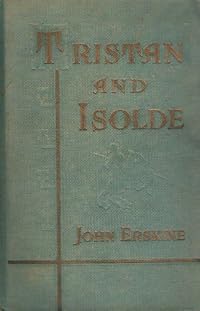
Tristan and Isolde, restoring Palamede
by John Erskine
On This Page
Tags
Member Reviews
Rating: 4* of five
The Book Report: I cannot conceive that anyone who can type "www.LibraryThing.com" does not know the story of Tristan and Isolde, so I won't recap it here.
Palomedes/Palamede needs some explanation. He was the insertion of a thirteenth-century author into the Arthurian mythos, the Stranger Who Calls and stays. He was the son of a pagan king who, being educated by his father's Christian slave, decides to set off for Christendom and see what he can see. In Erskine's beautifully wrought novel, Palamede is more honorable and Christian than that adulterous lout Tristan; in the antique version, he's the close-second parfit gentil knight, the foil of His Perfectness Tristan.
I like Erskine's version a lot better.
My Review: John show more Erskine published this book in 1932. It wasn't a terribly optimistic time in American history, and that sense of gloom-and-doom is reflected in his use of the perfect outsider commenting on the foibles of the smug, self-satisfied host Westerners. They're all nobility, so equivalent to the plutocrats who, in that more enlightened time, got the proper degree of blame and suffered the proper degree of economic punishment (unlike our own pusillanimous age, fearful of taxing the wealthiest entities at appropriate levels); Erskine isn't in any way shy about blasting the bad behavior, selfishness, and all-around turpitude of these small-souled greed machines.
I *batten* on his outrage. I share it.
Well, anyway, should you read it? Yes. Yes indeed. It is beautifully, simply written, and it's an evergreen plot. Marvelous stuff. Save it from obscurity, and read it soon. show less
The Book Report: I cannot conceive that anyone who can type "www.LibraryThing.com" does not know the story of Tristan and Isolde, so I won't recap it here.
Palomedes/Palamede needs some explanation. He was the insertion of a thirteenth-century author into the Arthurian mythos, the Stranger Who Calls and stays. He was the son of a pagan king who, being educated by his father's Christian slave, decides to set off for Christendom and see what he can see. In Erskine's beautifully wrought novel, Palamede is more honorable and Christian than that adulterous lout Tristan; in the antique version, he's the close-second parfit gentil knight, the foil of His Perfectness Tristan.
I like Erskine's version a lot better.
My Review: John show more Erskine published this book in 1932. It wasn't a terribly optimistic time in American history, and that sense of gloom-and-doom is reflected in his use of the perfect outsider commenting on the foibles of the smug, self-satisfied host Westerners. They're all nobility, so equivalent to the plutocrats who, in that more enlightened time, got the proper degree of blame and suffered the proper degree of economic punishment (unlike our own pusillanimous age, fearful of taxing the wealthiest entities at appropriate levels); Erskine isn't in any way shy about blasting the bad behavior, selfishness, and all-around turpitude of these small-souled greed machines.
I *batten* on his outrage. I share it.
Well, anyway, should you read it? Yes. Yes indeed. It is beautifully, simply written, and it's an evergreen plot. Marvelous stuff. Save it from obscurity, and read it soon. show less
Members
- Recently Added By
Lists

Modern Arthurian Fiction
237 works; 16 members
Author Information

47+ Works 548 Members
Classifications
- Genres
- Fiction and Literature, General Fiction, Historical Fiction, Fantasy
- DDC/MDS
- 823.1 — Literature & rhetoric English & Old English literatures English fiction Early English 1066-1400
- LCC
- PZ3 .E7287 — Language and Literature Fiction and juvenile belles lettres Fiction and juvenile belles lettres Fiction in English
Statistics
- Members
- 10
- Popularity
- 2,144,406
- Reviews
- 2
- Rating
- (4.00)
- Media
- Paper
- ASINs
- 1