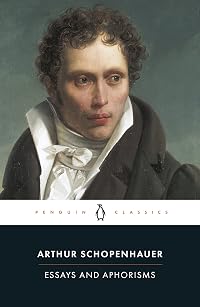
Essays and Aphorisms
by Arthur Schopenhauer (Author), R. J. Hollingdale (Translator)
On This Page
Description
Schopenhauer believed that human action is determined not by reason but by 'will', and his writing demonstrates his innovative-and pessimistic-attitude towards human conduct.Tags
Recommendations



















Member Reviews
Although the German philosopher Arthur Schopenhauer died in 1860, I could almost see him as an essayist writing today. Or more likely he’d be a blogger, since he disapproved of those that wrote for money. “Every writer writes badly as soon as he starts writing for gain.”
He’d definitely be considered a curmudgeon. Schopenhauer disapproved of many things. Some you can agree with – he was against cruelty to animals and felt religion was a substitute for the truth.
His attitude toward woman wouldn’t fly today. “They themselves are childish, silly and shortsighted.” And “one must accordingly say that the fundamental defect of the female character is a lack of a sense of justice.”
He could be almost charmingly pessimistic. show more On aging: “Today it is bad, and day by day it will get worse – until at last the worst of all arrives.” They won’t be posting that above the entrance of retirement homes anytime soon.
On suicide: “It will generally be found that where the terrors of life come to outweigh the terrors of death a man will put an end to his life.”
He had strange ideas on some issues: “You should read only when your own thoughts dry up.” He considered monarchies as a more natural form of government than republics.
An intriguing look into the thoughts of one of the most influential philosophers of the nineteenth century. show less
He’d definitely be considered a curmudgeon. Schopenhauer disapproved of many things. Some you can agree with – he was against cruelty to animals and felt religion was a substitute for the truth.
His attitude toward woman wouldn’t fly today. “They themselves are childish, silly and shortsighted.” And “one must accordingly say that the fundamental defect of the female character is a lack of a sense of justice.”
He could be almost charmingly pessimistic. show more On aging: “Today it is bad, and day by day it will get worse – until at last the worst of all arrives.” They won’t be posting that above the entrance of retirement homes anytime soon.
On suicide: “It will generally be found that where the terrors of life come to outweigh the terrors of death a man will put an end to his life.”
He had strange ideas on some issues: “You should read only when your own thoughts dry up.” He considered monarchies as a more natural form of government than republics.
An intriguing look into the thoughts of one of the most influential philosophers of the nineteenth century. show less
Arthur Schopenhauer wrote his essays and aphorisms in the financial hub city of Frankford, Germany during the mid-nineteenth century, a world where business owners and financiers ruthlessly competed against one another to amass fortunes, clerks chained to their desks toiled twelve hours a day, uneducated day laborers ground themselves down into faceless, mindless cogs of the urban wheel, and upper class ladies strolled the streets with parasols as they chattered incessantly over petty concerns - but, no matter what one's station in life - ruthless financial baron, toiling clerk, chattering lady or manual drudge - the monotonous hum of this bustling society gave few people encouragement or mental space to think independently or reflect show more philosophically. But no hustle and bustle for Arthur. Inheriting the family fortune and thus freed from any obligation to work for a living, Schopenhauer became a life-long bachelor and independent scholar, keeping his distance from other people as if they were a colony of doltish, novel-reading lepers.
And, thus, after rousing in the morning and before playing the flute, partaking of lunch, and going for his two hour walk with his pet poodle, Schopenhauer sat at his desk, completely dedicating his time to writing. And this collection is Schopenhauer at his hyper-arrogant best, as self-appointed genius and highbrow aesthete, shooting verbal barbs and passing harsh judgment on everyone and everything in sight - would-be philosophers, journalists, bookworms, scholars, literati, historians, women, among numerous others.
This book is great literature as well as original philosophy, the writing is so incredibly clear, crystal clear, actually - a straightforward, easy-to-follow, elegant prose. What a switch from hopelessly dry, turgid, stale academic philosophy with its endless references, footnotes and qualifications.
On the topic of books and writing, here is a quote which is vintage Schopenhauer: "The thoughts a man is capable of always express themselves in clear, comprehensible and unambiguous words. Those who put together difficult, obscure, involved, ambiguous discourses do not really know what they want to say: they have no more than a vague consciousness of it which is only struggling towards a thought; often, however, they also want to conceal from themselves and others that they actually have nothing to say." Keep this in mind the next time you read an incomprehensible piece of writing - in truth, the burden is on the writer to make their thoughts clear, no matter how impressive the author's credentials.
Among the topics address is aesthetics. As always, Schopenhauer never dances around an issue but goes right to the heart of the matter and tells it like it is. Here is what he has to say on opera: "Strictly speaking one could call opera an unmusical invention for the benefit of unmusical minds." For anybody with a keen interest in listening to music, these words have a very honest ring.
Here is a quote that is especially appropriate to our current age of information: "Students and learned men of every kind and every ago go as a rule in search of information, not insight. They make it a point of honor to have information about everything . . . When I see how much these well-informed people know, I sometimes say to myself: Oh, how little such a one must have had to think about, since he has had so much time for reading!" The truth of this statement is compounded with the omnipresence of the internet.
One more quote, this one capsulizing Schopenhauer's famous pessimistic view of life: "No rose without a thorn. But many a thorn without a rose." Even if you don't agree, you have to admire a brilliant, memorable metaphor.
If you are new to Schopenhauer or philosophy, R. J. Hollindale provides an introduction which includes a mini-history of philosophy leading up to Schopenhauer, the cultural, literary and social context of Germany in the nineteenth century, as well as a mini-biography of Schopenhauer. This is all you will need to have a rich appreciation for one of the most lucid and influential philosophers in the Western tradition. show less
Arthur Schopenhauer wrote his essays and aphorisms in the financial hub city of Frankford, Germany during the mid-nineteenth century, a world where business owners and financiers ruthlessly competed against one another to amass fortunes, clerks chained to their desks toiled twelve hours a day, uneducated day laborers ground themselves down into faceless, mindless cogs of the urban wheel, and upper class ladies strolled the streets with parasols as they chattered incessantly over petty concerns - but, no matter what one's station in life - ruthless financial baron, toiling clerk, chattering lady or manual drudge - the monotonous hum of this bustling society gave few people encouragement or mental space to think independently or reflect show more philosophically. But no hustle and bustle for Arthur. Inheriting the family fortune and thus freed from any obligation to work for a living, Schopenhauer became a life-long bachelor and independent scholar, keeping his distance from other people as if they were a colony of doltish, novel-reading lepers.
And, thus, after rousing in the morning and before playing the flute, partaking of lunch, and going for his two hour walk with his pet poodle, Schopenhauer sat at his desk, completely dedicating his time to writing. And this collection is Schopenhauer at his hyper-arrogant best, as self-appointed genius and highbrow aesthete, shooting verbal barbs and passing harsh judgment on everyone and everything in sight - would-be philosophers, journalists, bookworms, scholars, literati, historians, women, among numerous others.
This book is great literature as well as original philosophy, the writing is so incredibly clear, crystal clear, actually - a straightforward, easy-to-follow, elegant prose. What a switch from hopelessly dry, turgid, stale academic philosophy with its endless references, footnotes and qualifications.
On the topic of books and writing, here is a quote which is vintage Schopenhauer: "The thoughts a man is capable of always express themselves in clear, comprehensible and unambiguous words. Those who put together difficult, obscure, involved, ambiguous discourses do not really know what they want to say: they have no more than a vague consciousness of it which is only struggling towards a thought; often, however, they also want to conceal from themselves and others that they actually have nothing to say." Keep this in mind the next time you read an incomprehensible piece of writing - in truth, the burden is on the writer to make their thoughts clear, no matter how impressive the author's credentials.
Among the topics address is aesthetics. As always, Schopenhauer never dances around an issue but goes right to the heart of the matter and tells it like it is. Here is what he has to say on opera: "Strictly speaking one could call opera an unmusical invention for the benefit of unmusical minds." For anybody with a keen interest in listening to music, these words have a very honest ring.
Here is a quote that is especially appropriate to our current age of information: "Students and learned men of every kind and every ago go as a rule in search of information, not insight. They make it a point of honor to have information about everything . . . When I see how much these well-informed people know, I sometimes say to myself: Oh, how little such a one must have had to think about, since he has had so much time for reading!" The truth of this statement is compounded with the omnipresence of the internet.
One more quote, this one capsulizing Schopenhauer's famous pessimistic view of life: "No rose without a thorn. But many a thorn without a rose." Even if you don't agree, you have to admire a brilliant, memorable metaphor.
If you are new to Schopenhauer or philosophy, R. J. Hollindale provides an introduction which includes a mini-history of philosophy leading up to Schopenhauer, the cultural, literary and social context of Germany in the nineteenth century, as well as a mini-biography of Schopenhauer. This is all you will need to have a rich appreciation for one of the most lucid and influential philosophers in the Western tradition. show less
And, thus, after rousing in the morning and before playing the flute, partaking of lunch, and going for his two hour walk with his pet poodle, Schopenhauer sat at his desk, completely dedicating his time to writing. And this collection is Schopenhauer at his hyper-arrogant best, as self-appointed genius and highbrow aesthete, shooting verbal barbs and passing harsh judgment on everyone and everything in sight - would-be philosophers, journalists, bookworms, scholars, literati, historians, women, among numerous others.
This book is great literature as well as original philosophy, the writing is so incredibly clear, crystal clear, actually - a straightforward, easy-to-follow, elegant prose. What a switch from hopelessly dry, turgid, stale academic philosophy with its endless references, footnotes and qualifications.
On the topic of books and writing, here is a quote which is vintage Schopenhauer: "The thoughts a man is capable of always express themselves in clear, comprehensible and unambiguous words. Those who put together difficult, obscure, involved, ambiguous discourses do not really know what they want to say: they have no more than a vague consciousness of it which is only struggling towards a thought; often, however, they also want to conceal from themselves and others that they actually have nothing to say." Keep this in mind the next time you read an incomprehensible piece of writing - in truth, the burden is on the writer to make their thoughts clear, no matter how impressive the author's credentials.
Among the topics address is aesthetics. As always, Schopenhauer never dances around an issue but goes right to the heart of the matter and tells it like it is. Here is what he has to say on opera: "Strictly speaking one could call opera an unmusical invention for the benefit of unmusical minds." For anybody with a keen interest in listening to music, these words have a very honest ring.
Here is a quote that is especially appropriate to our current age of information: "Students and learned men of every kind and every ago go as a rule in search of information, not insight. They make it a point of honor to have information about everything . . . When I see how much these well-informed people know, I sometimes say to myself: Oh, how little such a one must have had to think about, since he has had so much time for reading!" The truth of this statement is compounded with the omnipresence of the internet.
One more quote, this one capsulizing Schopenhauer's famous pessimistic view of life: "No rose without a thorn. But many a thorn without a rose." Even if you don't agree, you have to admire a brilliant, memorable metaphor.
If you are new to Schopenhauer or philosophy, R. J. Hollindale provides an introduction which includes a mini-history of philosophy leading up to Schopenhauer, the cultural, literary and social context of Germany in the nineteenth century, as well as a mini-biography of Schopenhauer. This is all you will need to have a rich appreciation for one of the most lucid and influential philosophers in the Western tradition. show less
I have second-hand knowledge of Schopenhauer's "the will to live is consecrated in the act of procreation" thesis, and while it makes a brief appearance, much of this collection is focused on religion. The "On Various Subjects" section reads a little like La Rochefoucauld's Maxims, and makes some interesting assertions about genius (it is OK to make mistakes, just your masterpiece ought to be inimitable); on the farcical nature of higher education (perception must precede concept, not the other way around); an early statement concerning animal rights (p. 77); and that great works have to wait until enough idiots agree that it is great - such insight is possessed by the majority in the same way that a "castrate possesses of the power to show more beget children". Now to religion. Some of my favourites:
All religion is antagonistic towards culture; The absurdities of dogma... arise from the need to link together two heterogeneous doctrines as those of the Old and the New Testaments; Hatred and contempt are decidedly antagonistic to one another and mutually exclusive (p. 52); The more prudent rulers enter into an alliance with [priests]; and Faith and knowledge are totally different.The latter explains the dialogue On Religion, which, although I understand Schopenhauer was atheistic, appeared on the surface to be bombastic, but might otherwise resonate with court judges who have been confronted with decisions concerning the existence of God, and have deferred on the grounds that, in effect, "faith and knowledge" are different. Nevertheless, there is in this work the attitude (of The Enlightenment) that rational individuals cannot possibly believe in God. I have heard this sentiment expressed by senior academics, in addition to the buffoons who drool over the Facebook echo-chamber "I F***ing Love Science" which confirms empirically that God does not exist because it has 25 million "likes" (see quote above about "castrates"). That said, there is little to surprise the modern reader, but Schopenhauer was one of the few Western students of India and Buddhism, and his insights demonstrate that the glory days Conservatives dream about did not really exist in the nineteenth century, the counterfactuals were simply hidden from majority view. But to disclose the real gem in this work, I found another piece to the riddle of Benjamin Franklin. One of his "virtues" is "moderation". This is not a riddle in itself, but when "temperance" is also one of the virtues, what is so special about moderation that it should stand alone? Schopenhauer explains in the essay On Ethics by setting out some of the differences between Eastern and Western virtues and vices. For Schopenhauer, "virtues are qualities of will", which means that cowardice cannot be a vice if we have the "will to live"! The Platonic virtues closely align with Franklin's,one of which Cicero translated as temperantia, which is"in English moderation". Schopenhauer states:
[Moderation] is a very vague and ambiguous expression under which many different things can be subsumed, such as prudence, sobriety, keeping one's head.Prudence. Cautious. To Franklin, "avoiding extremes". "Sobriety", therefore, belongs with "temperance". But "prudence" and "keeping one's head", then, belong to moderation. Whether "keeping one's head" is the same thing as to "forbear resenting injuries so much as one is able" remains to be seen, but I daresay Schopenhauer and Franklin were conversant in the literature on virtues, and eventually I will solve the riddle. But what of Schopenhauer? Religion is something we believe because we are indoctrinated as children, but as humanity "grows up", religion must inevitably die because it doesn't make sense (irrational). Yet the final paragraph tells the story of adolescents throwing out the baby with the bathwater - Aesop's fables are too childish because everybody knows foxes, wolves, and ravens can't talk! Thus, Schopenhauer ends with a real noodle-baker (about the boy who was too grown up to read Aesop):
Who cannot see in this hopeful lad the future enlightened Rationalist?show less
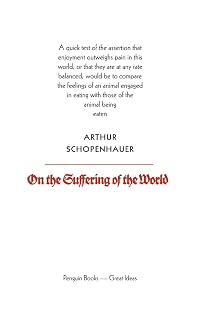
In The Horrors and Absurdities of Religion, Arthur Schopenhauer examines the nature of religion and dogma in society. He writes in the introductory dialogue, “The capacity for faith is at its strongest in childhood: which is why religions apply themselves before all else to getting these tender years into their possession” (pg. 4). Schopenhauer continues, “The power of religious dogmas imprinted in early years is such that they are capable of stifling conscience and finally all pity and humanity” (pg. 5). Further, “In every religion, faith, temple ceremonies and rites of all kinds soon come to be pronounced of more immediate interest to the divine will than moral actions; indeed, the former, especially when they are bound up show more with the emoluments of the priests, gradually come to be regarded as a substitute for the latter: animal sacrifices, or the saying of masses… soon come to be the most meritorious works, so that they atone for even the gravest crimes, as do penances, subjection to priestly authority, confessions, pilgrimages, donations to the temples and their priests… and the like, whereby the priests finally appear as virtually no more than go-betweens in a trade with bribable gods” (pg. 24). Schopenhauer then examines the nature of ethics, philosophy, religion, and “various subjects” (pg. 89). Discoursing on religion, Schopenhauer writes, “…He is still in his childhood who can think that superhuman beings have ever given our race information about the aim of its existence or that of the world” (pg. 66). He concludes, “Mankind is growing out of religion as out of its childhood clothes. Faith and knowledge do not get on well together in the same head” (pgs. 87-88). Despite his insights, Schopenhauer’s writing reveals his Euro-centric bias and general approval of imperialism as a force of social change. Thus, the reader must practice a certain amount of selective attention, focusing on the stronger points of his argument while understanding that he – like most authors – reflects the values of his time. That caveat in place, Schopenhauer’s The Horrors and Absurdities of Religion is a good entry in Penguin’s Great Ideas series for those interested in philosophy. show less
Entertaining and informative though it is in parts, you can't help get the feeling from this selection of his writings that Schopenhauer is just a grumpy old man. The introduction to this collection concerning his life, background and principle line of philosophy (The World as Will and Idea) was probably more interesting than the content. However, I am left wanting to read more of his philosophy of which he was pretty certain would prove him right and attain him the fame and credit he thought he was due.
I rate this book two stars because I think "it was OK". I have gladly evolved past the thinking of Arthur Schopenhauer. It puzzles me how a man of serious thought could come up with his ideas regarding women. Seems like common sense may have prevailed no matter the societal norms of his century. I am in a galaxy far-removed from this so-called great thinker. I did enjoy the exercise, but I could have done without.
Members
- Recently Added By
Lists

Philip Ward's Lifetime Reading Plan
592 works; 22 members

Books Read in 2019
4,052 works; 110 members

Ryan Holiday's Books To Base Your Life On
97 works; 2 members
Author Information

Arthur Schopenhauer traveled in childhood throughout Europe and lived for a time in Goethe's Weimar, where his mother had established a salon that attracted many of Europe's leading intellectuals. As a young man, Schopenhauer studied at the University of Gottingen and in Berlin, where he attended the lectures of Fichte and Schleiermacher. show more Schopenhauer's first work was The Fourfold Root of the Principle of Sufficient Reason (1813), followed by a treatise on the physiology of perception, On Vision and Colors (1816). When Schopenhauer wrote his principal work, The World as Will and Idea (1819), he was confident that it was a work of great importance that would soon win him fame, but in this he was badly disappointed. In 1819 he arranged to hold a series of philosophical lectures at the same time as those of the newly arrived professor Hegel, whom Schopenhauer despised (calling him, among other creative epithets, an "intellectual Caliban"). This move resulted only in further humiliation for Schopenhauer, since no one showed up to hear him. Schopenhauer continued to be frustrated in repeated attempts to achieve recognition. In 1839 and 1840 he submitted essays on freedom of the will and the foundation of morality to competitions sponsored by the Royal Danish Academy but he won no prize, even when his essay was the only entry in the competition. In 1844 he published a second volume of The World as Will and Idea, containing developments and commentaries on the first. Around 1850, toward the end of his life, Schopenhauer's philosophy began to receive belated recognition, and he died in the confidence that his long-awaited and deserved fame had finally come. Schopenhauer's philosophy exercised considerable influence in the late nineteenth and early twentieth centuries, not only among academic philosophers but even more among artists and literati. This may be in part because, unlike his German idealist contemporaries, Schopenhauer is a lucid and even witty writer, whose style consciously owes more to Hume than to Kant. Schopenhauer's philosophy is founded on the idea that reality is Will--a single, insatiable, objectless striving that manifests itself in the world of appearance as a vast multiplicity of phenomena, engaged in an endless and painful struggle with one another. He saw the same vision in the texts of Indian religions---Vedanta and Buddhism---which he regarded as vastly superior to Western monotheism. Schopenhauer's theory of the empirical world is an idealism, in which the doctrines of Kant are identified with those of Berkeley. In aesthetic enjoyment Schopenhauer saw a form of knowledge that is higher than ordinary empirical knowledge because it is a disinterested contemplation of the forms or essences of things, rather than a cognition of causal connections between particulars driven by the will's interest in control and domination. True salvation, however, lies in an intuitive insight into the evil of willing, which in its highest manifestations is capable of completely extinguishing the will in a state of nirvana. In his perceptive development of the psychological consequences of his theory, Schopenhauer gives particular emphasis to the way in which our knowledge and behavior are insidiously manipulated by our unconscious volition; this stress, plus the central role he gives to sexuality in his theory of the will, contains much that is found later in Freud (who acknowledged that Schopenhauer had anticipated his theory of repression). Schopenhauer's main influence on twentieth-century philosophy, however, was mediated by Nietzsche, whose theory of the will to power added a poignant twist by committing itself to the affirmation of the will while still conceiving it in essentially the same way---insatiable, painful, predatory, deceptive, and subversive of rational thought---which it had been in Schopenhauer's metaphysical pessimism. (Bowker Author Biography) show less

Awards and Honors
Notable Lists
Series
Belongs to Publisher Series
Common Knowledge
- Canonical title
- Essays and Aphorisms
- Alternate titles
- The Horrors and Absurdities of Religion
- Original publication date
- 1970
- First words
- If the immediate and direct purpose of our life is not suffering then our existence is the most ill-adapted to its purpose in the world: for it is absurd to suppose that the endless affliction of which the world is everywhere... (show all) full, and which arises out of the need and distress pertaining essentially to life, should be purposeless and purely accidental.
- Last words
- (Click to show. Warning: May contain spoilers.)He will not die like the rest.
- Original language
- German
Classifications
Statistics
- Members
- 1,655
- Popularity
- 13,564
- Reviews
- 10
- Rating
- (3.95)
- Languages
- English
- Media
- Paper, Ebook
- ISBNs
- 6
- ASINs
- 10