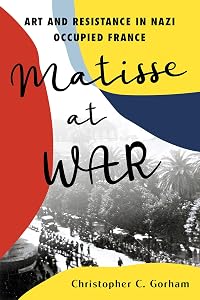
Matisse at War: Art and Resistance in Nazi Occupied France
by Christopher C. Gorham
On This Page
Description
"[This book] explores the transformative impact of World War II on Henri Matisse, one of the most revolutionary artists of the 20th century, and ... the passionate roles of his family in the French resistance"--Flap page 1 of dust jacket.Tags
Recommendations
































Member Reviews
They took decades to decipher, but with the passage of time came clarity: Matisse’s wartime canvasses were a mobilization of the intellect, a silent howl for a Europe passing through a terrible portal into a new, modern, world. from Matisse at War by Christopher C. Gorham.
This book about Matisse began interesting and ended thrilling, edge of your seat, reading.
The aging artist and his family all played a role in the resistance against fascism.
His son in New York City, running an art gallery, worked to get artists out of Europe, while his other son in France was in hiding,part of the Resistance. In Paris, his daughter and estranged wife were both arrested for their activities, the daughter tortured by the Nazis. And Henri, living in show more Nice and suffering from debilitating ill health and pain, created paper cut art with veiled political commentary.
The Matisse family had already survived the horrors of WWI when his mother was arrested and his brother was sent to a German labor camp. His work Bathers “could only have been painted in 1916,” art historian Catherine Bock wrote.
Matisse’s dependence on his muse/model/and employee Lydia incenced his wife, who left him in 1939. The role had once been his wife’s but she had fallen into depression. After their separation, Amelie rallied.
Matisse and Lydia lived in Nice; the Southern coast of France was teaming with refugees from Nazi controlled Europe. Matisse struggled with ill health, undergoing an operation. He never recovered his full health, spending much time in bed.
When the Nazis took over over Nice, violence and arrests and torture became the norm. It is horrifying to read the atrocities committed.
While his family was active in the resistance, Matisse was limited by his ill health. His art became his political voice. He would not leave France, even when officials harassed him and threatened to arrest the Russian born Lydia. But he later said that he had a barn used to harbor refugees.
The very act of painting–whether a vase of flowers or Guernica–“upheld the values of humanism.” from Matisse at War by Christopher C. Gorham
The book shows how Matisse’s art evolved, culminating in the paper cutouts he called “the simplest and most direct way to express myself.”
Thanks to the publisher for a free book through NetGalley show less
This book about Matisse began interesting and ended thrilling, edge of your seat, reading.
The aging artist and his family all played a role in the resistance against fascism.
His son in New York City, running an art gallery, worked to get artists out of Europe, while his other son in France was in hiding,part of the Resistance. In Paris, his daughter and estranged wife were both arrested for their activities, the daughter tortured by the Nazis. And Henri, living in show more Nice and suffering from debilitating ill health and pain, created paper cut art with veiled political commentary.
The Matisse family had already survived the horrors of WWI when his mother was arrested and his brother was sent to a German labor camp. His work Bathers “could only have been painted in 1916,” art historian Catherine Bock wrote.
Matisse’s dependence on his muse/model/and employee Lydia incenced his wife, who left him in 1939. The role had once been his wife’s but she had fallen into depression. After their separation, Amelie rallied.
Matisse and Lydia lived in Nice; the Southern coast of France was teaming with refugees from Nazi controlled Europe. Matisse struggled with ill health, undergoing an operation. He never recovered his full health, spending much time in bed.
When the Nazis took over over Nice, violence and arrests and torture became the norm. It is horrifying to read the atrocities committed.
While his family was active in the resistance, Matisse was limited by his ill health. His art became his political voice. He would not leave France, even when officials harassed him and threatened to arrest the Russian born Lydia. But he later said that he had a barn used to harbor refugees.
The very act of painting–whether a vase of flowers or Guernica–“upheld the values of humanism.” from Matisse at War by Christopher C. Gorham
The book shows how Matisse’s art evolved, culminating in the paper cutouts he called “the simplest and most direct way to express myself.”
Thanks to the publisher for a free book through NetGalley show less
Ratings
Members
- Recently Added By
Lists

Check Library
176 works; 1 member
Author Information
2 Works 200 Members
Common Knowledge
- Original publication date
- 2025-09-30
- People/Characters
- Henri Matisse
Classifications
Statistics
- Members
- 34
- Popularity
- 835,038
- Reviews
- 1
- Rating
- (3.88)
- Languages
- English
- Media
- Paper, Audiobook, Ebook
- ISBNs
- 3
- ASINs
- 3