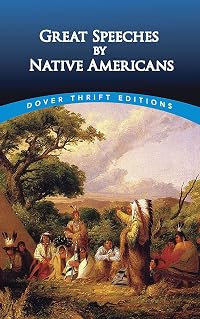
Great Speeches by Native Americans
by Bob Blaisdell (Editor)
On This Page
Description
Remarkable for their eloquence, depth of feeling, and oratorical mastery, these 82 compelling speeches encompass five centuries of Indian encounters with nonindigenous people. Beginning with a 1540 refusal by a Timucua chief to parley with Hernando de Soto ("With such a people I want no peace"), the collection extends to the 20th-century address of activist Russell Means to the United Nations affiliates and members of the Human Rights Commission ("We are people who love in the belly of the show more monster").Other memorable orations include Powhatan's "Why should you destroy us, who have provided you with food?" (1609); Red Jacket's "We like our religion, and do not want another" (1811); Osceola's "I love my home, and will not go from it" (1834); Red Cloud's "The Great Spirit made us both" (1870); Chief Joseph's "I will fight no more forever" (1877); Sitting Bull's "The life my people want is a life of freedom" (1882); and many more. Other notable speakers represented here include Tecumseh, Seattle, Geronimo, and Crazy Horse, as well as many lesser-known leaders.
Graced by forceful metaphors and vivid imagery expressing emotions that range from the utmost indignation to the deepest sorrow, these addresses are deeply moving documents that offer a window into the hearts and minds of Native Americans as they struggled against the overwhelming tide of European and American encroachment. This inexpensive edition, with informative notes about each speech and orator, will prove indispensable to anyone interested in Native American history and culture.
. show less
Tags
Recommendations

























Member Reviews
Anyone who thinks they know American history needs to read this book. Those who don't understand why the white men are hated also need to read it. In a nutshell, it's a testimonial of exploitation, lies, and aggression, which has been the norm on the part of supposed "civilized" nations for millennia. Seeing indigenous people as inferior, savages, and uncivilized based on their lifestyle and thus treating them no better than animals has a sordid and long history.
This book chronicles the treatment of the Indigenous Americans from the first contact by the Pilgrims in the 1600s through the 20th century. The lies and aggression are nothing short of shameful and an embarrassment to any honest person. Those of us who grew up playing "cowboys show more and Indians" and watching similar TV shows were not seeing things as they really are.
In most cases, the Indigenous Americans only wanted peace. Some had the foresight to see the problems that were coming. They saw the land as sacred, given to them by The Great Spirit, and they treated Mother Earth with respect and gratitude. They may not have had the white man's technology, but their societal norms were often far more advanced than "civilized" nations. The wholesale slaughter and exploitation of these people in the name of Christianity is a national disgrace.
Besides the actual slaughters, their children were often taken away, essentially kidnapped, and sent to boarding schools where their native culture was derided while they were indoctrinated with supposedly white civilization's values. Their women were often sterilized without their knowledge. There is no doubt the intent was genocide.
If you think things have changed today, think again. Power and control by those with selfish and evil intent still prevails. Corporate power subdues the rights of individuals. Nothing has changed.
I cried more reading this book than any novel. It's a very sad commentary on the foundation of the United States. These Native Americans were highly intelligent, moral individuals. In the vast majority of cases, they were only aggressive when they'd had enough of being lied to and could see the intent was their annihilation.
Read it. More people need their eyes opened to the truth that is our history and how it relates to what's going on today. show less
This book chronicles the treatment of the Indigenous Americans from the first contact by the Pilgrims in the 1600s through the 20th century. The lies and aggression are nothing short of shameful and an embarrassment to any honest person. Those of us who grew up playing "cowboys show more and Indians" and watching similar TV shows were not seeing things as they really are.
In most cases, the Indigenous Americans only wanted peace. Some had the foresight to see the problems that were coming. They saw the land as sacred, given to them by The Great Spirit, and they treated Mother Earth with respect and gratitude. They may not have had the white man's technology, but their societal norms were often far more advanced than "civilized" nations. The wholesale slaughter and exploitation of these people in the name of Christianity is a national disgrace.
Besides the actual slaughters, their children were often taken away, essentially kidnapped, and sent to boarding schools where their native culture was derided while they were indoctrinated with supposedly white civilization's values. Their women were often sterilized without their knowledge. There is no doubt the intent was genocide.
If you think things have changed today, think again. Power and control by those with selfish and evil intent still prevails. Corporate power subdues the rights of individuals. Nothing has changed.
I cried more reading this book than any novel. It's a very sad commentary on the foundation of the United States. These Native Americans were highly intelligent, moral individuals. In the vast majority of cases, they were only aggressive when they'd had enough of being lied to and could see the intent was their annihilation.
Read it. More people need their eyes opened to the truth that is our history and how it relates to what's going on today. show less
The Native Americans had a great tradition of oratory, regardless of the individual tribe, and a sample selection spanning four hundred years of interaction with white settlers and colonialists is presented here. Notable Native Americans such as Sagoyewatha, Chief Joseph, Sitting Bull, and Tecumseh are among the voices that speak of four hundred years of aggression, broken promises, and continual encroachment by the overwhelming tide of European and American influence. Twentieth century selections by Russell Means and Oren Lyons demonstrate that the same problems that generations of Native Americans faced are still present in the modern age.
These speeches are rich in vivid imagery and a wide range of emotions from indignation and sorrow show more to anger and calls restraint. These speeches make for sobering reading - the oppression and repression of the Native Americans is one of history's greatest errors and the full details from the Native American side comes out when reading. This offers a different view of European colonisation of North America and thus is a cause for reflection.
The selection of speeches covers a wide range of Native American tribes and times, but further biographical and historical details of the speaker, the location and timing of the speech etc. would have been useful. show less
These speeches are rich in vivid imagery and a wide range of emotions from indignation and sorrow show more to anger and calls restraint. These speeches make for sobering reading - the oppression and repression of the Native Americans is one of history's greatest errors and the full details from the Native American side comes out when reading. This offers a different view of European colonisation of North America and thus is a cause for reflection.
The selection of speeches covers a wide range of Native American tribes and times, but further biographical and historical details of the speaker, the location and timing of the speech etc. would have been useful. show less
Ratings
Members
- Recently Added By
Author Information

All Editions
Some Editions
Awards and Honors
Notable Lists
Series
Belongs to Publisher Series
Common Knowledge
- Canonical title
- Great Speeches by Native Americans
- Original publication date
- 2000
Classifications
Statistics
- Members
- 458
- Popularity
- 66,797
- Reviews
- 3
- Rating
- (4.14)
- Languages
- English
- Media
- Paper, Ebook
- ISBNs
- 2
- UPCs
- 1
- ASINs
- 2