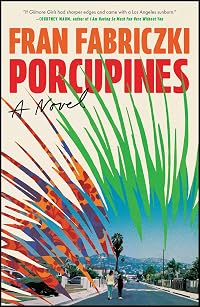
Porcupines
by Fran Fabriczki
On This Page
Tags
Recommendations







































Member Reviews
I have definite reservations about “Porcupines.” The pacing is slow, the humor muted, and I found its protagonist (Sonia) to be uninviting. It’s less a novel of engagement than of observation, less about connection than about the difficulty of achieving it.
Rather than driving forward on an engaging plot, Fabriczki seems to build a kind of emotional anthropology. Viewed this way, one can be more generous. Its slowness can be viewed as a reflection of Sonia’s own dislocation: immigration, generational tension, and identity aren’t experienced as neat arcs but as long stretches of uncertainty punctuated by small, often ambiguous encounters. It may seem to cohere more if one approaches it as a study of friction—between cultures, show more and between mothers and daughters.
Sonia may not have been drawn to be likable so much as legible. She is a woman shaped by competing expectations, whose feminist instincts don’t always translate cleanly across family or cultural lines. Her struggles with her daughter, mother, and sister aren’t framed as problems to be solved but as tensions she must endure. This has an unsatisfying feel, but it also resists the kind of tidy resolutions the novel seems to want to avoid.
For me, the novel didn’t land as “funny.” Its humor rarely announces itself. Outside of Mila—who provides the most immediate charm—the comedy tends to be dry, situational, even slightly uncomfortable. It lives in miscommunication, in social awkwardness, in the small absurdities of trying to belong.
This quietly heavy book can best be viewed as a kind of cultural anthropology. If you meet it on those terms, its restraint and dry humor can feel more purposeful than accidental. show less
Rather than driving forward on an engaging plot, Fabriczki seems to build a kind of emotional anthropology. Viewed this way, one can be more generous. Its slowness can be viewed as a reflection of Sonia’s own dislocation: immigration, generational tension, and identity aren’t experienced as neat arcs but as long stretches of uncertainty punctuated by small, often ambiguous encounters. It may seem to cohere more if one approaches it as a study of friction—between cultures, show more and between mothers and daughters.
Sonia may not have been drawn to be likable so much as legible. She is a woman shaped by competing expectations, whose feminist instincts don’t always translate cleanly across family or cultural lines. Her struggles with her daughter, mother, and sister aren’t framed as problems to be solved but as tensions she must endure. This has an unsatisfying feel, but it also resists the kind of tidy resolutions the novel seems to want to avoid.
For me, the novel didn’t land as “funny.” Its humor rarely announces itself. Outside of Mila—who provides the most immediate charm—the comedy tends to be dry, situational, even slightly uncomfortable. It lives in miscommunication, in social awkwardness, in the small absurdities of trying to belong.
This quietly heavy book can best be viewed as a kind of cultural anthropology. If you meet it on those terms, its restraint and dry humor can feel more purposeful than accidental. show less
A fresh and witty debut about a young immigrant mother and her increasingly inquisitive daughter, who wakes up one day and decides to find out who her father is.
Ratings
Members
- Recently Added By
Author Information
1 Work 59 Members
Common Knowledge
- Canonical title
- Porcupines
Statistics
- Members
- 59
- Popularity
- 520,909
- Reviews
- 2
- Rating
- (3.75)
- Languages
- English
- Media
- Paper, Ebook
- ISBNs
- 1
- ASINs
- 1