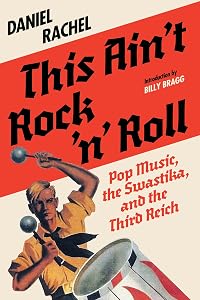
This Ain't Rock 'n' Roll: Pop Music, the Swastika, and the Third Reich
by Daniel Rachel
On This Page
Description
A meticulously researched and sensitively told history examining pop music's enduring and problematic fascination with the swastika--and Nazism itselfRecommendations
Member Recommendations

Member Reviews
This Ain't Rock 'n' Roll by Daniel Rachel is, like most of his books, hits on many cylinders but seriously misfires on others. But, also like the others, an uneven ride worth taking.
The strength of this book lies in the roundup of the many examples of rock/pop stars appropriating Nazi symbols and even sometimes rhetoric for both their public persona and their private enjoyment. Many of the instances here will be familiar to music history fans and scholars, but to have them collected in one volume highlights the range of use and abuse. From some that were mostly for shock purposes to some far more difficult to view that way and some that leave almost no doubt that they believed and approved.
I think that each case has to be understood show more separately. Not in a vacuum, certainly context has to be considered, but it is a mistake to simply lump these people into one or two cookie-cutter categories. And that is where Rachel, as usual, goes astray. Intellectual analyses and deep understanding is not his strength. It simply isn't why you pick up one of his books. But he makes broad, demonstrably false statements that generalize far more than he would get away with in a scholarly study. Even though I tend to agree with much of what he both implies and says, I at least understand that I don't "know" these things. He, however, seems to be able to read everyone's minds, even those who are dead, and tell us the truth.
Definitely worth reading and facing the possibility that some of your favorite musicians may not be all that you thought they were. Whether you chalk some of it up to misguided attempts to shock and be different or to blatant disregard for what the hate-inspired symbolism of the Third Reich still means to many people, knowing what these stars have done has to color your perception of them. Hiding from it is certainly a possibility but I think we are better off knowing what they did and coming to terms with it. Might you no longer love an artist you adored? Yes. But you will also learn where you might draw your own line and what kind of person you are. It isn't a positive statement about someone if they support genocide, whether it was almost a century ago or taking place right now. If you can't be consistent, then it isn't genocide you oppose, it is simply which group that suffers that matters to you.
Reviewed from a copy made available by the publisher via NetGalley. show less
The strength of this book lies in the roundup of the many examples of rock/pop stars appropriating Nazi symbols and even sometimes rhetoric for both their public persona and their private enjoyment. Many of the instances here will be familiar to music history fans and scholars, but to have them collected in one volume highlights the range of use and abuse. From some that were mostly for shock purposes to some far more difficult to view that way and some that leave almost no doubt that they believed and approved.
I think that each case has to be understood show more separately. Not in a vacuum, certainly context has to be considered, but it is a mistake to simply lump these people into one or two cookie-cutter categories. And that is where Rachel, as usual, goes astray. Intellectual analyses and deep understanding is not his strength. It simply isn't why you pick up one of his books. But he makes broad, demonstrably false statements that generalize far more than he would get away with in a scholarly study. Even though I tend to agree with much of what he both implies and says, I at least understand that I don't "know" these things. He, however, seems to be able to read everyone's minds, even those who are dead, and tell us the truth.
Definitely worth reading and facing the possibility that some of your favorite musicians may not be all that you thought they were. Whether you chalk some of it up to misguided attempts to shock and be different or to blatant disregard for what the hate-inspired symbolism of the Third Reich still means to many people, knowing what these stars have done has to color your perception of them. Hiding from it is certainly a possibility but I think we are better off knowing what they did and coming to terms with it. Might you no longer love an artist you adored? Yes. But you will also learn where you might draw your own line and what kind of person you are. It isn't a positive statement about someone if they support genocide, whether it was almost a century ago or taking place right now. If you can't be consistent, then it isn't genocide you oppose, it is simply which group that suffers that matters to you.
Reviewed from a copy made available by the publisher via NetGalley. show less
This Ain’t Rock n Roll details the many rock stars who have dabbled with Nazi imagery or praised Hitler and the Third Reich. Unfolding largely chronologically, we meet a depressing list of figures from Keith Richards in SS uniform and a swastika-wearing, racism-spouting Siouxsie Sioux, through to Kanye West declaring himself a Nazi. Unfortunately, though Rachel tries to give a sense of a developing narrative, it becomes repetitive: a rock star spouts pro-Nazi garbage, they (mostly) refuse to apologise or say they sought to shock, and Rachel reminds us how unacceptable that is.
In some cases, such as an artist praising Hitler as ‘the first rock star’, it’s easy to agree - such statements should have been scrutinised and criticised show more at the time. In other cases though, Rachel seems to argue that referencing the Nazis is artistically invalid unless the audience understands the context is criticism and not celebration. Yet later he praises the “righteous” Holocaust songs of the Manic Street Preachers. How does he know their listeners understood the context? Other arguments are weaker still: the BBC renaming Massive Attack as “Massive” on-air during the Gulf War is used to claim they should have similarly censored the name Joy Division, even though the situations are vastly different. At points, Rachel widens his lens to Nazi-fetishising cinema or books, demonstrating this is more than just a music problem. Rachel could have mitigated his weak analytical skills by interviewing qualified experts, but he never talks to a historian, sociologist, semiotician or any other useful expert. show less
In some cases, such as an artist praising Hitler as ‘the first rock star’, it’s easy to agree - such statements should have been scrutinised and criticised show more at the time. In other cases though, Rachel seems to argue that referencing the Nazis is artistically invalid unless the audience understands the context is criticism and not celebration. Yet later he praises the “righteous” Holocaust songs of the Manic Street Preachers. How does he know their listeners understood the context? Other arguments are weaker still: the BBC renaming Massive Attack as “Massive” on-air during the Gulf War is used to claim they should have similarly censored the name Joy Division, even though the situations are vastly different. At points, Rachel widens his lens to Nazi-fetishising cinema or books, demonstrating this is more than just a music problem. Rachel could have mitigated his weak analytical skills by interviewing qualified experts, but he never talks to a historian, sociologist, semiotician or any other useful expert. show less
Members
- Recently Added By
Author Information
8 Works 213 Members
Daniel Rachel is a writer and a musician. He wrote his first song when he was sixteen and was the lead singer of Rachels Basement. A specialist in Forum Theatre direction, he lives in North London with his partner and three children. The Art of Noise is his first book.
Awards and Honors
Awards
Common Knowledge
- People/Characters
- John Lennon; The Beatles; The Animals; John's Children; The Rolling Stones; Keith Moon (show all 75); Vivian Stanshall; Led Zeppelin; Iggy and the Stooges; Blue Öyster Cult; Sweet; Serge Gainsbourg; Roxy Music; Kiss; Motörhead; Alex Harvey; David Bowie; Queen; Eric Clapton; Malcolm McLaren; Sex Pistols; Siouxsie Sioux; Siouxsie and the Banshees; London SS; The Clash; New York Dolls; Ramones; Electric Eels; Dead Boys; The Residents; The Damned; Madonna; Lady Gaga; Adam and the Ants; Blondie; Sham 69; Joy Division; New Order; A Certain Ratio; Throbbing Gristle; Human League; Lou Reed; Spandau Ballet; Spear of Destiny; The Skids; The Birthday Party; The Exploited; The Fall; Woody Guthrie; Rush; Leonard Cohen; Paul Weller; Dead Kennedys; Manic Street Preachers; Janis Ian; Indigo Girls; Skunk Anansie; Kula Shaker; U2; Michael Jackson; Primal Scream; Interpol; Bryan Ferry; Slayer; Marilyn Manson; Ozzy Osbourne; Nicki Minaj; Jethro Tull; The Libertines; Nico; Pink Floyd; Ice Cube; Kanye West; Trupa Trupa; Fat White Family
- Epigraph
- For who would bear the whips and scorns of time,Th'oppressor's wrong, the proud man's contumely,The pangs of dispriz'd love, the law's delay,The insolence of office, and the spurnsThat patient merit of th'... (show all)unworthy takes,When he himself might his quietus make
William ShakespeareHamlet, Act 3, Scene 1
Nothing is more terrible than ignorance in action.
Goethe #231
Maxims and Reflections, translated by T. Bailey Saunders
A Holocaust survivor dies of old age, goes to heaven and tells God a Holocaust joke. God says, 'That's not funny,' and the survivor says, 'I guess you had to be there.'
Ricky Gervais to Jerry Seinfeld
Comedians in Cars Getting Coffee, Season 11, Episode 4
This ain't rock'n'roll; this is genocide.
David Bowie
'Diamond Dogs' - Dedication
- For Judith R. Rachel, who died sometime during my own rock'n'roll adventure. 'Look, Mum, I write books now with an introduction by someone you once feared would brainwash me!'
- Original language
- English
Classifications
- Genres
- Music, Nonfiction, History
- DDC/MDS
- 781.6409 — Arts & recreation Music General principles and musical forms Traditions of music Western popular music {equally instrumental and vocal} Biography And History
- LCC
- ML193 .R33 — Music Literature on music Literature on music History and criticism By period
- BISAC
Statistics
- Members
- 17
- Popularity
- 1,452,922
- Reviews
- 2
- Rating
- (3.00)
- Languages
- English
- Media
- Paper
- ISBNs
- 4