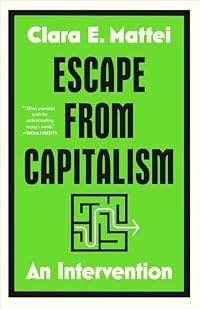
Escape from Capitalism: An Intervention
by Clara E. Mattei
On This Page
Tags
Recommendations

































Member Reviews
We don’t have a handle on capitalism. By and large, we can’t even imagine a system not based on capitalism. In Escape from Capitalism, Carla Mattei explodes the myths we hold as basic truths. She does not promulgate leftist views or rightwing views. She is all about demystifying the assumptions of capitalism we all live by. It can be quite shocking.
The current malaise in capitalism is largely a function of workers losing their position in economic theory, she says. This is the book’s first Big Idea. Workers are no longer the means of production, as Marx described it. Capital has taken over that function too, automating, roboting and AIing its way to making workers totally superfluous. With no standing in the old balancing act show more between capital and labor, workers will have to accept crummier jobs, at lower pay, under worsening conditions. Capital will rule, unchallenged and unchallengeable. Billionaires will be the ones to decide the fate of all workers. And clearly, only solutions that make them even bigger piles of capital will be considered.
The second Big Idea concerns inflation. Mattei traces inflation back to Mussolini and fascism. The mess Mussolini inherited after WWI had to be straightened out, so he cut down the unions, ended government programs, raised interest rates, raised taxes, and thereby attracted investment. As long as he could rule with an iron fist, Italy could rank as a player. It didn’t matter that Mussolini had destroyed the nascent middle class, increased unemployment and poverty dramatically, or made the country dependent on foreign capital injections. This became (and remains) the ideal model globally.
From the top of the pyramid, Mussolini was praised all over the western world for this. From JP Morgan to the Bank of England, he was seen as understanding capitalism like their own governments would not or could not. Pure economists of the day went crazy, making all kinds of idiotic claims. Mattei cites a few, such as claiming “a person’s class was a result of individual choices […] This is the fairy tale of meritocracy,” she says. Yet that has been drummed into everyone so hard they still believe it, despite all the evidence to the contrary. Or there would not be a 1-99 split.
Mussolini implemented austerity, the third Big Idea. The result is that ever since, third party programs (IMF, World Bank, Trump) insist first and foremost on austerity. All government support needs to be reduced or eliminated. Wages must fall, benefits must disappear, hours worked must increase for less pay, retirement put off, and so on. And every time, from Argentina to Egypt, Greece to Indonesia, it is misery for the population, while the 1% continues to rake in trillions from ownership.
Basically, workers are there to be exploited. If their pay is low and productivity is high, capital accumulates. If they strike for higher wages, capital doesn’t accumulate as fast. Instead, prices rise to make up the difference in profits. This inflation causes a slowing of the economy, leading to layoffs and less spending. It often ends in a recession or a depression, and the cycle begins again. But it never consummates in a healthy, wealthy nation where workers are satisfied with their lot. Only the capitalists increase their wealth throughout the cycle.
The fourth Big Idea is the invention of unemployment. Capitalism invented unemployment, Mattei says. Without a reserve of the unemployed, there could be no capitalism. The unemployment reserve is the threat that anyone can be fired, because there are lots of unemployed people waiting for positions to open up.
If unemployment declines, the power of capital over labor declines too, so capital has to find a way to increase unemployment. This can be through increased taxes on the 99%, cutting back government programs like the safety net, and making unions and collective bargaining illegal. More recently a new tool, automation, has proven to be very effective. The subsequent rise in unemployment is a breath of fresh air to capital. God bless the algorithm.
As proof, Mattei talks about the European colonization of Africa in the 1800s. This Big Idea is a demonstration of all the others in the book. At first, the Europeans could not convince Africans to work in their new mines. Africans at the time had subsistence covered. Everyone contributed work, and everyone could receive what they needed. Fishermen provided fish, hunters provided meat and leather, women provided clothing and meals, and children tended animals. The Europeans had to take that away from them in order to create unemployment, the need for money/wages, and subservience to capital.
To that end they made laws against manufacturing in the colonies (including the American colonies), forcing imports from the motherland on the locals. They taxed and prevented exports, regulated industries so that ordinary people could not produce what they needed, and so on until Africa fell into a pit it still cannot climb out of. But all the while, capital made more and more money on Africa, draining it of wealth continuously while the general population starved on insufficient wages. It remains plain for all to see today. This is the foundation of capitalism.
Mattei says “Far from accepting that African countries are poor because they have not yet implemented enough market reforms, we can see that it is the opening to global capitalism that reinforces their subordination […] Simply, there would be no wealth in the US and Europe without the construction of poverty in the rest of the world.”
We see the same process inside the USA today, as Walmart, the largest employer, not only pays poorly, it refuses to allow workers to be more than part time so it does not have to offer them benefits. This means Walmart employees make next to nothing annually, and they form the second largest block of people on SNAP food benefits and the ACA/Obamacare substitute for company health insurance. (Amazon has beaten them out by 100 employees in the latest report.)Walmart has fobbed off any responsibility for its employees to the federal government/taxpayers, and keeps outrageous profits from the savings.
But that’s not even the most extreme example. Meta/Facebook reports that it made a profit of $841,000 per employee at the company. As long as firms are allowed to keep that much profit per employee, there is no chance of reducing the gaping pit separating capital from labor.
For the so-called free marketers of the Chicago school, the solution is always more and freer markets. That is what will level the playing field. But this has always been pure fantasy, proven wrong over 300 years of capitalism. (The same goes for trickle down effects and numerous other myths taken as gospel.)
Inflation will result from too much employment. Employment must be kept low to keep labor subservient. “The problem of inflation cannot be solved with more free market competition,” Mattei says in her lovely straightforward way. “Markets only enable the accumulation of ever more capital.”
It seems to Mattei that what is happening here is simply the inability to imagine any other system. Capitalism is real, natural, fundamental, and so on. It’s the same argument used during centuries of the feudal system. It was the only stable, possible economic system and no one could imagine the world working any other way.
The extent to which this is true can be seen in the Federal Reserve System and other central banks around the world. The Fed is an agency of capitalism, not government. Bankers have created the solid and unassailable “knowledge” that nothing is more important than managing the currency/interest rate to keep inflation and unemployment under control. The Fed’s mandate is to rein in any movement outside narrow bands. It can lower or raise interest rates to get them back in their desired ranges. This has the effect of wreaking havoc with the finances and job security of the 99%, but clearly that is of no importance. Capitalism itself is always at risk, they think, if these two factors are not micromanaged.
In Mattei’s always simple and direct terms: “For there to be monetary stability, there must be a significant number of people without jobs.” Full employment actually means instability under capitalism. That is the basis of financial governance all over the world today. So regardless of who leads the country, the Fed will continue to manage interest rates on behalf of capital, and not labor, as a totally independent agency.
The final Big Idea is democracy: “It is a stark truth: capitalism and democracy are fundamentally incompatible.” Capital runs amok implementing laws, obtaining subsidies, grants and exclusive rights, while workers see tax increases and fewer options to survive. “For our system to function optimally, citizens must be excluded from decisions regarding society’s production and distribution of resources. It is thus profoundly antidemocratic.” That is why elected representatives don’t want to hear from voters after election day and will vote and act despite their wishes.
The book ends with examples of major foreign firms breaking away from the capitalist straitjacket, and doing really well for their employees, often owners, as well as for their countries. It is definitely possible to have a successful economy that is not shackled by capitalism, and the sooner we break free of it, the better off the vast majority of us will be.
I so enjoyed reading Escape From Capitalism, that I was saddened that it ended so quickly. I would have loved another hundred pages of it, but Mattei’s goal was to plant these Big Ideas, and having done so eloquently, she simply signed off. A terrifically important book putting the real way the economy works into clear-eyed perspective.
David Wineberg show less
The current malaise in capitalism is largely a function of workers losing their position in economic theory, she says. This is the book’s first Big Idea. Workers are no longer the means of production, as Marx described it. Capital has taken over that function too, automating, roboting and AIing its way to making workers totally superfluous. With no standing in the old balancing act show more between capital and labor, workers will have to accept crummier jobs, at lower pay, under worsening conditions. Capital will rule, unchallenged and unchallengeable. Billionaires will be the ones to decide the fate of all workers. And clearly, only solutions that make them even bigger piles of capital will be considered.
The second Big Idea concerns inflation. Mattei traces inflation back to Mussolini and fascism. The mess Mussolini inherited after WWI had to be straightened out, so he cut down the unions, ended government programs, raised interest rates, raised taxes, and thereby attracted investment. As long as he could rule with an iron fist, Italy could rank as a player. It didn’t matter that Mussolini had destroyed the nascent middle class, increased unemployment and poverty dramatically, or made the country dependent on foreign capital injections. This became (and remains) the ideal model globally.
From the top of the pyramid, Mussolini was praised all over the western world for this. From JP Morgan to the Bank of England, he was seen as understanding capitalism like their own governments would not or could not. Pure economists of the day went crazy, making all kinds of idiotic claims. Mattei cites a few, such as claiming “a person’s class was a result of individual choices […] This is the fairy tale of meritocracy,” she says. Yet that has been drummed into everyone so hard they still believe it, despite all the evidence to the contrary. Or there would not be a 1-99 split.
Mussolini implemented austerity, the third Big Idea. The result is that ever since, third party programs (IMF, World Bank, Trump) insist first and foremost on austerity. All government support needs to be reduced or eliminated. Wages must fall, benefits must disappear, hours worked must increase for less pay, retirement put off, and so on. And every time, from Argentina to Egypt, Greece to Indonesia, it is misery for the population, while the 1% continues to rake in trillions from ownership.
Basically, workers are there to be exploited. If their pay is low and productivity is high, capital accumulates. If they strike for higher wages, capital doesn’t accumulate as fast. Instead, prices rise to make up the difference in profits. This inflation causes a slowing of the economy, leading to layoffs and less spending. It often ends in a recession or a depression, and the cycle begins again. But it never consummates in a healthy, wealthy nation where workers are satisfied with their lot. Only the capitalists increase their wealth throughout the cycle.
The fourth Big Idea is the invention of unemployment. Capitalism invented unemployment, Mattei says. Without a reserve of the unemployed, there could be no capitalism. The unemployment reserve is the threat that anyone can be fired, because there are lots of unemployed people waiting for positions to open up.
If unemployment declines, the power of capital over labor declines too, so capital has to find a way to increase unemployment. This can be through increased taxes on the 99%, cutting back government programs like the safety net, and making unions and collective bargaining illegal. More recently a new tool, automation, has proven to be very effective. The subsequent rise in unemployment is a breath of fresh air to capital. God bless the algorithm.
As proof, Mattei talks about the European colonization of Africa in the 1800s. This Big Idea is a demonstration of all the others in the book. At first, the Europeans could not convince Africans to work in their new mines. Africans at the time had subsistence covered. Everyone contributed work, and everyone could receive what they needed. Fishermen provided fish, hunters provided meat and leather, women provided clothing and meals, and children tended animals. The Europeans had to take that away from them in order to create unemployment, the need for money/wages, and subservience to capital.
To that end they made laws against manufacturing in the colonies (including the American colonies), forcing imports from the motherland on the locals. They taxed and prevented exports, regulated industries so that ordinary people could not produce what they needed, and so on until Africa fell into a pit it still cannot climb out of. But all the while, capital made more and more money on Africa, draining it of wealth continuously while the general population starved on insufficient wages. It remains plain for all to see today. This is the foundation of capitalism.
Mattei says “Far from accepting that African countries are poor because they have not yet implemented enough market reforms, we can see that it is the opening to global capitalism that reinforces their subordination […] Simply, there would be no wealth in the US and Europe without the construction of poverty in the rest of the world.”
We see the same process inside the USA today, as Walmart, the largest employer, not only pays poorly, it refuses to allow workers to be more than part time so it does not have to offer them benefits. This means Walmart employees make next to nothing annually, and they form the second largest block of people on SNAP food benefits and the ACA/Obamacare substitute for company health insurance. (Amazon has beaten them out by 100 employees in the latest report.)Walmart has fobbed off any responsibility for its employees to the federal government/taxpayers, and keeps outrageous profits from the savings.
But that’s not even the most extreme example. Meta/Facebook reports that it made a profit of $841,000 per employee at the company. As long as firms are allowed to keep that much profit per employee, there is no chance of reducing the gaping pit separating capital from labor.
For the so-called free marketers of the Chicago school, the solution is always more and freer markets. That is what will level the playing field. But this has always been pure fantasy, proven wrong over 300 years of capitalism. (The same goes for trickle down effects and numerous other myths taken as gospel.)
Inflation will result from too much employment. Employment must be kept low to keep labor subservient. “The problem of inflation cannot be solved with more free market competition,” Mattei says in her lovely straightforward way. “Markets only enable the accumulation of ever more capital.”
It seems to Mattei that what is happening here is simply the inability to imagine any other system. Capitalism is real, natural, fundamental, and so on. It’s the same argument used during centuries of the feudal system. It was the only stable, possible economic system and no one could imagine the world working any other way.
The extent to which this is true can be seen in the Federal Reserve System and other central banks around the world. The Fed is an agency of capitalism, not government. Bankers have created the solid and unassailable “knowledge” that nothing is more important than managing the currency/interest rate to keep inflation and unemployment under control. The Fed’s mandate is to rein in any movement outside narrow bands. It can lower or raise interest rates to get them back in their desired ranges. This has the effect of wreaking havoc with the finances and job security of the 99%, but clearly that is of no importance. Capitalism itself is always at risk, they think, if these two factors are not micromanaged.
In Mattei’s always simple and direct terms: “For there to be monetary stability, there must be a significant number of people without jobs.” Full employment actually means instability under capitalism. That is the basis of financial governance all over the world today. So regardless of who leads the country, the Fed will continue to manage interest rates on behalf of capital, and not labor, as a totally independent agency.
The final Big Idea is democracy: “It is a stark truth: capitalism and democracy are fundamentally incompatible.” Capital runs amok implementing laws, obtaining subsidies, grants and exclusive rights, while workers see tax increases and fewer options to survive. “For our system to function optimally, citizens must be excluded from decisions regarding society’s production and distribution of resources. It is thus profoundly antidemocratic.” That is why elected representatives don’t want to hear from voters after election day and will vote and act despite their wishes.
The book ends with examples of major foreign firms breaking away from the capitalist straitjacket, and doing really well for their employees, often owners, as well as for their countries. It is definitely possible to have a successful economy that is not shackled by capitalism, and the sooner we break free of it, the better off the vast majority of us will be.
I so enjoyed reading Escape From Capitalism, that I was saddened that it ended so quickly. I would have loved another hundred pages of it, but Mattei’s goal was to plant these Big Ideas, and having done so eloquently, she simply signed off. A terrifically important book putting the real way the economy works into clear-eyed perspective.
David Wineberg show less
Ratings
Members
- Recently Added By
Lists

2026
17 works; 1 member
Author Information

4 Works 184 Members
Classifications
Statistics
- Members
- 34
- Popularity
- 834,999
- Reviews
- 1
- Rating
- (5.00)
- Languages
- English
- Media
- Paper
- ISBNs
- 5