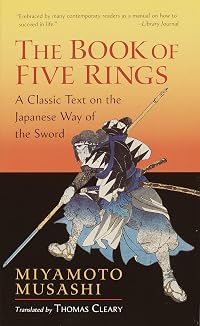
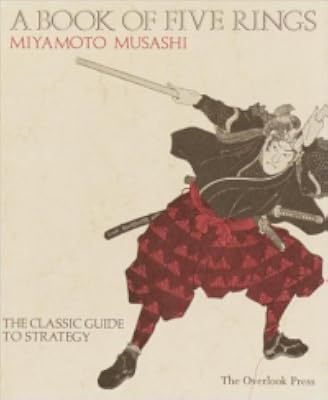
The Book of Five Rings
by Musashi Miyamoto
On This Page
Description
A classic work on martial arts, leadership, and conflict in a pocket-size format. Written around 1645, Miyamoto Musashi's Five Rings is a classic Japanese work. Musashi was a swordsman, philosopher, and strategist, and today his work remains influential not only in the realm of martial arts but in the business world as well. Musashi's no-nonsense approach to the martial arts and combat includes eliminating technical flourishes, understanding that technique should simply be understood as show more defeating your opponent, and appreciating that the same qualities apply in both small-scale and large-scale conflicts. Repeatedly, he stresses the importance of learning through practice, rather than mere theoretical learning. show lessTags
Recommendations





Member Reviews
A short, functional book, Miyamoto Musashi's The Book of Five Rings offers some rather basic philosophical tenets – know yourself, be calm, live in harmony with things, etc. – alongside extensive and specific instructions on various weapons and fighting stances and so on. The latter is, of course, less useful to a modern reader, and the former is elevated in many readers' eyes by its context. I believe ancient instruction manuals like this are elevated by some to the level of philosophy, when in truth they are nowhere near, simply because people like the aesthetic of learning from a samurai and following a 'warrior's path' or somesuch.
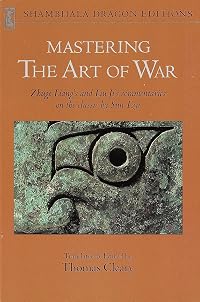
My Shambhala edition, translated by Thomas Cleary, also included a second short manual, The Book of show more Family Traditions on the Art of War by Yagyū Munenori, which is more of the same. It was a little bit more lively in its writing style, but in truth both books are a bit turgid. Ultimately, these books are shallow pools whereas real works of philosophy can be like great brawling oceans when you read them. The Book of Five Rings does have one profound line about expanding your knowledge beyond your own discipline, because "if you have wide knowledge of the ways, you encounter them in everything" (pg. 18). I only wish the books themselves had done more to show us. show less
My Shambhala edition, translated by Thomas Cleary, also included a second short manual, The Book of show more Family Traditions on the Art of War by Yagyū Munenori, which is more of the same. It was a little bit more lively in its writing style, but in truth both books are a bit turgid. Ultimately, these books are shallow pools whereas real works of philosophy can be like great brawling oceans when you read them. The Book of Five Rings does have one profound line about expanding your knowledge beyond your own discipline, because "if you have wide knowledge of the ways, you encounter them in everything" (pg. 18). I only wish the books themselves had done more to show us. show less
Another book that's sat on my Kindle for years unread. But having just finished David Kirks' books it really felt like the right time to read this.
It's hard to judge this book in any real contemporary terms because it simply has no place in the contemporary world. It's an anachronism from a time and place that is no more and will never be again.
It is aimed solely at the samurai warrior, but maybe there are those who are ultra competitive who do contact sports, and also military personnel, that could still gain a lot from reading it - which doesn't apply to me.
It is, however, an incredible view into the mind of one of the greatest strategists (swordsmen) from Japanese history, and it really gives you the genuine thoughts and attitude of show more a Samurai in regards to fighting and killing with swords. It's probably the most amoral thing i've ever read, and in that aspect alone it's quite wonderful because it is so genuine. show less
It's hard to judge this book in any real contemporary terms because it simply has no place in the contemporary world. It's an anachronism from a time and place that is no more and will never be again.
It is aimed solely at the samurai warrior, but maybe there are those who are ultra competitive who do contact sports, and also military personnel, that could still gain a lot from reading it - which doesn't apply to me.
It is, however, an incredible view into the mind of one of the greatest strategists (swordsmen) from Japanese history, and it really gives you the genuine thoughts and attitude of show more a Samurai in regards to fighting and killing with swords. It's probably the most amoral thing i've ever read, and in that aspect alone it's quite wonderful because it is so genuine. show less
More of a book on thinking than on specific strategies. It's a way to think on different situations with basic thought as a base that can lead to complex strategy. The theme of the book is to focus on ideas. The reasoning behind ideas leads to others ideas and so on. Turning thoughts inward is to understand how to use them in the outer world. Where you apply the principles of the book depend on you. The best applications come in combative situations. Dealing with give and take is where its best to use the principles of this book.
To fans of philosophy and strategy, this is one more of those great reads. Like Sun Tzu's Art of War, The Five Rings has estrategies very specific to its time. However, its time already involved guns amongst the Samurai, making it a pretty "modern" approach.
Besides the books teachings on martial arts, a lot of lessons are to be learned from it that can be applied to a normal person on it's path of life, like focus on especialty (can be university course or a carreer) and not letting it stop you from learning new skills and arts. It allows us to expand our consciensciousness, adaptability and sucess.
Of course its main theme is the use of the long sword and its mastery, but Musashi shows us many examples from other professions that use show more very similar mentalities and tactics to master, requiring dilligent reflection and, above all, practice, practice and more practice. It's a book that helps the person keep out from big distractions, keeping always on the Way without neglecting skills that might be useful later on. Some prefer thousands of big business gurus and coaching, but in the end, they're adapted ideas that come from books like this (or Art of War, Bible, Budhism...)and adapted to whatever behavioral product they're selling, the same way you can pick this book yourself and do the same being your own coach, with todays ethics. show less
Besides the books teachings on martial arts, a lot of lessons are to be learned from it that can be applied to a normal person on it's path of life, like focus on especialty (can be university course or a carreer) and not letting it stop you from learning new skills and arts. It allows us to expand our consciensciousness, adaptability and sucess.
Of course its main theme is the use of the long sword and its mastery, but Musashi shows us many examples from other professions that use show more very similar mentalities and tactics to master, requiring dilligent reflection and, above all, practice, practice and more practice. It's a book that helps the person keep out from big distractions, keeping always on the Way without neglecting skills that might be useful later on. Some prefer thousands of big business gurus and coaching, but in the end, they're adapted ideas that come from books like this (or Art of War, Bible, Budhism...)and adapted to whatever behavioral product they're selling, the same way you can pick this book yourself and do the same being your own coach, with todays ethics. show less
Thoroughly enjoyable historical texts that represent the Taoist perspectives of the samurai warriors of the 17th century.
This book written by a legendary tokugaiwa/samurai of 1600's , Miyamoto Musashi ; he wrote this a little before he died . In this book he talks bout the way of the samurai and the how to weild a sword and stuff;he would say like when you were challenge in a duel w/ swords , you would never stab , you always slash (i cant tell u why though) He also talks about certain components of the Art of Sword to certain elements such as basic qualities and facilities of this arm come with Earth.Water is positioning and works with strategies as sticking and following through. Fire is pretty much giving out extra energy ,just over powering your oppenent , giving hi no chance to think . Air isjust talkin about other schools and traditions ; to think show more inside an opponents ,and thinking of his next move. Those four elements earth ,water , fire , and air are the basic compenents and structure of his way of the samurai . I dont want to kill the ending , but the last ring is Emptiness and Ms.dickie said i cant tell u ppl the ending, so yea. show less
I shall certainly return to this often; there’s a lot to this slim volume.
Members
- Recently Added By
Lists

philosophy
28 works; 2 members

history
12 works; 1 member

current
52 works; 1 member

important
24 works; 1 member

Ryan Holiday's Books To Base Your Life On
97 works; 2 members
Author Information

46 Works 6,453 Members
Common Knowledge
- Canonical DDC/MDS
- 355.547
- Disambiguation notice
- The Shambala Classics (Thomas Cleary translation) of the Book of Five Rings includes a second work, Heiho Kadensho by Yagyu Munenori in addition to Mushashi's Go Rin No Sho.
Classifications
- Genres
- Philosophy, Nonfiction, Sports and Leisure, General Nonfiction, History
- DDC/MDS
- 355.547 — Society, government, & culture Public administration & military science The Military - Land, Air & Sea / Warfare Military training Military Training and Martial Arts
- LCC
- U101 .M5913 — Military Science Military science (General)
- BISAC
Statistics
- Members
- 1,386
- Popularity
- 17,112
- Reviews
- 15
- Rating
- (3.75)
- Languages
- English
- Media
- Paper, Ebook
- ISBNs
- 9
- ASINs
- 4