
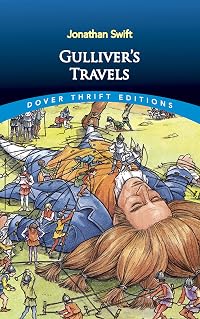
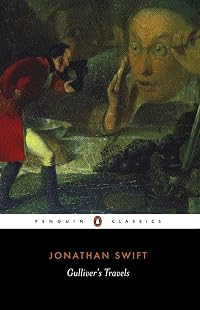
Gulliver's Travels [Dover Thrift Editions]
by Jonathan Swift
On This Page
Tags
Recommendations









Member Reviews
"Thus, gentle Reader, I have given thee a faithful History of my Travels for Sixteen Years, and above Seven Months; wherein I have not been so studious of Ornament as of Truth. I could perhaps like others have astonished thee with strange improbably Tales; but I rather chose to relate plain Matter of Fact in the simplest Manner and Style; because my principal Design was to inform, and not to amuse thee."
This book took me a long time to read. I couldn't figure out why it was taking me so long until I started quoting sections to my sister and my spouse and on my blog and realized just how much translation English from this era requires. So, I let myself off the hook a little bit and just tried to enjoy my leisurely reading pace. I'm glad show more to have read this book, but I'll also be glad to move onto to something written in more contemporary language.
I admit, I think a fair amount of this book was lost on me. Throughout it I was unsure about whether the opinions Gulliver expressed were meant to be his alone or if they reflected Swift's opinions as well. For example, there's the very funny section in which Gulliver goes off about lawyers and judges. I found it absolutely hilarious and read it aloud to my sister (the attorney) over the phone one night. In retrospect, it may have been a little rude to read it to her. As an attorney, she's well aware of the variety of lawyer jokes out there; it was probably unnecessary to bring to her attention eighteenth-century lawyer jokes.
In addition, since I'm not intimately acquainted with the history of England during this (or, really, any) period, I couldn't really tell when he was making fun of the culture or political structure of the time and when he was just telling the story. I mean, in the first section, he goes into great detail about where and how he excretes among the diminutive Lilliputians and how astonished they are at his prodigious passage of urine. Are these scatological asides meant to tell the reader about Gulliver's character (like when he notes that his personal habits of cleanliness have often come into question and he's interested in setting the record straight), or are these descriptions themselves part of the satire? Are they spoofs of travel writing of the time? Being unfamiliar with either the culture or the travel-writing genre of eighteenth-century England, I couldn't say. Same thing with the rather sexual nature of some of his experiences among the giants of Brobdingnag.
However, even amid my confusion several bits struck me as quite funny. As a homeschooler I quite appreciated Gulliver's observation that, in Lilliput, "Parents are the last of all others to be trusted with the Education of their own Children." Even more amusing was the Lilliputians' reasoning for why parents are unqualified to educate their children: that a child's parents likely were fairly unintentional about bringing that child into being as their "Thoughts in the their Love-encounters were otherwise employed."
There are several sections that seem like a criticism of contemporary Western culture, including one of my favorite sections of Part III. Gulliver travels to the city of Lagado on the island of Balnibarbi where the people have embraced a thoroughly intellectual manner of problem-solving. New innovations will improve building, manufacture, agriculture, and every pursuit in which the city might engage. Among the benefits promised: “one Man shall do the Work of Ten; a Palace may be built in a Week…all the Fruits of the Earth shall come to Maturity at whatever Season we think fit to chuse, and increase an Hundred Fold more than they do at present.” Trouble is, these methods haven’t been perfected, and the people are suffering for it, going without adequate food and safe shelter as they wait for the innovations to catch up with their needs.
Rather than changing course, the people of Lagado persist: “Instead of being discouraged, they are Fifty Times more violently bent upon prosecuting their Schemes, driven equally on by Hope and Despair.”
I found it interesting that after both his visit to the giants in Brobdingnag and his visit to the rational Houyhnhnms, Gulliver ends up feeling an aversion to his own image in a mirror. In the first situation, the giants have developed a worldview in which a creature's worth is directly proportional to its size, so when Gulliver looks in the mirror, he's reminded of his own insignificance. In the second, he has developed such a positive opinion of the moral and honest Houyhnhnms (rational Horses) and so internalized their revulsion towards the Yahoos (the feral humans on that island) that he cannot stand to see the reminder that he is, in fact, a Yahoo and not a Houyhnhm. It's like Gulliver experiences a kind of Stockholm syndrome in every place he visits. I wonder if this is a comment on how people who are exposed to pretentious views can adopt them as their own and then do all they can to class themselves with their "betters" and distance themselves from their true nature.
Oh, and if you read Gulliver's Travels, I highly recommend going back after you're done and re-reading, "A Letter From Capt. Gulliver to His Cousin Simpson" that's at the beginning of the book. His comments about Yahoos and Houyhnhnms make a lot more sense---and are a lot more amusing---now that I've read the whole book. show less
The author of Gulliver’s Travels, Jonathan Swift, was born in the 17th century and penned this, his most famous work, in the early 18th century. It is a magnificent piece of satire and has stood the test of time, perhaps better than any novel of its kind.
Through Gulliver’s travels to Lilliput, Brobdingnag, Laputa and the land of the Houyhnhnms (intelligent horses) and Yahoos (dumb and brutish humanoids), Swift is able to hold up many of the institutions of his day, such as our system of government, laws, religion, armed conflict, medicine and education to ridicule, as Lemuel Gulliver seeks to explain them to his various hosts, to their horror and disbelief.
Swift’s razor sharp wit and entertaining method of satire is as effective show more today as it was when written, when it must have been an absolute sensation. While it can be an effective teaching tool, and many view it as simply a children’s book, much of the work would be far too sophisticated for young children, and I can testify that as a well-read 53 year old, I found it highly entertaining and enlightening. show less
Through Gulliver’s travels to Lilliput, Brobdingnag, Laputa and the land of the Houyhnhnms (intelligent horses) and Yahoos (dumb and brutish humanoids), Swift is able to hold up many of the institutions of his day, such as our system of government, laws, religion, armed conflict, medicine and education to ridicule, as Lemuel Gulliver seeks to explain them to his various hosts, to their horror and disbelief.
Swift’s razor sharp wit and entertaining method of satire is as effective show more today as it was when written, when it must have been an absolute sensation. While it can be an effective teaching tool, and many view it as simply a children’s book, much of the work would be far too sophisticated for young children, and I can testify that as a well-read 53 year old, I found it highly entertaining and enlightening. show less
Swift pokes fun of everyone and everything in England and Europe: government, tastes, manners, religion, conflict, and finally and fully himself. The story gets a little stale toward the end, the satire more pointed, less obtuse, and the repetition of the inadequacies of man become old. And as with most satire, only the negative is portrayed, except of course, when the author is poking fun at himself.
Swift pokes fun of everyone and everything in England and Europe: government, tastes, manners, religion, conflict, and finally and fully himself. The story gets a little stale toward the end, the satire more pointed, less obtuse, and the repetition of the inadequacies of man become old. And as with most satire, only the negative is portrayed, except of course, when the author is poking fun at himself.
This is considered a masterpiece of satire and is Jonathan Swift's longest work. It is a satire of both humans and of travel literature. Written in 1726 it is still relevant today. I don't believe I have read the entire work before but was so well acquainted with most of it, I must have read an abridged version. I still like A Modest Proposal best by this author but this was good too. This can be read as a children's story, as almost science fiction/fantasy genre, but the author meant it as political satire as well as a satire of travel literature. In fact there is a lot of references to bodily functions and to sexual activity that makes this not a work for children though children will certainly find the defecating and urinating funny. show more The book is a study of human nature and whether man is just a Yahoo or if there is some that are kind and generous.
Part I: A Voyage to Lilliput (Small)
Part II: A Voyage to Brobdingnag (big)
Part III: A Voyage to Laputa, Balnibarbi, Luggnagg, Glubbdubdrib and Japan (wise)
Part IV: A Voyage to the Land of the Houyhnhnms: (ignorant)
The book has had mixed receptions but it cannot be denied that it has had lasting influence on the development of the novel as well as our language. show less
Part I: A Voyage to Lilliput (Small)
Part II: A Voyage to Brobdingnag (big)
Part III: A Voyage to Laputa, Balnibarbi, Luggnagg, Glubbdubdrib and Japan (wise)
Part IV: A Voyage to the Land of the Houyhnhnms: (ignorant)
The book has had mixed receptions but it cannot be denied that it has had lasting influence on the development of the novel as well as our language. show less
It was all right. Gulliver got on my nerves quite a bit. It seems to me that Jonathan Swift would have been either someone you would have loved to hang around or someone who could annoy you to no end.
Ratings
Members
- Recently Added By
Lists

1001 Books You Must Read Before You Die
1,448 works; 1,134 members

The Guardian's 1000 Novels Everyone Must Read
1,005 works; 550 members

Classics you know you should have read but probably haven't
421 works; 408 members
501 Must-Read Books
529 works; 72 members

1898 C.K. Shorter List of Best 100 Novels
100 works; 34 members

100 Books to Read in a Lifetime (That Are Older Than 200 Years)
415 works; 175 members
Best of British Literature
226 works; 41 members

The 100 Best Books of All Time by Norwegian Book Club (World Library)
104 works; 23 members

Newsweek's Top 100 Books: The Meta-List
100 works; 18 members

Best Fantasy Novels
821 works; 361 members
The Top Ten: Writers Pick Their Favorite Books
240 works; 31 members
The Telegraph's 110 Best Books: The Perfect Library
101 works; 18 members
Philip Ward's Lifetime Reading Plan
592 works; 22 members
Best Satire
188 works; 29 members

18th Century
42 works; 10 members
Best Dystopias
280 works; 276 members

PBS The Great American Read
100 works; 21 members
Best Political Fiction
92 works; 12 members

Best Books About Journeys and Quests
117 works; 30 members
Favourite Books
1,819 works; 316 members
Books That Changed Me
158 works; 47 members

1001 Children's Books You Must Read Before You Grow Up
774 works; 101 members

The Guardian's 100 greatest novels of all time
100 works; 16 members
Folio Society
831 works; 53 members

Western World's Greatest Books - Project Gutenberg
295 works; 15 members

Survey of Classic Fantastic Fiction
36 works; 9 members

Harold Bloom - The Western Canon: B. The Aristocratic Age
231 works; 13 members

Best Adventure Stories
66 works; 15 members
150 Best Novels Selected by Brander Matthews (1883)
150 works; 7 members
Survey of Science Fiction and Fantasy
101 works; 13 members
LibraryThingers' 1001 Books You Must Read Before You Die
442 works; 30 members
Survey of Fantasy Classics
111 works; 23 members
Banned or Challenged Books
400 works; 41 members
Blue Pyramid 1,276 Best Books of All Time
1,248 works; 32 members

Books You Read During High School (For School)
301 works; 52 members

Cawthorn and Moorcock's Fantasy: The 100 Best Books
110 works; 7 members

The Well-Educated Mind Reading Challenge
75 works; 7 members

100 Most Recommended Works
100 works; 11 members
1,001 BYMRBYD Concensus
723 works; 27 members
Mensa for Kids Excellence in Reading Award Program (Grades 9-12)
116 works; 5 members

Best of Irish Literature
37 works; 7 members

1964 College Preparatory Reading List
202 works; 8 members
Out of Copyright
244 works; 14 members
Books Set on Islands
190 works; 24 members

A Novel Cure
742 works; 23 members
The Greatest Books
99 works; 5 members
100 World Classics
99 works; 15 members

CCE 100 Great Books List
145 works; 8 members

Fantasy: The 100 Best Books
11 works; 3 members

The Road to Freedom (Will Durant's 100 Best Books for an Education)
100 works; 8 members
The College Board: 101 Great Books Recommended for College-Bound Readers
111 works; 7 members
Mensa for Kids Excellence in Reading Award Program (Grades 9-12)
116 works; 3 members

CCE 1000 Good Books List
1,033 works; 12 members
Books mentioned in The Diary of a Provincial Lady
59 works; 4 members

BBC Top Books
78 works; 3 members
F. B. Perkins' List of 100 Best Fiction
100 works; 5 members

100 books that changed the world
31 works; 2 members

University literature
145 works; 5 members

Generation Joshua
115 works; 3 members

99 Bücher, die man gelesen haben muss
37 works; 1 member
Speculative Fiction to Read
706 works; 32 members

1720s
5 works; 1 member

aijowenuwaneaw
10 works; 1 member

Books Read in 2015
3,299 works; 129 members

Blackwell's Five Foot Bookshelf
72 works; 4 members

http://thegreatestbooks.org's Greatest Fiction Books
59 works; 1 member

Books Read in 2020
4,379 works; 124 members

Leseliste
21 works; 1 member

W. S. Maugham's Reading Suggestions for Spiritual Enrichment: British
24 works; 3 members

Tall tales
25 works; 1 member

Fave Books
27 works; 1 member
Books available on Open Library
171 works; 3 members
A Reading List
100 works; 3 members

Books Read in 2018
4,360 works; 110 members
Best books I read in 2013
152 works; 3 members
Read
28 works; 1 member

Books related to Films By Studio Ghibli
12 works; 3 members
Speculative Fiction: The Classics
36 works; 5 members
Works Referenced in The League of Extraordinary Gentlemen
122 works; 6 members
Puffin Books 70th anniversary handbook recommendations
537 works; 10 members

Literary Works Read in College
316 works; 15 members
Literary Classics To Read (pre 1900)
19 works; 2 members

Miniature, little, tiny characters -- children's/young adult fiction
278 works; 13 members
Allegorical Fiction
16 works; 4 members
XB-1: Osobnosti zanru doporucuji
67 works; 1 member
Ambleside Books
459 works; 18 members

Sonlight Books
1,487 works; 25 members

Satori Smiles Children's Book List
262 works; 7 members
Best Children's Books You've Read
197 works; 75 members
Children's Fantasy
73 works; 10 members

Best Young Adult
399 works; 101 members

Unread books
1,063 works; 87 members
Author Information

1,105+ Works 45,663 Members
Apparently doomed to an obscure Anglican parsonage in Laracor, Ireland, even after he had written his anonymous masterpiece, A Tale of a Tub (c.1696), Swift turned a political mission to England from the Irish Protestant clergy into an avenue to prominence as the chief propagandist for the Tory government. His exhilaration at achieving importance show more in his forties appears engagingly in his Journal to Stella (1710--13), addressed to Esther Johnson, a young protegee for whom Swift felt more warmth than for anyone else in his long life. At the death of Queen Anne and the fall of the Tories in 1714, Swift became dean of St. Patrick's Cathedral, Dublin. In Ireland, which he considered exile from a life of power and intellectual activity in London, Swift found time to defend his oppressed compatriots, sometimes in such contraband essays as his Drapier's Letters (1724), and sometimes in such short mordant pieces as the famous A Modest Proposal (1729); and there he wrote perhaps the greatest work of his time, Gulliver's Travels (1726). Using his characteristic device of the persona (a developed and sometimes satirized narrator, such as the anonymous hack writer of A Tale of a Tub or Isaac Bickerstaff in Predictions for the Ensuing Year, who exposes an astrologer), Swift created the hero Gulliver, who in the first instance stands for the bluff, decent, average Englishman and in the second, humanity in general. Gulliver is a full and powerful vision of a human being in a world in which violent passions, intellectual pride, and external chaos can degrade him or her---to animalism, in Swift's most horrifying images---but in which humans do have scope to act, guided by the Classical-Christian tradition. Gulliver's Travels has been an immensely successful children's book (although Swift did not care much for children), so widely popular through the world for its imagination, wit, fun, freshness, vigor, and narrative skill that its hero is in many languages a common proper noun. Perhaps as a consequence, its meaning has been the subject of continuing dispute, and its author has been called everything from sentimental to mad. Swift died in Dublin and was buried next to his beloved "Stella." (Bowker Author Biography) show less
Common Knowledge
Classifications
Statistics
- Members
- 411
- Popularity
- 75,467
- Reviews
- 6
- Rating
- (3.47)
- Languages
- English
- Media
- Paper


