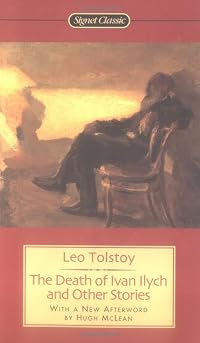
The Death of Ivan Ilych And Other Stories
by Leo Tolstoy
On This Page
Description
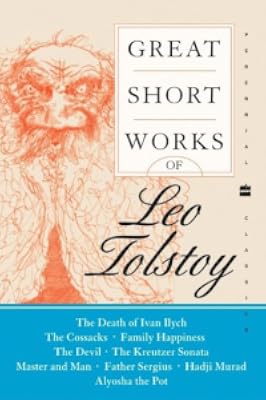
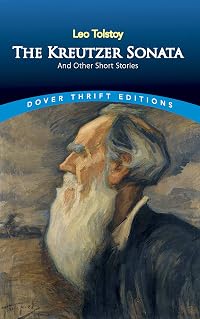
A collection of Tolstoy's short stories, including "Master and Man," "Family Happiness," and "The Kreutzer Sonata."Tags
Recommendations






Member Reviews
The Death of Ivan Ilych is notable for many things not the least being its focus on the life of Ivan Ilych; for, after introducing the narrative with the announcement of his death the story continues with his life up to and including his last days. This is the story of a very ordinary man, a Russian equivalent of an American John Smith, who is notable by his coworkers as being likable, but not so important that they do not make their first thoughts upon his death an intense discussion about how each might benefit from his passing -- whether through promotion or increase in salary.
A deceptively simple tale, it is admirable in its brevity, succinctness, and even ordinariness. Reading this short novel reminded me of some of the show more existentialist works that I have read and studied over the years (think of Camus' The Stranger or The Plague).
Tolstoy's story is a meditation on the death of an every man, a bureaucrat whose life was anything but uncommon. Effortlessly, Tolstoy examines life’s shallow exteriors as well as its inner workings. And in the quotidian details of a life we see pageant of folly. After noting Ivan's rise to apparent success in chapter three, there begins a slow descent into illness and inevitably death. As death approaches there are signs ignored, reality deferred, and only slowly does wisdom emerge not like a dull moral lesson, but heavy, as if from a downpour, with all the weight, shine and freshness of real life. We see, vividly, Ivan Ilych’s errors until one day we realize that someone is looking at us as if we were a character in The Death of Ivan Ilych. This is a small book with a large impact on the reader. It is one that has not lost its power more than a century after its first appearance. In addition to The Death of Ivan Ilych this volume also includes the stories: The Kreutzer Sonata, Hadji Murad, and Family Happiness. show less
A deceptively simple tale, it is admirable in its brevity, succinctness, and even ordinariness. Reading this short novel reminded me of some of the show more existentialist works that I have read and studied over the years (think of Camus' The Stranger or The Plague).
Tolstoy's story is a meditation on the death of an every man, a bureaucrat whose life was anything but uncommon. Effortlessly, Tolstoy examines life’s shallow exteriors as well as its inner workings. And in the quotidian details of a life we see pageant of folly. After noting Ivan's rise to apparent success in chapter three, there begins a slow descent into illness and inevitably death. As death approaches there are signs ignored, reality deferred, and only slowly does wisdom emerge not like a dull moral lesson, but heavy, as if from a downpour, with all the weight, shine and freshness of real life. We see, vividly, Ivan Ilych’s errors until one day we realize that someone is looking at us as if we were a character in The Death of Ivan Ilych. This is a small book with a large impact on the reader. It is one that has not lost its power more than a century after its first appearance. In addition to The Death of Ivan Ilych this volume also includes the stories: The Kreutzer Sonata, Hadji Murad, and Family Happiness. show less
Don't read Ivan Ilych when you're down...one of those books where everything is so very familiar, yet taken as a whole is so very very depressing. Like running ones soul over with a truck. But possibly worth it in the end?
A short story about life and death and the mental suffering that results at the end of a life lived without meaning. For a book written in the 1800's, I found this to be still relevant today. It is the very common story of a man who throws himself into his work when he finds himself dissatisfied with his home life. His focus becomes about upward mobility but as he reflects at the end of his life "It is as if I had been going downhill while I imagined I was going up." A very short read, if you haven't read this classic yet it is worth the day to do it.
My version of The Death of Ivan Ilych and other stories contained the following four novellas:
Family Happiness
The story concerns the love and marriage of a young girl, Mashechka (Masha), and the much older Sergey Mikhaylych, an old family friend. After a somewhat awkward courtship, the two are married and move to Mikhaylych's home. Mikhaylych was concerned that as Mashe was so much younger she would be more concerned with the frivolities in life and could not settle with a man such as him. Their marriage begins well with the two in love, until they join society and Mikhaylych becomes cold to his popular wife. Tolstory seems of the opinion that marriage cannot remain happy, but must fall into routine with both parties plodding along and show more not rocking the boat. The title is highly ironic.
The Death of Ivan Ilych
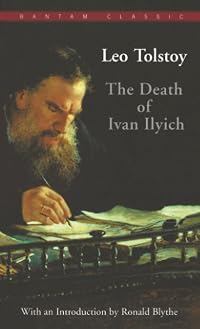
At the beginning Ivan Ilych has just died and we attend his funeral. Present are a series of work colleagues all after his job and promotion and his wife who just wants as much money from the government as possible. Looking back over Ivan's life we see how he wasted it. His focus was on material possessions and it is on hanging curtains one day that he suffers his injury that will later kill him. On his death bed he finally sees the light and undergoes a conversion of sorts after a painful last few days.
The Kreutzer Sonata
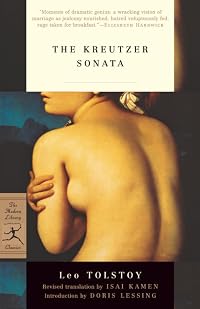
During a train ride, Pozdnyshev overhears a conversation concerning marriage, divorce and love. When a woman argues that marriage should not be arranged but based on true love, he asks "what is love?". It turns out he is famous for having murdered his wife. He began by having a string of affairs and laments on how mothers push their daughters into society to sell themselves to the highest bidder. He does settle and marry, more out of a sense of duty than anything else. He never experiences what others seem to call love and eventually becomes convinced his wife is having an affaier with her music teacher. He is later acquitted of her murder in light of her apparent adultery, and Pozdnyshev rides the trains seeking forgiveness from fellow passengers.
Master and Man
Land owner Vasili Andreevich Brekhunov takes along one of his peasants, Nikita, for a short journey to the house of the owner of a forest. He is impatient and wishes to get to the town more quickly 'for business' (purchasing the forest before other contenders can get there and undercut him). They find themselves in the middle of a blizzard, but the master wishes to press on and get the cheap land. They eventually get lost off the road and they try to camp. The master's peasant soon finds himself about to die from hypothermia and his master leaves with the horse letting him die. Nikita (he used to suffer from a drinking problem but has since given up vodka) awaits his death, but his mater has a change of heart when he attains a spiritual/moral revelation (similar to The Death of Ivan Ilych). He returns and lies on top of the Nikita to keep him warm through the cold night. He, himself is too exposed to the cold though and dies (along with the steadfast horse sadly). Nikita's life is saved.
There are themes of anti-marriage, the praise of the life of peasants over society who merely waste their money and time in vain pursuits and death allowing for spiritual conversions. An interesting collection of stories not to be overlooked by fans of Anna Karenina as it has some similar ideas. show less
Family Happiness
The story concerns the love and marriage of a young girl, Mashechka (Masha), and the much older Sergey Mikhaylych, an old family friend. After a somewhat awkward courtship, the two are married and move to Mikhaylych's home. Mikhaylych was concerned that as Mashe was so much younger she would be more concerned with the frivolities in life and could not settle with a man such as him. Their marriage begins well with the two in love, until they join society and Mikhaylych becomes cold to his popular wife. Tolstory seems of the opinion that marriage cannot remain happy, but must fall into routine with both parties plodding along and show more not rocking the boat. The title is highly ironic.
The Death of Ivan Ilych
At the beginning Ivan Ilych has just died and we attend his funeral. Present are a series of work colleagues all after his job and promotion and his wife who just wants as much money from the government as possible. Looking back over Ivan's life we see how he wasted it. His focus was on material possessions and it is on hanging curtains one day that he suffers his injury that will later kill him. On his death bed he finally sees the light and undergoes a conversion of sorts after a painful last few days.
The Kreutzer Sonata
During a train ride, Pozdnyshev overhears a conversation concerning marriage, divorce and love. When a woman argues that marriage should not be arranged but based on true love, he asks "what is love?". It turns out he is famous for having murdered his wife. He began by having a string of affairs and laments on how mothers push their daughters into society to sell themselves to the highest bidder. He does settle and marry, more out of a sense of duty than anything else. He never experiences what others seem to call love and eventually becomes convinced his wife is having an affaier with her music teacher. He is later acquitted of her murder in light of her apparent adultery, and Pozdnyshev rides the trains seeking forgiveness from fellow passengers.
Master and Man
Land owner Vasili Andreevich Brekhunov takes along one of his peasants, Nikita, for a short journey to the house of the owner of a forest. He is impatient and wishes to get to the town more quickly 'for business' (purchasing the forest before other contenders can get there and undercut him). They find themselves in the middle of a blizzard, but the master wishes to press on and get the cheap land. They eventually get lost off the road and they try to camp. The master's peasant soon finds himself about to die from hypothermia and his master leaves with the horse letting him die. Nikita (he used to suffer from a drinking problem but has since given up vodka) awaits his death, but his mater has a change of heart when he attains a spiritual/moral revelation (similar to The Death of Ivan Ilych). He returns and lies on top of the Nikita to keep him warm through the cold night. He, himself is too exposed to the cold though and dies (along with the steadfast horse sadly). Nikita's life is saved.
There are themes of anti-marriage, the praise of the life of peasants over society who merely waste their money and time in vain pursuits and death allowing for spiritual conversions. An interesting collection of stories not to be overlooked by fans of Anna Karenina as it has some similar ideas. show less
Ratings
Members
- Recently Added By
Lists

Russian Literature
184 works; 35 members

The 100 Best Books of All Time by Norwegian Book Club (World Library)
104 works; 23 members

Best of World Literature
435 works; 52 members

Out of Copyright
244 works; 14 members

Top Five Books of 2014
1,064 works; 398 members

Short Story Collections and Anthologies
261 works; 42 members

Short and Sweet
246 works; 24 members

CCE 1000 Good Books List
1,033 works; 12 members

GreatBooks Worldview Academy Lists
133 works; 4 members
Generation Joshua
115 works; 3 members
Author Information

2,512+ Works 129,788 Members
Count Lev Nikolayevich Tolstoy was born on September 9, 1828 in Russia. He is usually referred to as Leo Tolstoy. He was a Russian author who is regarded as one of the greatest authors of all time. Leo Tolstoy is best known for his novels War and Peace (1869) and Anna Karenina (1877). Tolstoy's fiction includes dozens of short stories and several show more novellas such as The Death of Ivan Ilyich, Family Happiness, and Hadji Murad. He also wrote plays and numerous philosophical essays. Tolstoy had a profound moral crisis and spiritual awakening in the 1870's which he outlined in his work, A Confession. His literal interpretation of the ethical teachings of Jesus, centering on the Sermon on the Mount, caused him to become a fervent Christian anarchist and pacifist. His ideas of nonviolent resistance which he shared in his works The Kingdom of God is Within You, had a profund impact on figures such as Mohandas Gandhi and Martin Luther King, Jr. On September 23, 1862 Tolstoy married Sophia Andreevna Behrs. She was the daughter of a court physician. They had 13 children, eight of whom survived childhood. Their early married life allowed Tolstoy much freedom to compose War and Peace and Anna Karenina with his wife acting as his secretary and proofreader. The Tolstoy family left Russia in the aftermath of the Russian Revolution and the subsequent establishment of the Soviet Union. Leo Tolstoy's relatives and descendants moved to Sweden, Germany, the United Kingdom, France and the United States. Tolstoy died of pneumonia at Astapovo train station, after a day's rail journey south on November 20, 1910 at the age of 82. (Bowker Author Biography) Count Leo Tolstoy was born in 1828 on the family estate of Yasnaya Polyana in the Tula province. He married in 1862 & was the father of 13 children. Tolstoy managed the estate of Yasnaya Polyana & ran its peasant schools, while writing his great novels, "War & Peace" (1869) & "Anna Karenina" (1877). He died in 1910. (Publisher Provided) show less
Series
Belongs to Publisher Series
Common Knowledge
- Canonical title*
- The Death of Ivan Ilych And Other Stories [Family Happiness; The Death of Ivan Ilyich; The Kreutzer Sonata; Master and Man]
- Original title
- The Death of Ivan Ilych And Other Stories [Family Happiness; The Death of Ivan Ilyich; The Kreutzer Sonata; Master and Man]
- Canonical DDC/MDS
- 891.733
*Some information comes from Common Knowledge in other languages. Click "Edit" for more information.
Classifications
- Genres
- Fiction and Literature, General Fiction
- DDC/MDS
- 891.733 — Literature & rhetoric Literatures of other languages East Indo-European and Celtic literatures Russian and East Slavic languages Russian fiction 1800–1917
- LCC
- PG3366 .A13 — Language and Literature Slavic languages and literatures. Baltic languages. Albanian language Slavic. Baltic. Albanian Russian literature Individual authors and works 1800-1870 Tolstoi
- BISAC
Statistics
- Members
- 792
- Popularity
- 35,141
- Reviews
- 4
- Rating
- (3.95)
- Languages
- English, Italian
- Media
- Paper
- ISBNs
- 1
- ASINs
- 1