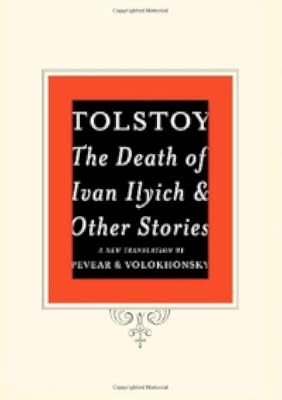
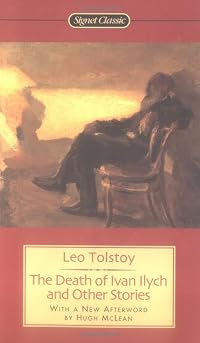
The Death of Ivan Ilyich and Other Stories
by Leo Tolstoy
On This Page
Description
"This book is a new translation of Tolstoy's most important short fiction. Here are eleven stories from the mature author, some autobiographical, others moral parables, and all imaginative, transcendent, and evocatively drawn. They include The Prisoner of the Caucasus, inspired by Tolstoy's experiences as a soldier in the Chechen War, and one of only two of his works that Tolstoy himself considered "good art"; Hadji Murat, the novella Harold Bloom called "the best story in the world," show more featuring the real-life war hero Hadji Murat, a Chechen rebel who ravaged his Russian occupiers only to defect to the Russian side after a falling-out with his own commander; The Devil, a tale of sexual obsession based on Tolstoy's relationship with a married peasant woman on his estate in the years before his marriage; and the celebrated The Death of Ivan Ilyich, an intense and moving examination of death and the possibilities of redemption."--BOOK JACKET. show lessTags
Recommendations




Member Reviews
It's nice to be reminded every now and then that moralization can be used to make great literature, since our literature is so dominated by the idea that moralizing is always a flaw. Tolstoy appears to have been a natural at moralizing.
Others will not doubt disagree, but I'm willing to argue that the best stories here are precisely those in which the moral of the story (or morality of the author) comes through most clearly: Ivan Ilyich, of course, but also The Kreutzer Sonata, The Devil, Master and Man, Father Sergius, and After the Ball (Alyosha the Pot is also moralizing, but unbearably dull. Alyosha is just good. It's important to the other stories that we see the evil as well as the simple hearts. The Forged Coupon is moralizing, show more but is also a Dostoevsky novel shrunk down to 1/10th of its original size and given a happy ending. No thank you).
The bookending tales set in the Russian borderlands, on the other hand, are rollicking, but not particularly inspiring. I was very disappointed with Hadji Murat, in particular, though it made me want to learn more (something, anything) about the region.
Anything else I have to say will be said better by Tolstoy. Well, almost anything. The Kreutzer Sonata features a wonderful proto-Bernhardian rant, in this case against marriage. I'd love to know if Bernhard had read it, what he thought of it, and if anyone has compared his work with Tolstoy's story. show less
Others will not doubt disagree, but I'm willing to argue that the best stories here are precisely those in which the moral of the story (or morality of the author) comes through most clearly: Ivan Ilyich, of course, but also The Kreutzer Sonata, The Devil, Master and Man, Father Sergius, and After the Ball (Alyosha the Pot is also moralizing, but unbearably dull. Alyosha is just good. It's important to the other stories that we see the evil as well as the simple hearts. The Forged Coupon is moralizing, show more but is also a Dostoevsky novel shrunk down to 1/10th of its original size and given a happy ending. No thank you).
The bookending tales set in the Russian borderlands, on the other hand, are rollicking, but not particularly inspiring. I was very disappointed with Hadji Murat, in particular, though it made me want to learn more (something, anything) about the region.
Anything else I have to say will be said better by Tolstoy. Well, almost anything. The Kreutzer Sonata features a wonderful proto-Bernhardian rant, in this case against marriage. I'd love to know if Bernhard had read it, what he thought of it, and if anyone has compared his work with Tolstoy's story. show less
Wow! Just in case War and Peace and Anna Karenina were not impressive enough, Tolstoy adds "The Death of Ivan Ilyich."
The writing is magnificent, largely because the two translators do such a superb job of rendering the original Russian into English that resonates with a 21st century reader. I have often found that books written in languages others than my own are difficult to read, but his volume reads smoothly and comfortably.
Even though I have read the two aforementioned books by Tolstoy, I was still blown away by his ability to create such a marvelous book. Here, Ivan Ilyich is the lead selection in a collection of other Tolstoy works and I found most of them excellent, providing deep insights into human nature. (The last show more selection, "Hadji Murat," did not seem as polished or complex as the others selections, and I felt more like I was reading Zane Grey or Louis L'Amour than Tolstoy).
I still cannot get over the deep insights into human nature Tolstoy reveals. His understanding of characters, motives and behaviors exceeds than that of many modern day psychologists. In fact, they could quit reading Freud and Jung and start reading Tolstoy.
My reading goals for the year include reading at least 4 classic of literature, re-reading one or two and reading other classics I have not yet read. I am delighted that I started with this excellent book. It encourages me as a return to reading the classics I have usually found so great in the past. Too long have I known of some classics, like this one, and applied Twain's definition to them: "books everyone talks about but no one reads." This book should change his observation to say: "books everyone reads and then can't stop talking about." show less
The writing is magnificent, largely because the two translators do such a superb job of rendering the original Russian into English that resonates with a 21st century reader. I have often found that books written in languages others than my own are difficult to read, but his volume reads smoothly and comfortably.
Even though I have read the two aforementioned books by Tolstoy, I was still blown away by his ability to create such a marvelous book. Here, Ivan Ilyich is the lead selection in a collection of other Tolstoy works and I found most of them excellent, providing deep insights into human nature. (The last show more selection, "Hadji Murat," did not seem as polished or complex as the others selections, and I felt more like I was reading Zane Grey or Louis L'Amour than Tolstoy).
I still cannot get over the deep insights into human nature Tolstoy reveals. His understanding of characters, motives and behaviors exceeds than that of many modern day psychologists. In fact, they could quit reading Freud and Jung and start reading Tolstoy.
My reading goals for the year include reading at least 4 classic of literature, re-reading one or two and reading other classics I have not yet read. I am delighted that I started with this excellent book. It encourages me as a return to reading the classics I have usually found so great in the past. Too long have I known of some classics, like this one, and applied Twain's definition to them: "books everyone talks about but no one reads." This book should change his observation to say: "books everyone reads and then can't stop talking about." show less
Wow! Just in case War and Peace and Anna Karenina were not impressive enough, Tolstoy adds "The Death of Ivan Ilyich."
The writing is magnificent, largely because the two translators do such a superb job of rendering the original Russian into English that resonates with a 21st century reader. I have often found that books written in languages others than my own are difficult to read, but his volume reads smoothly and comfortably.
Even though I have read the two aforementioned books by Tolstoy, I was still blown away by his ability to create such a marvelous book. Here, Ivan Ilyich is the lead selection in a collection of other Tolstoy works and I found most of them excellent, providing deep insights into human nature. (The last show more selection, "Hadji Murat," did not seem as polished or complex as the others selections, and I felt more like I was reading Zane Grey or Louis L'Amour than Tolstoy).
I still cannot get over the deep insights into human nature Tolstoy reveals. His understanding of characters, motives and behaviors exceeds than that of many modern day psychologists. In fact, they could quit reading Freud and Jung and start reading Tolstoy.
My reading goals for the year include reading at least 4 classic of literature, re-reading one or two and reading other classics I have not yet read. I am delighted that I started with this excellent book. It encourages me as a return to reading the classics I have usually found so great in the past. Too long have I known of some classics, like this one, and applied Twain's definition to them: "books everyone talks about but no one reads." This book should change his observation to say: "books everyone reads and then can't stop talking about." show less
The writing is magnificent, largely because the two translators do such a superb job of rendering the original Russian into English that resonates with a 21st century reader. I have often found that books written in languages others than my own are difficult to read, but his volume reads smoothly and comfortably.
Even though I have read the two aforementioned books by Tolstoy, I was still blown away by his ability to create such a marvelous book. Here, Ivan Ilyich is the lead selection in a collection of other Tolstoy works and I found most of them excellent, providing deep insights into human nature. (The last show more selection, "Hadji Murat," did not seem as polished or complex as the others selections, and I felt more like I was reading Zane Grey or Louis L'Amour than Tolstoy).
I still cannot get over the deep insights into human nature Tolstoy reveals. His understanding of characters, motives and behaviors exceeds than that of many modern day psychologists. In fact, they could quit reading Freud and Jung and start reading Tolstoy.
My reading goals for the year include reading at least 4 classic of literature, re-reading one or two and reading other classics I have not yet read. I am delighted that I started with this excellent book. It encourages me as a return to reading the classics I have usually found so great in the past. Too long have I known of some classics, like this one, and applied Twain's definition to them: "books everyone talks about but no one reads." This book should change his observation to say: "books everyone reads and then can't stop talking about." show less
I haven't read this in decades. It reinvigorated my love of Leo Tolstoy.
Maybe, I found it more compelling now as death is closer than it was when I first read it in my early 20's. The emotions feel very authentic…he seems to capture real life.
Maybe, I found it more compelling now as death is closer than it was when I first read it in my early 20's. The emotions feel very authentic…he seems to capture real life.
This is a new translation of some of Tolstoy's shorter works by the noted translators Richard Pevear and Larissa Volokhonsky, and I snapped it up both because of my love for "War and Peace" and "Anna Karenina" and because I've admired the translators' previous work. I am glad I read it, and I really enjoyed some of the stories/novellas, especially "Hadji Murat" (which I'd read before), "the Forged Coupon," and "Master and Man." Some of the other stories I found fascinating, although difficult to relate to, for their intense depiction of sexual desire as a manifestation of the devil, and some written after Tolstoy "got religion" were just too religiously based for me. Nevertheless, as an admirer of Tolstoy, I was glad to get a broader show more picture of his work, although W&P and AK are certainly in another league than many of these stories.
ETA Reading "Hadji Murat" will tell you everything you need to know about Russia's continuing problems with Chechnya, and a lot about western problems in Muslim countries. show less
ETA Reading "Hadji Murat" will tell you everything you need to know about Russia's continuing problems with Chechnya, and a lot about western problems in Muslim countries. show less
I enjoyed this book but find it hard to understand. In order for me to understand the stories in this book I have to read them more than once. I have read the story "Death of Ivan Ilyich" at least two or three times now so I understand that one. But I need to re-read the other stories in this book again before I can tell you what they were fully about.
Ratings
Members
- Recently Added By
Lists

Russian Literature
184 works; 35 members
Author Information

2,513+ Works 129,795 Members
Count Lev Nikolayevich Tolstoy was born on September 9, 1828 in Russia. He is usually referred to as Leo Tolstoy. He was a Russian author who is regarded as one of the greatest authors of all time. Leo Tolstoy is best known for his novels War and Peace (1869) and Anna Karenina (1877). Tolstoy's fiction includes dozens of short stories and several show more novellas such as The Death of Ivan Ilyich, Family Happiness, and Hadji Murad. He also wrote plays and numerous philosophical essays. Tolstoy had a profound moral crisis and spiritual awakening in the 1870's which he outlined in his work, A Confession. His literal interpretation of the ethical teachings of Jesus, centering on the Sermon on the Mount, caused him to become a fervent Christian anarchist and pacifist. His ideas of nonviolent resistance which he shared in his works The Kingdom of God is Within You, had a profund impact on figures such as Mohandas Gandhi and Martin Luther King, Jr. On September 23, 1862 Tolstoy married Sophia Andreevna Behrs. She was the daughter of a court physician. They had 13 children, eight of whom survived childhood. Their early married life allowed Tolstoy much freedom to compose War and Peace and Anna Karenina with his wife acting as his secretary and proofreader. The Tolstoy family left Russia in the aftermath of the Russian Revolution and the subsequent establishment of the Soviet Union. Leo Tolstoy's relatives and descendants moved to Sweden, Germany, the United Kingdom, France and the United States. Tolstoy died of pneumonia at Astapovo train station, after a day's rail journey south on November 20, 1910 at the age of 82. (Bowker Author Biography) Count Leo Tolstoy was born in 1828 on the family estate of Yasnaya Polyana in the Tula province. He married in 1862 & was the father of 13 children. Tolstoy managed the estate of Yasnaya Polyana & ran its peasant schools, while writing his great novels, "War & Peace" (1869) & "Anna Karenina" (1877). He died in 1910. (Publisher Provided) show less
Common Knowledge
- Canonical title*
- The Death of Ivan Ilyich and Other Stories [The Death of Ivan Ilyich; The Kreutzer Sonata; Happy Ever After; Master and Man; After the Ball; The Raid; Hadji Murad]
- Original title
- The Death of Ivan Ilyich and Other Stories [The Death of Ivan Ilyich; The Kreutzer Sonata; Happy Ever After; Master and Man; After the Ball; The Raid; Hadji Murad]
*Some information comes from Common Knowledge in other languages. Click "Edit" for more information.
Classifications
- Genres
- Fiction and Literature, General Fiction
- DDC/MDS
- 891.733 — Literature & rhetoric Literatures of other languages East Indo-European and Celtic literatures Russian and East Slavic languages Russian fiction 1800–1917
- LCC
- PG3366 .A13 .P47 — Language and Literature Slavic languages and literatures. Baltic languages. Albanian language Slavic. Baltic. Albanian Russian literature Individual authors and works 1800-1870 Tolstoi
- BISAC
Statistics
- Members
- 254
- Popularity
- 127,707
- Reviews
- 6
- Rating
- (4.35)
- Languages
- English, Italian
- Media
- Paper
- ISBNs
- 1