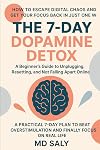
The 7-Day Dopamine Detox: A Beginner's Guide to Unplugging, Resetting, and Not Falling Apart Online
by M.D. Saly
On This Page
Description
By MD Saly Ever feel like your brain has been hijacked by your phone? You pick it up for a "quick check" and look up thirty minutes later, wondering where your focus--and your time--just disappeared. You're not lazy. You're not weak-willed. And your brain isn't broken. You're simply living in a world engineered to capture and monetize your attention. But what if the popular solution--the so-called "dopamine detox"--is built on a myth? Here's the truth: you can't detox from dopamine. Dopamine show more isn't a toxin. It's the brain chemical behind motivation, pleasure, and focus. The real issue isn't your biology--it's your habits. The 7-Day Dopamine Detox cuts through the trendy nonsense and delivers a practical, science-backed reset that actually works. This isn't about depriving your brain. It's about retraining it. In just one focused, no-fluff week, you'll move from digital chaos to calm control using proven principles from behavioral psychology--not internet fads. Inside, you'll learn: The Big Lie -- Why "dopamine detoxes" are biologically impossible (and why that's good news). Day 1: The Triage -- How to stop fighting digital fires that aren't yours by silencing constant interruptions. Day 2: Space Sculpting -- How to design your environment to support focus instead of sabotaging it. Day 3: The Boredom Advantage -- Why learning to sit with boredom unlocks creativity and inner calm. Day 4: The Body Buffer -- How one simple physical action can interrupt the urge to mindlessly scroll. Day 5: The Analog Reset -- How to recalibrate your brain to the slower, more satisfying rhythm of real life. Day 6: The Intentional Rebuild -- How to reintroduce technology on your terms, not its own. Day 7 and Beyond -- How to turn a one-week reset into a lifelong practice of disciplined attention. This book is for: * Anyone whose phone is the first thing they touch in the morning and the last thing at night. * Students, creators, and professionals exhausted by constant distraction. * People who've tried extreme digital detoxes--only to relapse harder. * Anyone seeking a practical, halal-friendly guide free from guilt and pseudoscience. This isn't about quitting the internet. It's about quitting the chaos. Think of it as a beginner's guide to building a sustainable peace treaty with your devices--so you can unplug, reset, and stay grounded without falling apart online. The reset you need isn't chemical. It's behavioral. Your focus is waiting to come home. Click Buy Now and begin your real 7-day reset today. And if the book helps you, please consider leaving an honest review on Amazon. As an independent author, your words are the greatest support--helping others cut through the noise and reclaim a focused, intentional life. show lessTags
Member Reviews
The 7-Day Dopamine Detox: A Beginner’s Guide to Unplugging, Resetting, and Not Falling Apart Online by MD Saly is a practical and accessible guide for readers who feel overwhelmed by digital distraction and constant online stimulation. The author quickly addresses a common misconception: the idea that people can literally “detox” dopamine. Instead, the book explains that dopamine itself isn’t harmful—it’s a natural chemical involved in motivation and reward—and the real issue lies in the habits and systems that exploit our attention.
Structured as a seven-day framework, the book walks readers through small behavioral and environmental changes designed to break compulsive scrolling and digital overload. The early chapters show more focus on awareness—tracking cues and identifying habits—while later sections introduce strategies such as reducing notifications, restructuring physical spaces to support focus, and intentionally creating periods of boredom to restore attention and creativity.
The tone is direct and conversational, which makes the concepts approachable even for readers who are new to productivity or behavioral psychology. The author draws on principles from cognitive behavioral therapy and habit-building research to emphasize practical steps rather than extreme digital abstinence.
At times the ideas repeat or could be condensed, but the book’s structured approach and clear explanations make it useful for readers looking for a manageable reset rather than a strict or unrealistic “detox.”
Overall, The 7-Day Dopamine Detox offers a thoughtful reminder that regaining focus isn’t about eliminating technology entirely, but about rebuilding healthier habits around it.
I received this book through LibraryThing Early Reviewers in exchange for an honest review. show less
Structured as a seven-day framework, the book walks readers through small behavioral and environmental changes designed to break compulsive scrolling and digital overload. The early chapters show more focus on awareness—tracking cues and identifying habits—while later sections introduce strategies such as reducing notifications, restructuring physical spaces to support focus, and intentionally creating periods of boredom to restore attention and creativity.
The tone is direct and conversational, which makes the concepts approachable even for readers who are new to productivity or behavioral psychology. The author draws on principles from cognitive behavioral therapy and habit-building research to emphasize practical steps rather than extreme digital abstinence.
At times the ideas repeat or could be condensed, but the book’s structured approach and clear explanations make it useful for readers looking for a manageable reset rather than a strict or unrealistic “detox.”
Overall, The 7-Day Dopamine Detox offers a thoughtful reminder that regaining focus isn’t about eliminating technology entirely, but about rebuilding healthier habits around it.
I received this book through LibraryThing Early Reviewers in exchange for an honest review. show less
 This review was written for LibraryThing Early Reviewers.
I received a free copy of this book to be reviewed. I recently finished the 7-Day Dopamine Detox, and it provided a much-needed recalibration of my relationship with technology and my own focus. Here are my key takeaways for anyone looking to reclaim their mental clarity:
1. Understanding the "Drive": Molecule Dopamine isn't just about pleasure; it's the molecule of motivation, movement, and memory. When our levels are depleted or constantly spiked by "Traps"—apps designed for infinite consumption—we lose our natural "will to move" and fall into cycles of severe distraction.
2. The Power of the "Buffer": One of the most practical tips was the "Buffer Rule." When you feel a compulsive urge to check your phone, set a timer for a few show more minutes and do something else—make tea or organize a drawer. This small moment of deliberation allows the rational brain to catch up with the impulse.
3. Embracing "Productive Uncertainty": We’ve become accustomed to "reflexive outsourcing"—searching for every answer the second it pops into our heads. The book argues for sitting with questions and letting the mind "chew" on them. This "Analog Revival"—choosing physical books or manual tasks like gardening—reintroduces necessary friction that makes experiences and learning actually "stick".
4. Designing for Presence: The concept of "Choice Architecture" was a game-changer. By simply increasing the physical distance between myself and my phone, I use "Proximity Bias" to my advantage. If scrolling requires more steps than a beneficial activity, you've already won the "architecture war".
5. Boredom as a Precondition for Creativity: We often treat boredom as a problem to be solved with a screen, but the book reframes it as the "fertile void" where the self is repaired and creativity is seeded. By avoiding every quiet moment, we starve our brains of the essential "housekeeping" that happens during undirected thought.
Final Thought:
a. The goal isn't to live entirely offline, but to be "attentively online and profoundly offline at the right times". This isn't just a 7-day project; it’s a lifelong practice of protecting our sleep, our focus, and our "inner calm".
b. I liked the way the author expressed her thoughts throughout the book. Though the book focuses primarily on digital detox, I felt a good number of these pointers can be used to get rid of other addictive habits as well. show less
1. Understanding the "Drive": Molecule Dopamine isn't just about pleasure; it's the molecule of motivation, movement, and memory. When our levels are depleted or constantly spiked by "Traps"—apps designed for infinite consumption—we lose our natural "will to move" and fall into cycles of severe distraction.
2. The Power of the "Buffer": One of the most practical tips was the "Buffer Rule." When you feel a compulsive urge to check your phone, set a timer for a few show more minutes and do something else—make tea or organize a drawer. This small moment of deliberation allows the rational brain to catch up with the impulse.
3. Embracing "Productive Uncertainty": We’ve become accustomed to "reflexive outsourcing"—searching for every answer the second it pops into our heads. The book argues for sitting with questions and letting the mind "chew" on them. This "Analog Revival"—choosing physical books or manual tasks like gardening—reintroduces necessary friction that makes experiences and learning actually "stick".
4. Designing for Presence: The concept of "Choice Architecture" was a game-changer. By simply increasing the physical distance between myself and my phone, I use "Proximity Bias" to my advantage. If scrolling requires more steps than a beneficial activity, you've already won the "architecture war".
5. Boredom as a Precondition for Creativity: We often treat boredom as a problem to be solved with a screen, but the book reframes it as the "fertile void" where the self is repaired and creativity is seeded. By avoiding every quiet moment, we starve our brains of the essential "housekeeping" that happens during undirected thought.
Final Thought:
a. The goal isn't to live entirely offline, but to be "attentively online and profoundly offline at the right times". This isn't just a 7-day project; it’s a lifelong practice of protecting our sleep, our focus, and our "inner calm".
b. I liked the way the author expressed her thoughts throughout the book. Though the book focuses primarily on digital detox, I felt a good number of these pointers can be used to get rid of other addictive habits as well. show less
This review was written for LibraryThing Early Reviewers.I won this book as an early reviewer. I wanted to read this book with my son who has severe ADHD (and phone/internet addiction issues). Unfortunately, he has refused to even look at it.
I did read it and appreciated the author's brevity, humor and that detox isn't giving up all access but making choices. Its an eay read with daily actions to do. Its all good advice and logic. Now if I could get my son to read it, that would be a 5 star :)!
I did read it and appreciated the author's brevity, humor and that detox isn't giving up all access but making choices. Its an eay read with daily actions to do. Its all good advice and logic. Now if I could get my son to read it, that would be a 5 star :)!
This review was written for LibraryThing Early Reviewers.This is a different read, on the grounds of dopamine, a chemical in our brains, and we are learning to reset or train our brains to expect interruptions in every task. Yet we hear some people's frustrations in their loud sighs when they've been interrupted or distracted by the computer or phone.
MD Saly clearly states that we cannot detox dopamine; our behaviors can be hijacked; and she offers to rewire our normal routines by logging every cue that triggers a mindless scroll (phone or Internet via social media) and removing ourselves from the chaos.
*I am also using this to create a video for adolescents who do not know the dangers of social media/Internet, and this book is that intervention and potential help for such risks (3.9.2026 due show more by Friday night).
I received an eBook version from the LibraryThing contest win in February 2026.
This book took longer than the normal 30 days. As a Psychology major, I was able to give the author credit/reference for a discussion project, which was well-received. The project was in relation to social media, addiction to cellphones, similar to substance abuse, and mindful of the lurkers and aggression that cell phone usage can cause. This book helps reset and reframe our thinking and processes around our phone use.
3.5/4 stars. show less
MD Saly clearly states that we cannot detox dopamine; our behaviors can be hijacked; and she offers to rewire our normal routines by logging every cue that triggers a mindless scroll (phone or Internet via social media) and removing ourselves from the chaos.
*I am also using this to create a video for adolescents who do not know the dangers of social media/Internet, and this book is that intervention and potential help for such risks (3.9.2026 due show more by Friday night).
I received an eBook version from the LibraryThing contest win in February 2026.
This book took longer than the normal 30 days. As a Psychology major, I was able to give the author credit/reference for a discussion project, which was well-received. The project was in relation to social media, addiction to cellphones, similar to substance abuse, and mindful of the lurkers and aggression that cell phone usage can cause. This book helps reset and reframe our thinking and processes around our phone use.
3.5/4 stars. show less
This review was written for LibraryThing Early Reviewers.Title and author: The 7-Day Dopamine Detox: A Beginner's Guide to Unplugging, Resetting, and Not Falling Apart Online by MD Saly reviewed 2-27-26
Why I picked this book up: It is based on Cognitive Behavioral therapy, CBT, which I used for years as a psychologist and adding the biology aspect of dopamine was interesting and I’ve read a few of her other books and I wanted to see if it’s as good as her other books.
Thoughts: This is a digital short, easy read with pragmatic material I found useful.
Why I finished this read: this book is filled with useful actionable material to help change online habits.
Stars 5 of 5 stars as it did what it set out to
Why I picked this book up: It is based on Cognitive Behavioral therapy, CBT, which I used for years as a psychologist and adding the biology aspect of dopamine was interesting and I’ve read a few of her other books and I wanted to see if it’s as good as her other books.
Thoughts: This is a digital short, easy read with pragmatic material I found useful.
Why I finished this read: this book is filled with useful actionable material to help change online habits.
Stars 5 of 5 stars as it did what it set out to
This review was written for LibraryThing Early Reviewers.Members
- Recently Added By
Author Information
11 Works 72 Members
Classifications
- Genres
- Nonfiction, Religion & Spirituality
- BISAC
Statistics
- Members
- 11
- Popularity
- 2,004,691
- Reviews
- 5
- Rating
- (4.10)
- Languages
- English
- Media
- Paper
- ISBNs
- 1
- ASINs
- 1