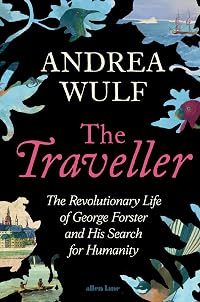
The Traveler: One Man's Quest for Humanity from the South Seas to Revolutionary Paris
by Andrea Wulf
On This Page
Recommendations










Member Reviews
Rating: 4.75* of five
The Publisher Says: Step into the life and times of George Forster, the young naturalist and revolutionary who journeyed to the far reaches of the known world and whose radical ideas about humanity and freedom made waves in eighteenth-century Europe—from the bestselling author of The Invention of Nature and Magnificent Rebels.
From an early age, it was clear that George Forster possessed a brilliant mind. A polyglot and gifted scientist, he became an invaluable asset to the ambitions of his domineering father, Reinhold. As a young boy, he travelled with his father from the plains of West Prussia to the wild shores of the Volga to St. Petersburg and London on scientific endeavors, and soon became the breadwinner by show more publishing translations of hugely popular exploration accounts. When Reinhold Forster was offered the position of naturalist aboard Captain James Cook’s second voyage, he accepted on the condition that his seventeen-year-old son serve as his assistant.
The HMS Resolution set sail in 1772 with orders to find the hypothetical southern continent of Antarctica. On her voyage to the Antarctic Circle and the islands of the South Pacific—including New Zealand, Vanuatu, Tonga, Tahiti, and Easter Island—the Resolution carried the ambitions of the most powerful empire in the world. But George Forster brought an understanding that was centuries ahead of the attitudes of his day—his ideas belonged to the future. A remarkable observer, linguist, artist, and writer whose intelligence surpassed that of his own father, he studied the diverse cultures of the world without prejudice and sought to uncover our common humanity. He was a traveler in body and mind—not bound by place, people or establishment.
Recognized as one of Europe’s brightest minds on his return, Forster held positions across the continent and regaled the world not only with tales from his travels but also radical ideas about human nature. He would write against empire, white supremacy, and slavery. He would become a revolutionary and be declared an outlaw. He would never seek to control others as he had been controlled by his father, and even embraced a liberal idea of marriage, accepting his wife’s affairs and independence Andrea Wulf’s The Traveler recounts an extraordinary life largely forgotten by history, the tale of a man who broke with convention and was unafraid to critique the world around him in dedication to his belief in the human right to dignity, equality, and freedom.
I RECEIVED A DRC FROM THE PUBLISHER VIA NETGALLEY. THANK YOU.
My Review: A man as astonishing as Author Wulf's previous science-biography topic, Alexander von Humboldt (see here). Forster has been brought out of obscurity at a time when his delighted curiosity in the world is curdling die to the way we as a species ignored the warnings of imbalance von Humboldt was observing and reporting on. Forster is still known to us today because he wrote of his travels extensively. He was unusual for his attention to the contributions of women and his respect for the contributions of non-whites in many fields around the world. He died before he was fifty; it's a sadness to me personally that he and Alexander von Humboldt never traveled together. As Forster was two decades older than von Humboldt, I can only dream of what the synergy in these men's inclusive, broad views might have gifted us.
A man born in 1754 writing passionately about the flimsiness and dishonesty of white supremacy, and the idiocy of the idea of dominionism deserves a wide audience in the twenty-first century. If we're going to lionize dead white men, let's lionize George Forster the proponent of equality, the supporter of women's rights, the spreader of Enlightenment values. Here's a British man worthy of our respect and deserving of emulation.
Forster's travels broadened his mind and his spirit. He was a person who saw, as his private papers show, the connections among people in a time when colonialism and sexism were drawing ever thicker lines between us. I am saddened that his first-hand observations of the idiocy and evil that Othering (in today's terminology) colonized people was exacting never gained traction. I dream of a Forster who lived to lift up Mary Wollestonecraft, who worked effectively with Revolutionary Parisians to moderate the evils inherent in destroying systems to rebuild them fairly.
Author Wulf has, as is her wont, seen past History's battlefield fog to choose another target of worth and merit to remind us how long the world has been falling from Grace.
And how many before us saw it.
Honoring their legacies by taking action seems appropriate to me. I hope you'll read this dynamically written, thoroughly researched work on an unjustly underknown thinker, and feel inspired to do just that. show less
The Publisher Says: Step into the life and times of George Forster, the young naturalist and revolutionary who journeyed to the far reaches of the known world and whose radical ideas about humanity and freedom made waves in eighteenth-century Europe—from the bestselling author of The Invention of Nature and Magnificent Rebels.
From an early age, it was clear that George Forster possessed a brilliant mind. A polyglot and gifted scientist, he became an invaluable asset to the ambitions of his domineering father, Reinhold. As a young boy, he travelled with his father from the plains of West Prussia to the wild shores of the Volga to St. Petersburg and London on scientific endeavors, and soon became the breadwinner by show more publishing translations of hugely popular exploration accounts. When Reinhold Forster was offered the position of naturalist aboard Captain James Cook’s second voyage, he accepted on the condition that his seventeen-year-old son serve as his assistant.
The HMS Resolution set sail in 1772 with orders to find the hypothetical southern continent of Antarctica. On her voyage to the Antarctic Circle and the islands of the South Pacific—including New Zealand, Vanuatu, Tonga, Tahiti, and Easter Island—the Resolution carried the ambitions of the most powerful empire in the world. But George Forster brought an understanding that was centuries ahead of the attitudes of his day—his ideas belonged to the future. A remarkable observer, linguist, artist, and writer whose intelligence surpassed that of his own father, he studied the diverse cultures of the world without prejudice and sought to uncover our common humanity. He was a traveler in body and mind—not bound by place, people or establishment.
Recognized as one of Europe’s brightest minds on his return, Forster held positions across the continent and regaled the world not only with tales from his travels but also radical ideas about human nature. He would write against empire, white supremacy, and slavery. He would become a revolutionary and be declared an outlaw. He would never seek to control others as he had been controlled by his father, and even embraced a liberal idea of marriage, accepting his wife’s affairs and independence Andrea Wulf’s The Traveler recounts an extraordinary life largely forgotten by history, the tale of a man who broke with convention and was unafraid to critique the world around him in dedication to his belief in the human right to dignity, equality, and freedom.
I RECEIVED A DRC FROM THE PUBLISHER VIA NETGALLEY. THANK YOU.
My Review: A man as astonishing as Author Wulf's previous science-biography topic, Alexander von Humboldt (see here). Forster has been brought out of obscurity at a time when his delighted curiosity in the world is curdling die to the way we as a species ignored the warnings of imbalance von Humboldt was observing and reporting on. Forster is still known to us today because he wrote of his travels extensively. He was unusual for his attention to the contributions of women and his respect for the contributions of non-whites in many fields around the world. He died before he was fifty; it's a sadness to me personally that he and Alexander von Humboldt never traveled together. As Forster was two decades older than von Humboldt, I can only dream of what the synergy in these men's inclusive, broad views might have gifted us.
A man born in 1754 writing passionately about the flimsiness and dishonesty of white supremacy, and the idiocy of the idea of dominionism deserves a wide audience in the twenty-first century. If we're going to lionize dead white men, let's lionize George Forster the proponent of equality, the supporter of women's rights, the spreader of Enlightenment values. Here's a British man worthy of our respect and deserving of emulation.
Forster's travels broadened his mind and his spirit. He was a person who saw, as his private papers show, the connections among people in a time when colonialism and sexism were drawing ever thicker lines between us. I am saddened that his first-hand observations of the idiocy and evil that Othering (in today's terminology) colonized people was exacting never gained traction. I dream of a Forster who lived to lift up Mary Wollestonecraft, who worked effectively with Revolutionary Parisians to moderate the evils inherent in destroying systems to rebuild them fairly.
Author Wulf has, as is her wont, seen past History's battlefield fog to choose another target of worth and merit to remind us how long the world has been falling from Grace.
And how many before us saw it.
Honoring their legacies by taking action seems appropriate to me. I hope you'll read this dynamically written, thoroughly researched work on an unjustly underknown thinker, and feel inspired to do just that. show less
Some 250 years ago, George Forster began his search for our common humanity, urging that we–as a species—share the right to equality and freedom. from The Traveler by Andrea Wulf
I echo what others have written: I was enthralled and thrilled by The Traveler. Andrea Wulf resurrects a forgotten man who led a remarkable life and who early developed a respect for all peoples that was remarkable in his time.
George Forster was a teenager when he accompanied his naturalist father on Captain Cook’s second voyage. He was already a seasoned traveler and botanist, having accompanied his father on an expedition in Russia.
George was a detailed observer not only of flora and fauna with his sketches, but he also used his pen to describe the show more cultures and peoples encountered in the South Seas.
George emphasized that every culture had to be understood in its particular context. from The Traveler by Andrea Wulf
His attitude was open and nonjudgmental. He noted that Indigenous people had intelligence and skill that was different from Europeans, but just as sharp and critical. This attitude became foundational to all his life’s work and set him apart from the leading philosophers of the day.
After the three year voyage, George was a celebrity. He traveled and met leading thinkers and scientists of his time, including Benjamin Franklin. The depravations of the voyage had harmed his health, and his skin had been blemished by small pox, but he was feted everywhere. He wrote and served in various jobs across Europe, married for love a woman who could not be faithful, and in middle age was inspired by the ideals of the French Revolution which he hoped would bring in a new age of true liberty and equality.
His life was filled with success and trauma, making this a real page-turner. But it is his hopeful, open, mind and heart that impressed me most. Those who knew him best revered him as the best of men.
Fr ome, George Forster’s most important legacy was his unshakable belief in humankind–this messy, uncontrollable and incomprehensible thing that is us. from The Traveler by Andrea Wulf
Thanks to Knopf for a free book through NetGalley. show less
I echo what others have written: I was enthralled and thrilled by The Traveler. Andrea Wulf resurrects a forgotten man who led a remarkable life and who early developed a respect for all peoples that was remarkable in his time.
George Forster was a teenager when he accompanied his naturalist father on Captain Cook’s second voyage. He was already a seasoned traveler and botanist, having accompanied his father on an expedition in Russia.
George was a detailed observer not only of flora and fauna with his sketches, but he also used his pen to describe the show more cultures and peoples encountered in the South Seas.
George emphasized that every culture had to be understood in its particular context. from The Traveler by Andrea Wulf
His attitude was open and nonjudgmental. He noted that Indigenous people had intelligence and skill that was different from Europeans, but just as sharp and critical. This attitude became foundational to all his life’s work and set him apart from the leading philosophers of the day.
After the three year voyage, George was a celebrity. He traveled and met leading thinkers and scientists of his time, including Benjamin Franklin. The depravations of the voyage had harmed his health, and his skin had been blemished by small pox, but he was feted everywhere. He wrote and served in various jobs across Europe, married for love a woman who could not be faithful, and in middle age was inspired by the ideals of the French Revolution which he hoped would bring in a new age of true liberty and equality.
His life was filled with success and trauma, making this a real page-turner. But it is his hopeful, open, mind and heart that impressed me most. Those who knew him best revered him as the best of men.
Fr ome, George Forster’s most important legacy was his unshakable belief in humankind–this messy, uncontrollable and incomprehensible thing that is us. from The Traveler by Andrea Wulf
Thanks to Knopf for a free book through NetGalley. show less
Ratings
Members
- Recently Added By
Author Information

13+ Works 5,254 Members
Andrea Wulf is an English historian and writer, born in New Delhi, India in 1972. She studied design at the Royal College of Art. She is a public speaker and has lectured in the UK and USA. Her books include This Other Eden: Seven Great Gardens and 300 Years of English History; Founding Gardeners: The Revolutionary Generation, Nature, and the show more Shaping of the American Nation; and Chasing Venus: The Race to Measure the Heavens. Her award winning book, The Brother Gardeners, received a CBHL Annual Literature Award in 2010. The Invention of Nature: How Alexander Von Humboldt Revolutionized Our World, received the 2015 Costa Book Award in the biography category, and the 2016 Royal Society Science Book Prize for 'outstanding popular science books' written for a non-specialist audience. (Bowker Author Biography) show less
Awards and Honors
Distinctions
The Guardian Book of the Day (2026-06-04)
Classifications
Statistics
- Members
- 44
- Popularity
- 673,898
- Reviews
- 2
- Rating
- (3.33)
- Languages
- English
- Media
- Paper
- ISBNs
- 1