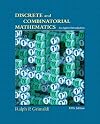
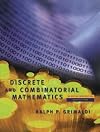
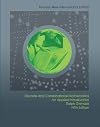
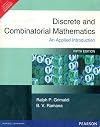
Discrete and Combinatorial Mathematics: An Applied Introduction
by Ralph P. Grimaldi
On This Page
Description
This fifth edition continues to improve on the features that have made it the market leader. The text offers a flexible organization, enabling instructors to adapt the book to their particular courses. The book is both complete and careful, and it continues to maintain its emphasis on algorithms and applications. Excellent exercise sets allow students to perfect skills as they practice. This new edition continues to feature numerous computer science applications-making this the ideal text show more for preparing students for advanced study. show lessTags
Recommendations












Member Reviews
I had the fortune to be educated in the ways of discrete mathematics by the author of this book. Dr. Grimaldi taught his class very well, and made the information within its pages stand out to the student. His enthusiasm for mathematics was very well balanced with his enthusiasm for teaching. Because of this fact, I am not sure if other teachers teaching the same material would get the same end result as I did. I graduated around the same time he published the fifth edition, so I never really saw it in print. My review pertains to the fourth.
Discrete mathematics is not to be confused with discreet mathematics (we don't usually talk about such...), but is instead a way to measure a discrete (that is, not continuous) event using various show more mathematical properties. Likewise, combinatorics is just a fancy-schmancy way of saying "counting." Of course, it's counting with style, where "style" here means neat mathematical tricks.
The book covers several topics ranging from an introduction to the main topics, to more advanced topics, such as graph theory and self-correcting codes. If you're like me, with an uncanny fascination for mathematics, you too would get enjoyment from reading this book and working on the exercises (fun fact: Grimaldi himself worked through each problem in the book, as opposed to having a teacher's aide do it, in order to generate the answer key). This book requires a strong understanding of mathematics and logic, perhaps at least an understanding of pre-calculus.
I'm sure I've said this before (but sometimes, I must repeat those things I find particularly witty), but the more advanced mathematics you learn, the less you deal with actual numbers. This book is yet another stepping stone to a world of mathematics devoid completely of those pesky numbers that only weigh you down.
I recommend this book for mathematicians and computer scientists alike. It's sure to be helpful to either profession. show less
Discrete mathematics is not to be confused with discreet mathematics (we don't usually talk about such...), but is instead a way to measure a discrete (that is, not continuous) event using various show more mathematical properties. Likewise, combinatorics is just a fancy-schmancy way of saying "counting." Of course, it's counting with style, where "style" here means neat mathematical tricks.
The book covers several topics ranging from an introduction to the main topics, to more advanced topics, such as graph theory and self-correcting codes. If you're like me, with an uncanny fascination for mathematics, you too would get enjoyment from reading this book and working on the exercises (fun fact: Grimaldi himself worked through each problem in the book, as opposed to having a teacher's aide do it, in order to generate the answer key). This book requires a strong understanding of mathematics and logic, perhaps at least an understanding of pre-calculus.
I'm sure I've said this before (but sometimes, I must repeat those things I find particularly witty), but the more advanced mathematics you learn, the less you deal with actual numbers. This book is yet another stepping stone to a world of mathematics devoid completely of those pesky numbers that only weigh you down.
I recommend this book for mathematicians and computer scientists alike. It's sure to be helpful to either profession. show less
Lots of content, and lots of exercises. It's a fifth edition, so it has stood the test of time and has relatively few errors or glaring flaws. But the writing is awful, and the presentation of somes topics makes me want to tear my hair out. For example, the sections on logic are really weak (although all true and accurate), and clearly the author prefers combinatorics. You could say its just a textbook and so its asking a lot to expect good, enthusiastic writing. But an unspired text is not going to inspire anyone!
Ratings
Members
- Recently Added By
Lists

Books Read in 2007
326 works; 8 members
Author Information
8 Works 278 Members
Common Knowledge
- Canonical title
- Discrete and Combinatorial Mathematics: An Applied Introduction
- Original publication date
- 1998 (Fourth Edition) (Fourth Edition)
Classifications
Statistics
- Members
- 253
- Popularity
- 127,436
- Reviews
- 2
- Rating
- (3.25)
- Languages
- English
- Media
- Paper, Ebook
- ISBNs
- 14
- ASINs
- 1