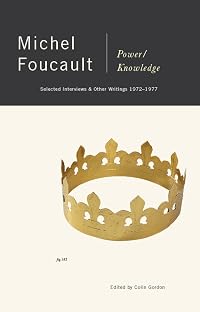
Power and Knowledge: Selected Interviews and Other Writings 1972-1977
by Michel Foucault
On This Page
Description
"Michel Foucault has become famous for a series of books that have permanently altered our understanding of many institutions of Western society. He analyzed mental institutions in the remarkable Madness and Civilization; hospitals in The Birth of the Clinic; prisons in Discipline and Punish; and schools and families in The History of Sexuality. But the general reader as well as the specialist is apt to miss the consistent purposes that lay behind these difficult individual studies, thus show more losing sight of the broad social vision and political aims that unified them. Now, in this superb set of essays and interviews, Foucault has provided a much-needed guide to Foucault. These pieces, ranging over the entire spectrum of his concerns, enabled Foucault, in his most intimate and accessible voice, to interpret the conclusions of his research in each area and to demonstrate the contribution of each to the magnificent - and terrifying - portrait of society that he was patiently compiling. For, as Foucault shows, what he was always describing was the nature of power in society; not the conventional treatment of power that concentrates on powerful individuals and repressive institutions, but the much more pervasive and insidious mechanisms by which power "reaches into the very grain of individuals, touches their bodies and inserts itself into their actions and attitudes, their discourses, learning processes and everyday lives" Foucault's investigations of prisons, schools, barracks, hospitals, factories, cities, lodgings, families, and other organized forms of social life are each a segment of one of the most astonishing intellectual enterprises of all time -- and, as this book proves, one which possesses profound implications for understanding the social control of our bodies and our minds." http://www.loc.gov/catdir/description/random046/79003308.html. show lessTags
Recommendations




















Member Reviews
Any scholar in the wide array of disciplines, approaches, and questions which might be encompassed by the term 'critique' has to deal with the legacy of Michel Foucault. In reading Foucault, two questions are always foremost: "How do I explain this to someone else?" And "What the hell is Foucault saying?" Knowledge/Power serves as an adequate aide to answering both these questions, although it does not quite manage to stand on its own.
A collection of interviews and lectures through the mid-1970s, Knowledge/Power shows a more informal Foucault, one working through the contradictions and terminology of his own theories. As such, the various pieces help show 'why' Foucault approached the overarching question of power through strategies, show more discourses, institutions and the like, as well as some of the methodological 'how' of genealogy and archaeology. The quality of the interviews varies widely. I found 'Two Lectures' and 'Truth and Power' to be the best, with the drunken 'Confessions of the Flesh' a lot of fun as well. Sadly, the book opens with the tedious and annoying 'On Popular Justice: A Discussion with Maoists.'
On the whole, this book is probably best read as a companion to Foucualt's longer histories. The jargon is dense and could use some more clarification. But for all that, I think this collection makes a decent antidote to the unthinking and cult-like academic copying of Foucault's style without his insight. show less
A collection of interviews and lectures through the mid-1970s, Knowledge/Power shows a more informal Foucault, one working through the contradictions and terminology of his own theories. As such, the various pieces help show 'why' Foucault approached the overarching question of power through strategies, show more discourses, institutions and the like, as well as some of the methodological 'how' of genealogy and archaeology. The quality of the interviews varies widely. I found 'Two Lectures' and 'Truth and Power' to be the best, with the drunken 'Confessions of the Flesh' a lot of fun as well. Sadly, the book opens with the tedious and annoying 'On Popular Justice: A Discussion with Maoists.'
On the whole, this book is probably best read as a companion to Foucualt's longer histories. The jargon is dense and could use some more clarification. But for all that, I think this collection makes a decent antidote to the unthinking and cult-like academic copying of Foucault's style without his insight. show less
The essay on Trust and Power - should be read: very frank, very difficult, very relevant.
The essay on Trust and Power - should be read: very frank, very difficult, very relevant.
I have read Lecture 1 and Lecture 2 from this book.
Ratings
Members
- Recently Added By
Lists

Some Things for Me to Read
20 works; 1 member
Author Information

348+ Works 49,706 Members
Michel Foucault was born on October 15, 1926, in Poitiers, France, and was educated at the Sorbonne, in Paris. He taught at colleges all across Europe, including the Universities of Lill, Uppsala, Hamburg, and Warsaw, before returning to France. There he taught at the University of Paris and the College of France, where he served as the chairman show more of History of Systems of Thought until his death. Regarded as one of the great French thinkers of the twentieth century, Foucault's interest was in the human sciences, areas such as psychiatry, language, literature, and intellectual history. He made significant contributions not just to the fields themselves, but to the way these areas are studied, and is particularly known for his work on the development of twentieth-century attitudes toward knowledge, sexuality, illness, and madness. Foucault's initial study of these subjects used an archaeological method, which involved sifting through seemingly unrelated scholarly minutia of a certain time period in order to reconstruct, analyze, and classify the age according to the types of knowledge that were possible during that time. This approach was used in Madness and Civilization: A History of Insanity in the Age of Reason, for which Foucault received a medal from France's Center of Scientific Research in 1961, The Birth of the Clinic, The Order of Things, and The Archaeology of Knowledge. Foucault also wrote Discipline and Punishment: The Birth of the Prison, a study of the ways that society's views of crime and punishment have developed, and The History of Sexuality, which was intended to be a six-volume series. Before he could begin the final two volumes, however, Foucault died of a neurological disorder in 1984. (Bowker Author Biography) An outstanding philosopher and intellectual figure on the contemporary scene, Foucault has been influential in both philosophy and the recent interpretation of literature. Trained in philosophy and psychology, he was named to a chair at the College de France in 1970. He also taught in various departments of French literature as a visiting professor in the United States. Until 1968 he was a major figure in the critical movement known as structuralism, a method of intellectual inquiry based on the idea that all human behavior and achievement arises from an innate ability to organize, or "structure," human experiences. In both The Order of Things (1966) and The Archaeology of Knowledge (1969) he was interested in the organization of human knowledge and in the transformations of intellectual categories. His influential history of the prison, Discipline and Punish (1975), contributed to the study of the relationship of power and various forms of knowledge, as did the several volumes of an unfinished History of Sexuality published just before his death. (Bowker Author Biography) show less
All Editions
Common Knowledge
- Canonical title
- Power and Knowledge: Selected Interviews and Other Writings 1972-1977
Classifications
- Genres
- Philosophy, Nonfiction, Literature Studies and Criticism, General Nonfiction, History
- DDC/MDS
- 303.33 — Society, government, & culture Social sciences, sociology & anthropology Social processes Coordination and control Social control
- LCC
- HM291 .F59 — Social sciences Sociology (General) Sociology These are obsolete numbers no longer used
- BISAC
Statistics
- Members
- 1,461
- Popularity
- 15,930
- Reviews
- 5
- Rating
- (3.96)
- Languages
- English
- Media
- Paper, Ebook
- ISBNs
- 6
- UPCs
- 1
- ASINs
- 4