On This Page
Description
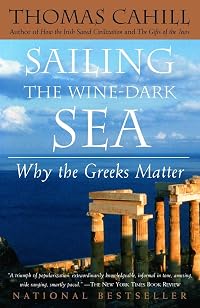
"In Sailing the Wine-Dark Sea, his latest bestselling work of popular history, Thomas Cahill escorts the reader on another entertaining-and historically unassailable-journey through the landmarks of art and bloodshed that defined Greek culture nearly three millennia ago. In ancient Greece, honors could be won in making love and war, and lives were rife with contradictions. By developing the alphabet, the Greeks empowered the reader and encouraged civil discussion--yet they kept slaves. The show more glorious verses of the Iliad suggest that their "bellicose society of gleaming metals and rattling weapons" is not so very distant from more recent campaigns of "shock and awe." And, centuries before Zorba, Greece was a land where music, dance, and wine were essential to the high life. Granting equal time to the sacred and the profane, Cahill rivets our attention to the legacies of an ancient and enduring worldview." show lessTags
Recommendations















Member Recommendations
gmicksmith These two volumes, although different in treatment and scope, do cover similar ground and make an interesting comparison.

Member Reviews
There are reasons why government buildings in Washington, DC look very much like ancient Athens. If you have been shaped by the Western tradition, you have been shaped by ancient Greeks.
In Sailing the Wine Dark Sea: Why the Greeks Matter, Thomas Cahill continues his “Hinges of History” series which explores the critical moments and people who have led us to be as we are today. In many respects, this work can be understood as how the “civilization” came about which the Irish would need to save in the early medieval era.
The author writes well and brings you into the story. You need not already have much of a background in ancient Greece to be able to follow him and the story he told.
He began, as one must, with the Mycenaean show more world from which the characters in the Iliad and the Odyssey would spring. Much is then made of the warfare and travel described therein, as well as the Early Iron Age world of the Greeks during which the bards would have sung the stories of Troy and afterward (unfortunately, but understandably because of the time, spoken of in terms of a Dark Age). The author continued to tell the story of the history of Greece in its Archaic and Classical periods, but did so through the parties and poetry, the development of the tragedies and comedies, the philosophers and their developments, the artists and the craft of what has become familiar to us as Greek sculpture. He concluded by considering how the Romans would appropriate much of Greek culture, and how it would interact with Christianity and its Jewish heritage, leading to a Greco-Roman/Judeo-Christian synthesis which would define the medieval Western world and following.
Even if you already have an understanding of ancient Greece, you can benefit from how the author portrays what happened: its novelty, its extraordinary development, and how the moment proved fleeting. And yet for good reason all philosophy since can be understood as footnotes to Plato, we still admire the aesthetics of Greek art, we still read the Iliad and the Odyssey, and we ultimately still have the same kinds of arguments and disputes they did. The Greeks still matter because the way we think has been shaped by them and we remain haunted by their questions and quests. show less
In Sailing the Wine Dark Sea: Why the Greeks Matter, Thomas Cahill continues his “Hinges of History” series which explores the critical moments and people who have led us to be as we are today. In many respects, this work can be understood as how the “civilization” came about which the Irish would need to save in the early medieval era.
The author writes well and brings you into the story. You need not already have much of a background in ancient Greece to be able to follow him and the story he told.
He began, as one must, with the Mycenaean show more world from which the characters in the Iliad and the Odyssey would spring. Much is then made of the warfare and travel described therein, as well as the Early Iron Age world of the Greeks during which the bards would have sung the stories of Troy and afterward (unfortunately, but understandably because of the time, spoken of in terms of a Dark Age). The author continued to tell the story of the history of Greece in its Archaic and Classical periods, but did so through the parties and poetry, the development of the tragedies and comedies, the philosophers and their developments, the artists and the craft of what has become familiar to us as Greek sculpture. He concluded by considering how the Romans would appropriate much of Greek culture, and how it would interact with Christianity and its Jewish heritage, leading to a Greco-Roman/Judeo-Christian synthesis which would define the medieval Western world and following.
Even if you already have an understanding of ancient Greece, you can benefit from how the author portrays what happened: its novelty, its extraordinary development, and how the moment proved fleeting. And yet for good reason all philosophy since can be understood as footnotes to Plato, we still admire the aesthetics of Greek art, we still read the Iliad and the Odyssey, and we ultimately still have the same kinds of arguments and disputes they did. The Greeks still matter because the way we think has been shaped by them and we remain haunted by their questions and quests. show less
The ancient Greeks looked at the world as it was and thought, ‘We can improve upon all of this. Just…all of it.’
Well, not really. But that’s what they ended up doing. Whether it was in ways of warfare, poetry, politics or philosophy–even how we thought about being alive and our place in the world–they had their hands in it and minds on it. They wound up creating Western civilization.
Sailing the Wine Dark Sea follows the Greeks from the time when they were separate, warring tribes with very different personalities to the era of Greece’s unlimited power, to its fall to Rome. It tracks the various movers and shakers of each movement through those times and makes them as real as if they were standing before you. (Pythagoras show more was a cult-having hippie and the politicians of the first democracy are as unscrupulous as the ones we know today. The more things change…)
Cahill provides translations of poetry and plays and speeches (some from Robert Fagles and some of his own) to illustrate the changing Greek mind over time. There are also images of sculpture, pottery and other types of artwork and architecture, showing the evolution of each of these throughout the golden age of Greece.
Entertaining and informative, Sailing the Wine Dark Sea is an excellent introduction to the history of ancient Greece and its contributions to Western civilization. At 352 pages it’s not for the established Greek scholar, but it is a good overview and gives some idea of the scope of their influence. For those reasons I give it 5/5 show less
Well, not really. But that’s what they ended up doing. Whether it was in ways of warfare, poetry, politics or philosophy–even how we thought about being alive and our place in the world–they had their hands in it and minds on it. They wound up creating Western civilization.
Sailing the Wine Dark Sea follows the Greeks from the time when they were separate, warring tribes with very different personalities to the era of Greece’s unlimited power, to its fall to Rome. It tracks the various movers and shakers of each movement through those times and makes them as real as if they were standing before you. (Pythagoras show more was a cult-having hippie and the politicians of the first democracy are as unscrupulous as the ones we know today. The more things change…)
Cahill provides translations of poetry and plays and speeches (some from Robert Fagles and some of his own) to illustrate the changing Greek mind over time. There are also images of sculpture, pottery and other types of artwork and architecture, showing the evolution of each of these throughout the golden age of Greece.
Entertaining and informative, Sailing the Wine Dark Sea is an excellent introduction to the history of ancient Greece and its contributions to Western civilization. At 352 pages it’s not for the established Greek scholar, but it is a good overview and gives some idea of the scope of their influence. For those reasons I give it 5/5 show less
I rather thought, when I picked this book up, that it would provide a great number of little known facts about the Greeks, that it would draw clearly the often hidden connections modern life has to the earliest democracy, and that Cahill would underline the importance of studying Greek culture for what it can teach us today. Sailing the Wine Dark Sea: Why the Greeks Matter is not really that book. In fact, Cahill’s book is really a quick dip in the bath of well-known Greek history and art, a cultural CliffNotes.Cahill, who became pop-famous for his book How the Irish Saved Civilization, detailing how Irish monasteries kept up writing and copying manuscripts throughout the Dark Ages, has parlayed that success into a series of pop show more histories he names Hinges of History. These hinges are points in which the whole world could have gone one way or the other and why they fell the way they did. Hinges hold up doors; they should slam this one shut. At no point does Cahill demonstrate that this moment constitutes a hinge nor does he actually go about proving that the Greeks matter.Does he show us how we can use Greek thought in the current world? No. Does he dig up forgotten Greek wisdom of some staggering utility for now? No. What he does is jog through the history and culture of a time and occasionally mention how that notion sure came in handy once upon a time.Sailing the Wine-Dark Sea spends a great, great deal of its length quoting liberally, using Homer’s epic poems (replete with deus ex machina out the wazoo and anachronisms up the ying yang) as though they were historical documents on par with Thucydidies — who he also ladles out with heavy hand. For this mythical leaning one can thank his Jesuit upbringing/education which does the same thing substituting the Bible for The Iliad. As the book progresses, Cahill lifts from Joyce, Auden, Tennyson, and every third Greek writer of note, padding out the thinness of his own ideas with poignant bits of poetry.When Cahill discusses the origins of the alphabet, first a Semitic-Phoenician accounting tool, then with vowels added by the Greeks, there are rather interesting tidbits and I smacked my lips in pleasure. This was all I got, however, tidbits. The book lacks anything like scope of ideology, just sampling here and there from the Greek culture platter.For tidbits, we are treated to this fact: the earliest Greek inscription currently known is on the side of a cup and notes that the finest dancer will receive the cup as a prize. Cahill comments that this differs from the furrowed brow of the believer (the Jews) and the green-eye shade hardness of the accountant (the Phoenicians), the two previous possessors of language. Irreverence makes its first recorded appearance at 700BCE on a cup inscription recommending drinking and fucking. The more you learn of Greek history, the more it seems that had the Greeks remained dominant, Western society would sure be a lot more fun.Cahill takes a moment here to laud Greece’s phonetic alphabet innovations as being the seed-germ of enlightenment. His observation that if we wrote in cuneiform today we’d still have slavery is hard to argue against, as it is so filled with supposition that there is no point in even making the observation. It’s like suggesting that if we drank more wine we’d have fewer reality TV shows. You can not prove such an argument nor can you prove it’s faulty. It’s a Jesuitical fallacy one wishes Cahill’s editor had sliced from his reasoning or at least his teachers had drummed out of him lo those many years ago.As a natural result of discussing alphabets, Sailing sails on to literature, where Cahill skims the surface a good deal and never dives deep into this wine-dark sea. Instead, he suggests that we shouldn’t take the comedy of a society as a good representation of the morality of a society, yet he makes no end of other kinds of literature, such as epics and epithalamia. This is simply the intellectual abuse of comedy that I’ve grown increasingly tired of the older I’ve gotten, the kind of commentary exposes an author’s narrow thinking. If comedy is of no use in determining morality — after all, what is funnier than pricking pompous moralists and shocking delicate sensibilities? — then neither are epics or any other form of literature. One just might as well have said that abstract painting is no way to understand the psyche of an era, and out goes Picasso’s Guernica as any kind of commentary on war in general and war in specific.The discussion of literature leads to drama, which does allow Cahill to waste time regaling us with an excruciatingly detailed account of the story of Oedipus, including giving away that hoary old chestnut, the riddle of the Sphinx, in the bargain. He dwells on non-textual issues like how the black blood gushes from Oedipus’ sockets after he gouges out his eyes, demonstrating that Cahill was at least quite struck by one stage production he saw. But why does he go into such complete and total detail? Has anyone over the age of seventeen not heard this story yet? I’m going to go out on a limb and suggest that Oedipus Rex is taught in the grand majority of English-speaking high schools. I’d even go so far as to say that having to read Oedipus Rex is as much an adolescent rite of passage as getting over wanting to fuck your parents. (I suspect if you were to read his other books, like the one on the importance of the Jews, you’d be treated to such things as lengthy Biblical quotes and a summary of the story of the crucifixion.)Drama of course leads to philosophy’s most dramatic writer, Plato. Cahill’s chapter on philosophy doesn’t provide any cohesive arrangement that moves along, demonstrating refinement and the various arguments still at the heart of philosophical debate today. Rather, he gives us one little anecdote and character after another. This guy says water’s at the heart of the universe, this guy says fire, this guy says seeds. Whew, thanks for clearing that up. The remainder of the chapter consists of several page long Socratic dialogues lifted directly and lengthy summaries of same. Let me save you the trouble of reading this chapter and simply direct you to read the introduction to any volume of Plato dialogues (which will almost certainly include snippets of the pre-Socratic schools of thought) then read the dialogues themselves.The book’s sixth chapter is almost entirely without any recognizable merit. Cahill, instead of using this space to educate the reader or to quote the half of The Republic he left out of the philosophy chapter, lends his lyre to straining metaphors, letting us know that ancient Hebrew is a tense, terse language, as efficient and stubborn as a Jewish desert nomad while Latin is the language of precise farmers who’ve gone into real estate as empire and Greek is the language of ebullient self-lovers. This is followed up with airy speculation on kouros (Greek statuary) as a projection of the ideal. And a thumbnail sketch of a variety of sculpture, next to worthless in audio form as we only have Cahill’s maudlin descriptions to go on. Cahill proves a strident mind reader, filling us in on what the various characters in sculpture and pottery paintings are thinking as they go about their drinking, gaming, lusting. And apparently according to Cahill, the only way we can know that females were at some point well-considered or publicly considered was if any nude sculptures ever were made of them. Internet porn and beer advertisements have shown how well that turned out, yeah?Moving on to politics, Cahill quotes the full text of Pericles’ Funeral Oration, a 3,000 word speech about how great democracy is and how noble those who die to support it truly are. This is followed by Cahill’s lengthy love letter to John F. Kennedy as a man who really knew his Pericles. Politics leads to the destruction of Greek culture and Cahill slanders various factions, none more in Greece than the Epicureans who he paints as no more than debauched gluttons, the usual ignorant depiction. And none outside Greece come in for more spanking than the Romans, who he falsely declares as having no spirituality or sense of religion save what they stole from Greece. As though they had no beliefs prior to usurping the Greek model. This is so obviously false I won’t go into schooling readers of Cahill, save to recommend any other book on Mediterranean history than this one.Having barely introduced us to “the plodding Romans” Cahill rushes them off the stage to suggest that it was only the meeting of Greek culture and Judeo-Christianity that was of any value in the development of Western culture. I won’t deny how influential Greek ideas were in the development of Christianity, but the shabby treatment of the Romans is unbecoming of a historian. It is the expansion of the Roman Empire, the absorption of the local mythologies of those they conquered, that shaped the hierarchies and ceremonies of the Catholic Church and through them the Protestants. What happened to more Greek influenced Christianity? It became the hodgepodge of Byzantium iconography enslaved by the Ottoman Empire, a poor companion to the lusty life that Western Christianity experienced as the mistress of Roman Imperialism. Almost the whole of the Church calendar is of Roman derivation, not Greek.Once you subtract Cahill’s lengthy quotations and lengthier plot summaries of Greek literature, you’re left with not much more than a pamphlet on why the Greeks matter. And they do matter: they gave us democracy and types of warfare and literature about people. They matter like any other sterile old manuscript, dusty with age. Ho hum. Cahill fails to prove his primary thesis, that the Greeks do matter. show less
Cahill's object in this book is not to present a scholarly screed on the merits and demerits of the Ancient Greeks, but to transmit to the reader their humanity and personality in a way that veers from lyricism to a selective recitation of how they lived to influence the rise of the West. Not for him the weary recounting of kings and battles, but rather the enjoyment of their art, a meditation on their language, and an appreciation of their myths.
I, a relative novice in the historical arts, mired in the contemporary dogmas of multiculturalism, gained something from this book. It is that culture matters, and that not all cultures are equal at all times, for all times. The Greeks brought some unique materials to the table of a progressing show more civilization, and it merits some study to determine what the threads running through it were.
Their much celebrated discoveries of the practice of democracy, their penchant for skepticism, and invention of a heartless logic, all influence our own version of civilization in ways that we are hardly aware of, and that our pedagogues of today would have you believe came from everywhere but the Greeks.
Yes, the Greeks enslaved others, they killed one another endlessly, loved carelessly, believed in the merits of their race, and excluded women from their political palavers. But this is true of almost all civilizations everywhere at all times, and arguing that the Greeks are unworthy of our attention as a consequence, although fashionable in the current abominations of the academy, is as stupid as arguing that chemistry can be taught without acknowledging the centrality of the elements.
Cahill's sometimes excessively irreverent style, and his annoying attention to speculations on sexual matters, occasionally get in the way of his central message, but overall he has done a credible job here and produced a thought-provoking book that is worth reading, especially for multiculturalists with an open mind. show less
I, a relative novice in the historical arts, mired in the contemporary dogmas of multiculturalism, gained something from this book. It is that culture matters, and that not all cultures are equal at all times, for all times. The Greeks brought some unique materials to the table of a progressing show more civilization, and it merits some study to determine what the threads running through it were.
Their much celebrated discoveries of the practice of democracy, their penchant for skepticism, and invention of a heartless logic, all influence our own version of civilization in ways that we are hardly aware of, and that our pedagogues of today would have you believe came from everywhere but the Greeks.
Yes, the Greeks enslaved others, they killed one another endlessly, loved carelessly, believed in the merits of their race, and excluded women from their political palavers. But this is true of almost all civilizations everywhere at all times, and arguing that the Greeks are unworthy of our attention as a consequence, although fashionable in the current abominations of the academy, is as stupid as arguing that chemistry can be taught without acknowledging the centrality of the elements.
Cahill's sometimes excessively irreverent style, and his annoying attention to speculations on sexual matters, occasionally get in the way of his central message, but overall he has done a credible job here and produced a thought-provoking book that is worth reading, especially for multiculturalists with an open mind. show less
I've always been a fan of demotic erudition, and that's Cahill all over. Lots of fun, doubtless real historians might be given fits by some of Cahill's stretches, but heck . . . it's probably the most exercise they've had all day. A genuinely learned man's personal take on some things he's thought about a lot.
A decent general introduction to Greek history and culture. It is populated with interesting insights and nifty stories that help elucidate the culture of the Greeks, how it evolved, and how modern Western society inherited it. The book suffers, though, from Cahill's every-now-and-then intruding opinions, which are generally of a leftist nature (for instance: boo George W. Bush [pp. 46, 250n], hooray John F. Kennedy [pp. 247-248]). It reads, sometimes, as a paean to hedonism.
The foundations of what we call Western culture today seemingly sprung from one place, Greece, yet that is not the entire truth. Sailing the Wine-Dark Sea, the fourth volume of Thomas Cahill’s Hinges of History, examines and explains the structure of Greek society and ideas as well as the reasons why it has permeated so much of what we know of Western culture. But Cahill’s answer to why the Greeks matter is two-fold.
Over the course of 264 pages of text, Cahill looks at all the features of Greek culture that made them so different from other ancient cultures. Through the study of Homer’s Iliad and Odyssey, Cahill examined the Greek’s view of war and honor in their grand war epic then how the same man expressed how the Greek’s show more expressed their feelings. The contradiction of the Homeric works is part of a larger theme that Cahill explores in Greek poetry beyond Homer, politicians and playwrights, philosophers, and artists. Throughout each chapter, Cahill examines what the Greeks did differently than anyone else as well as relate examples that many will know. Yet Cahill reveals that as time went on the Greeks own culture started to swallow itself until stabilized by the Romans who were without the Greek imagination and then merged with newly developing Christian religion that used Greek words to explain its beliefs to a wider world; this synthesis of the Greco-Roman world and Judeo-Christian tradition is what created Western thought and society that we know today.
Cahill’s analysis and themes are for the general reader very through-provoking, but even for someone not well versed in overall Greek scholarship there seems to be something missing in this book. Just in comparing previous and upcoming volumes of Cahill’s own series, this book seems really short for one covering one of the two big parts of Western Civilization. Aside from the two chapters focused around the Homeric epics, all the other chapters seemed to be less than they could be not only in examples but also in giving connections in relevance for the reader today.
For the Western society in general, the Greeks are remembered for their myths, magnificent ruins, and democracy. Thomas Cahill’s Sailing the Wine-Dark Sea does reveal that ancient Greece was more than that and why a culture millennia old matters to us today. While not perfect, this book is at least a good read for the general reader which may be what Cahill is aiming for but for those more well read it feels lacking once finished. show less
Over the course of 264 pages of text, Cahill looks at all the features of Greek culture that made them so different from other ancient cultures. Through the study of Homer’s Iliad and Odyssey, Cahill examined the Greek’s view of war and honor in their grand war epic then how the same man expressed how the Greek’s show more expressed their feelings. The contradiction of the Homeric works is part of a larger theme that Cahill explores in Greek poetry beyond Homer, politicians and playwrights, philosophers, and artists. Throughout each chapter, Cahill examines what the Greeks did differently than anyone else as well as relate examples that many will know. Yet Cahill reveals that as time went on the Greeks own culture started to swallow itself until stabilized by the Romans who were without the Greek imagination and then merged with newly developing Christian religion that used Greek words to explain its beliefs to a wider world; this synthesis of the Greco-Roman world and Judeo-Christian tradition is what created Western thought and society that we know today.
Cahill’s analysis and themes are for the general reader very through-provoking, but even for someone not well versed in overall Greek scholarship there seems to be something missing in this book. Just in comparing previous and upcoming volumes of Cahill’s own series, this book seems really short for one covering one of the two big parts of Western Civilization. Aside from the two chapters focused around the Homeric epics, all the other chapters seemed to be less than they could be not only in examples but also in giving connections in relevance for the reader today.
For the Western society in general, the Greeks are remembered for their myths, magnificent ruins, and democracy. Thomas Cahill’s Sailing the Wine-Dark Sea does reveal that ancient Greece was more than that and why a culture millennia old matters to us today. While not perfect, this book is at least a good read for the general reader which may be what Cahill is aiming for but for those more well read it feels lacking once finished. show less
Members
- Recently Added By
Author Information

Awards and Honors
Distinctions
Series

Common Knowledge
- Canonical title
- Sailing the Wine-dark Sea: Why the Greeks Matter
- Original title
- Sailing the wine-dark sea
- Original publication date
- 2003-10
- Important places
- Greece
- Epigraph
- 'One can achieve his fill of all good things, even of sleep, even of making love...' Homer
'Once out of nature I shall never take
My bodily form from any natural thing,
But such a form as Grecian goldsmiths make
O... (show all)f hammered gold and gold enamelling
To keep a drowsy Emperor awake;
Or set upon a golden bough to sing
To lords and ladies of Byzantium
Of what is past, or passing, or to come.' William Butler Yeats - Dedication
- To Madeleine L'Engle and Leah and Desmond Tutu and in memory of Pauline Kael mentors and models of life and art
- First words
- History must be learned in pieces.
- Last words
- (Click to show. Warning: May contain spoilers.)Whatever we experience in our day, whatever we hope to learn, whatever we most desire, whatever we set out to find, we see that the Greeks have been there before us, and we meet them on our way back.
- Original language*
- English
*Some information comes from Common Knowledge in other languages. Click "Edit" for more information.
Classifications
- Genres
- History, General Nonfiction, Nonfiction, Religion & Spirituality
- DDC/MDS
- 909.09821 — History & geography History World history Other Geographic Classifications Other Classifications Ocean And Sea Basins The West; the Atlantic region
- LCC
- DF77 .C28 — History of Europe, Asia, Africa and Oceania Greece History of Greece Antiquities. Civilization. Culture. Ethnography
- BISAC
Statistics
- Members
- 1,930
- Popularity
- 11,039
- Reviews
- 24
- Rating
- (3.62)
- Languages
- 6 — Czech, English, Greek, Italian, Portuguese, Spanish
- Media
- Paper, Audiobook, Ebook
- ISBNs
- 20
- ASINs
- 14