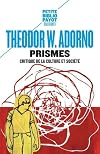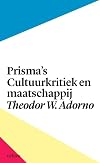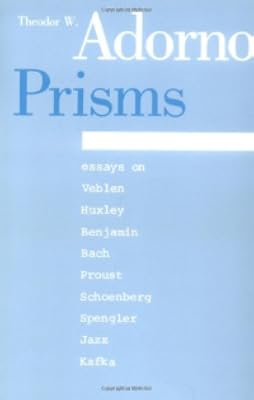
Prisms (Studies in Contemporary German Social Thought)
by Theodor W. Adorno
340 Members (4.08)
On This Page
Description
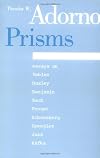
Prisms, essays in cultural criticism and society, is the work of a critic and scholar who has had a marked influence on contemporary American and German thought. It displays the unusual combination of intellectual depth, scope, and philosophical rigor that Adorno was able to bring to his subjects, whether he was writing about astrology columns in Los Angeles newspapers, the special problems of German academics immigrating to the United States during the Nazi years, or Hegel's influence on show more Marx. In these essays, Adorno explores a variety of topics, ranging from Aldous Huxley's Brave New World and Kafka's The Castle to Jazz, Bach, Schoenberg, Proust, Veblen's theory of conspicuous consumption, museums, Spengler, and more. His writing throughout is knowledgeable, witty, and at times archly opinionated, but revealing a sensitivity to the political, cultural, economic, and aesthetic connections that lie beneath the surfaces of everyday life. Prisms is included in the series, Studies in Contemporary German Social Thought, edited by Thomas McCarthy. show lessTags
Recommendations












Member Reviews
Members
- Recently Added By
Author Information

329+ Works 14,388 Members
Theodor W. Adorno is the progenitor of critical theory, a central figure in aesthetics, and the century's foremost philosopher of music. He was born and educated in Frankfurt, Germany. After completing his Ph.D. in philosophy, he went to Vienna, where he studied composition with Alban Berg. He soon was bitterly disappointed with his own lack of show more talent and turned to musicology. In 1928 Adorno returned to Frankfurt to join the Institute for Social Research, commonly known as The Frankfurt School. At first a privately endowed center for Marxist studies, the school was merged with Frankfort's university under Adorno's directorship in the 1950s. As a refugee from Nazi Germany during World War II, Adorno lived for several years in Los Angeles before returning to Frankfurt. Much of his most significant work was produced at that time. Critics find Adorno's aesthetics to be rich in insight, even when they disagree with its broad conclusions. Although Adorno was hostile to jazz and popular music, he advanced the cause of contemporary music by writing seminal studies of many key composers. To the distress of some of his admirers, he remained pessimistic about the prospects for art in mass society. Adorno was a neo-Marxist who believed that the only hope for democracy was to be found in an interpretation of Marxism opposed to both positivism and dogmatic materialism. His opposition to positivisim and advocacy of a method of dialectics grounded in critical rationalism propelled him into intellectual conflict with Georg Hegel, Martin Heidegger, and Heideggerian hermeneutics. (Bowker Author Biography) show less
Series
Belongs to Publisher Series
Common Knowledge
- Canonical title*
- Prisma's : cultuurkritiek en maatschappij
*Some information comes from Common Knowledge in other languages. Click "Edit" for more information.
Classifications
- Genres
- Nonfiction, Philosophy, Literature Studies and Criticism, General Nonfiction
- DDC/MDS
- 306 — Society, government, & culture Social sciences, sociology & anthropology Social Behavior - Dating, Marriage, Divorce
- LCC
- HM101 .A4513 — Social sciences Sociology (General) Sociology These are obsolete numbers no longer used
- BISAC
Statistics
- Members
- 340
- Popularity
- 93,602
- Rating
- (4.08)
- Languages
- 7 — Dutch, English, French, German, Italian, Portuguese, Spanish
- Media
- Paper, Ebook
- ISBNs
- 18
- ASINs
- 7